

More news on this day
Passengers across the Gulf and Southeast Asia are facing a fresh wave of disruptions as Qatar Airways, Gulf Air and Malaysia Airlines ground 25 flights and report extensive delays on key routes linking Doha, Bahrain, Kuala Lumpur, Riyadh, Kuwait City and other major hubs.
Get the latest news straight to your inbox!
Security Crisis Keeps Airspace Tight and Schedules Fragile
The latest round of cancellations comes against the backdrop of a wider regional security crisis that has constrained airspace across parts of the Gulf. Publicly available information shows that Qatar’s airspace was initially closed on 28 February 2026 following Iranian missile attacks linked to the ongoing Iran conflict, forcing Hamad International Airport to cut back regular commercial traffic and rely on limited emergency or evacuation corridors.
Reports indicate that while restricted movements have gradually resumed, schedules remain thin and vulnerable to further disruption. Airlines operating through Doha continue to publish rolling updates and short-notice changes, with many passengers learning of cancellations only hours before departure as carriers adjust to airspace availability and routing constraints.
This volatile backdrop is now feeding into a concentrated cluster of cancellations and delays, including 25 grounded services attributed to Qatar Airways, Gulf Air and Malaysia Airlines. The affected flights span regional links within the Gulf as well as long-haul connections into Europe and Asia that normally depend on Doha and Bahrain as high-frequency transit hubs.
Aviation industry observers note that this pattern is consistent with previous crises in the region, where carriers prioritize limited capacity for repatriation, essential travel and carefully selected trunk routes while suspending or consolidating other services.
Hamad International at the Center of a Sprawling Disruption
Hamad International Airport remains the focal point of the disruption, with Qatar Airways trimming departures and arrivals as it navigates restricted air corridors and altered routings. According to published coverage, the closure of Qatari airspace in late February triggered significant disruption, and subsequent partial reopenings have not yet restored normal commercial schedules.
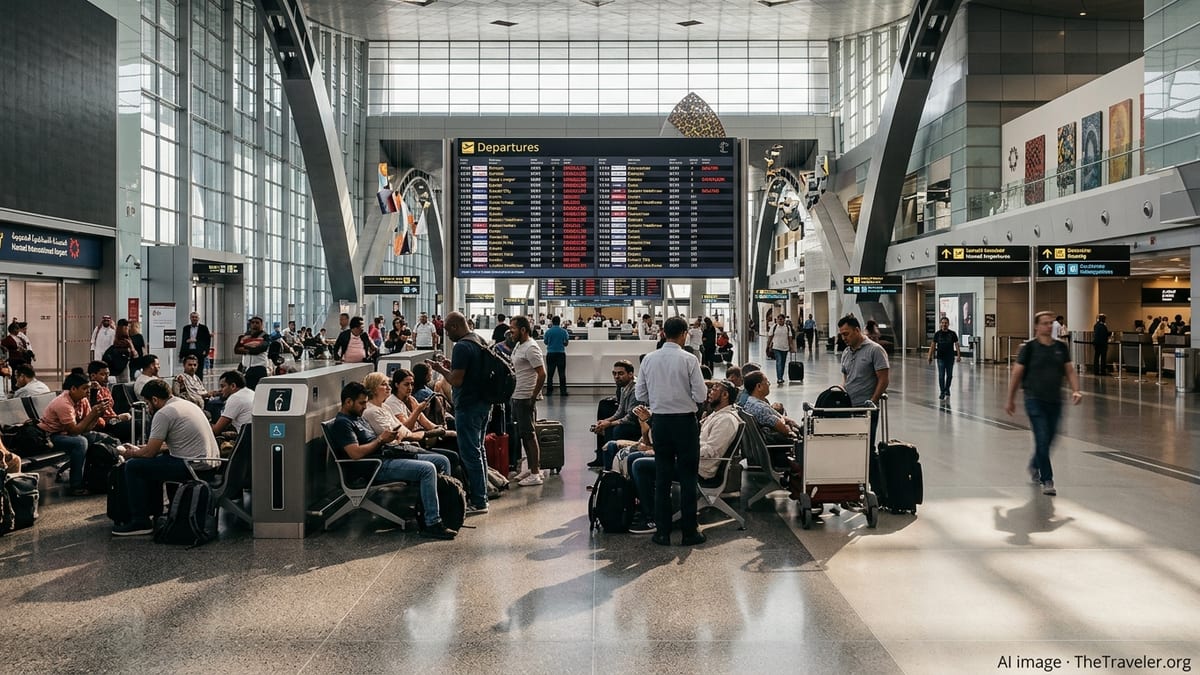
Recent passenger accounts from Doha describe an airport that is operational but markedly quieter than usual, with fewer departure boards active and more frequent last-minute gate changes. Some travelers report multiple rebookings and disappearing reservations as flights are successively canceled or merged into reduced-frequency services.
The grounding of selected Qatar Airways flights in and out of Doha is affecting onward connections across Europe, Asia and Africa. Popular transfer itineraries that normally rely on tightly timed banks of arrivals and departures are particularly exposed, as even minor delays can cause passengers to miss onward legs that may not operate again for several days under the current reduced schedule.
For Hamad International itself, the challenge lies in maintaining core airport operations and passenger services while managing highly variable daily flight numbers. Limited but steady flows of relief, repatriation and priority commercial flights are still transiting the hub, yet the overall network remains far from its pre-crisis volume.
Gulf Air and Bahrain Routes Strained by Regional Tensions
Bahrain, another key node in Gulf aviation, is experiencing its own parallel pressures. Gulf Air has already been heavily affected by earlier airspace restrictions, and the latest tally of grounded flights includes several services linking Bahrain with Doha, Riyadh, Kuwait City and other regional destinations.
Available advisories show that Bahrain’s connectivity has been repeatedly constrained since early March as military risk assessments and airspace management measures limit options for civilian aviation. Short-haul shuttles that once connected Gulf capitals with multiple daily frequencies are now often reduced to a fraction of their normal schedule or suspended on select days.
The result is a patchwork of operational routes that complicates travel planning for both point-to-point passengers and those using Bahrain as a transfer hub. Travelers attempting to route through Bahrain to reach destinations in Saudi Arabia, Kuwait or further afield are encountering longer layovers, forced overnight stays or rerouting via alternative hubs outside the immediate conflict zone.
Industry data and traveler reports suggest that, in response, some airlines are temporarily shifting capacity to more northerly or westerly corridors, bypassing particularly congested or restricted sectors of Gulf airspace. For many passengers, however, the quickest theoretical route via Bahrain or Doha is currently not the most reliable.
Ripple Effects for Malaysia Airlines and Southeast Asia Links
The disruption is not confined to the Gulf. Malaysia Airlines has also grounded a number of services, contributing to the total of 25 affected flights and underscoring how far the operational shock is spreading along long-haul corridors. Kuala Lumpur’s role as a major Southeast Asian gateway means that even a modest number of cancellations can reverberate widely through regional networks.
Connections between Kuala Lumpur and Doha are particularly sensitive, as they feed traffic to Europe, the Middle East and Africa. With selected Malaysia Airlines flights canceled or delayed and Qatar Airways’ own Doha schedule curtailed, passengers originating in Southeast Asia are finding fewer through-connection options on their preferred dates.
Publicly available information indicates that some travelers are being rerouted via alternative Asian hubs, including Singapore and Bangkok, or via secondary Middle Eastern gateways less directly affected by current airspace limits. These alternatives often involve longer travel times, more stops and greater exposure to further schedule changes.
The combined effect for Malaysia Airlines is an operational puzzle that demands constant adjustments to fleet deployment and crew scheduling. For passengers, it translates into a higher likelihood of last-minute itinerary changes and the need to remain flexible about travel dates and routing.
Passengers Face Uncertainty, Longer Journeys and Complex Rebookings
Across Doha, Bahrain, Kuala Lumpur, Riyadh, Kuwait City and beyond, the human impact of the disruptions is increasingly visible. Travelers recount sequences of multiple cancellations, repeated rebookings and long waits for updated information as airlines respond to shifting airspace conditions and operational windows.
According to passenger accounts shared publicly, some itineraries have been rebooked three or four times over the space of a few weeks. Others describe being moved onto partner airlines at short notice, sometimes via unfamiliar hubs, as carriers attempt to honor tickets despite capacity constraints and suspended routes.
Travel guidance from airline advisories and airport notices consistently urges passengers to monitor their bookings closely, use mobile apps and online tools to track schedule changes, and avoid heading to the airport without a confirmed, operating flight. Flexible ticket policies introduced in response to the crisis are allowing many customers to change dates or routes without additional fees, but refunds and complex multi-sector itineraries can still take time to resolve.
With no definitive timeline for a full restoration of pre-crisis schedules, the situation remains fluid. For now, the grounding of 25 flights operated by Qatar Airways, Gulf Air and Malaysia Airlines serves as a snapshot of a wider aviation system adjusting day by day to geopolitical tensions, constrained airspace and evolving safety assessments across the Gulf and its extended network.