

More news on this day
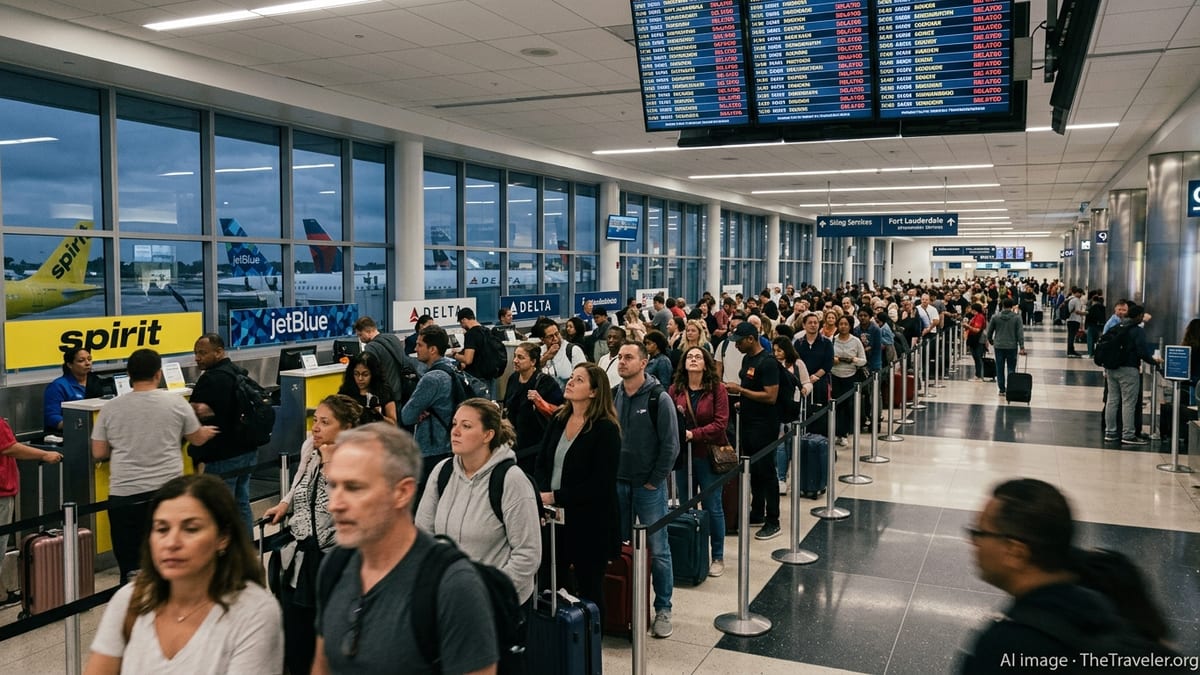
Travelers at Fort Lauderdale–Hollywood International Airport faced mounting frustration as a cluster of disruptions involving Spirit Airlines, Delta Air Lines, and JetBlue Airways led to the suspension of 17 flights and more than 100 delays, affecting a string of major destinations including New York, Kansas City, Columbus, Detroit, and Sint Maarten.
Get the latest news straight to your inbox!
Heavy Disruptions Ripple Across Key Domestic and Caribbean Routes
Publicly available flight-tracking data for Fort Lauderdale–Hollywood International Airport on Tuesday indicates a concentrated series of operational disruptions affecting several major U.S. carriers. Seventeen departures and arrivals operated by Spirit Airlines, Delta Air Lines, and JetBlue Airways were listed as canceled or suspended, while more than 100 additional flights showed varying degrees of delay as the day progressed.
The impact has been most visible on high-demand domestic routes linking Fort Lauderdale with New York, Detroit, Kansas City, and Columbus, as well as on Caribbean services including Sint Maarten. Flight boards reflected rolling pushbacks, with some services initially delayed before later being marked canceled, forcing travelers to seek alternative routings or overnight stays.
While exact causation varied by flight and carrier, the pattern at Fort Lauderdale fits into a broader trend of tight airline schedules and limited spare aircraft or crew, which can quickly cascade into widespread disruption when even a small number of rotations are affected. For travelers, that translated into long lines at check-in counters and service desks, crowded gate areas, and uncertainty over revised departure times.
Spirit, Delta, and JetBlue Under Pressure at a Major South Florida Hub
Fort Lauderdale–Hollywood International Airport is a critical base for Spirit Airlines and an important station for both JetBlue Airways and Delta Air Lines, handling millions of passengers a year on domestic and international routes. Airport activity reports show that Spirit alone accounts for roughly one-third of traffic at the airport, with JetBlue and Delta combining for another sizable share of passenger movements.
Because these three carriers operate such a large portion of Fort Lauderdale’s schedule, even a limited wave of cancellations and extended delays can have an outsized effect on the overall flow of travelers through the terminals. With Spirit, Delta, and JetBlue all contending with disrupted rotations on the same day, the airport’s role as a connecting gateway for both the Northeast and Midwest, as well as the Caribbean, amplified the fallout.
Past data and airline disclosures have highlighted how quickly operational issues can escalate. Delta, for example, has previously experienced large-scale disruption during major technology outages, while Spirit and JetBlue have faced pressure navigating cost constraints, route adjustments, and high seasonal demand on Florida routes. The current episode at Fort Lauderdale appears more localized but still underscores how sensitive hub operations remain to schedule shocks.
Travelers to New York, Detroit, Columbus, and Kansas City Confront Tough Choices
Routes linking Fort Lauderdale with the New York metropolitan area and Detroit were among the most heavily affected, according to airport departure and arrival boards. These city pairs are core markets for Spirit and JetBlue in particular, serving a mix of leisure and visiting-friends-and-relatives traffic that tends to remain strong year-round.
Disruptions on those corridors ripple far beyond south Florida, as passengers often rely on connections via New York or Detroit to reach secondary cities across the Northeast and Midwest. With several nonstop options removed from the schedule and others substantially delayed, many travelers were left weighing whether to accept multi-stop rebookings, pay out-of-pocket for last-minute tickets on other carriers, or postpone trips entirely.
Flights touching Columbus and Kansas City also appeared on the disrupted list, underscoring how secondary markets can be disproportionately affected when a relatively small number of daily frequencies is reduced. On routes served only once or twice a day, the cancellation of a single flight can mean a full 24-hour gap in direct service, forcing travelers to route through larger hubs or remain overnight in Fort Lauderdale.
Caribbean Links, Including Sint Maarten, See Knock-On Effects
The disruption was not limited to the U.S. mainland. Fort Lauderdale’s growing role as a low-cost gateway to the Caribbean meant that travelers headed to island destinations such as Sint Maarten also saw their plans upended. Published schedules show that Spirit and JetBlue jointly provide an important share of low-fare connectivity between south Florida and key leisure destinations in the region.
When a Caribbean-bound flight is canceled or significantly delayed, options for same-day reaccommodation can be limited compared with major domestic routes. Many island destinations see only a handful of daily flights from the continental United States, making it more complex and often more expensive for passengers to secure alternative arrangements, especially during peak travel periods.
In some cases, disruptions on Caribbean flights can also feed back into the domestic network. Aircraft and crews that operate morning departures from Fort Lauderdale to the islands often return later in the day to serve evening flights to cities like New York or Detroit. When one leg of that rotation fails to operate as planned, it can remove capacity from subsequent domestic segments as well.
Operational Strains Highlight the Importance of Contingency Planning
The Fort Lauderdale disruptions come at a time when U.S. airlines are continuing to balance high travel demand with operating constraints ranging from labor availability to aircraft maintenance requirements and occasional technology challenges. Reports on recent system outages have shown how closely integrated airline and airport operations now are, with even localized problems capable of creating regional or national ripple effects.
Industry observers note that when schedules are built with little spare capacity, a relatively modest number of cancellations and delays at a major airport can quickly compound. The situation at Fort Lauderdale illustrates this dynamic, as a cluster of 17 suspended flights and more than 100 delays affected a broad set of origins and destinations, even though runway and airspace conditions at the airport itself remained broadly normal.
For travelers, the episode serves as a reminder of the value of monitoring flight status closely, building additional time into connections, and understanding airline policies around rebooking and compensation when disruptions occur. As Spirit, Delta, and JetBlue work through backlogs and reposition aircraft and crews, schedules at Fort Lauderdale are expected to gradually stabilize, but residual delays and occasional cancellations may persist as operations reset.