

More news on this day
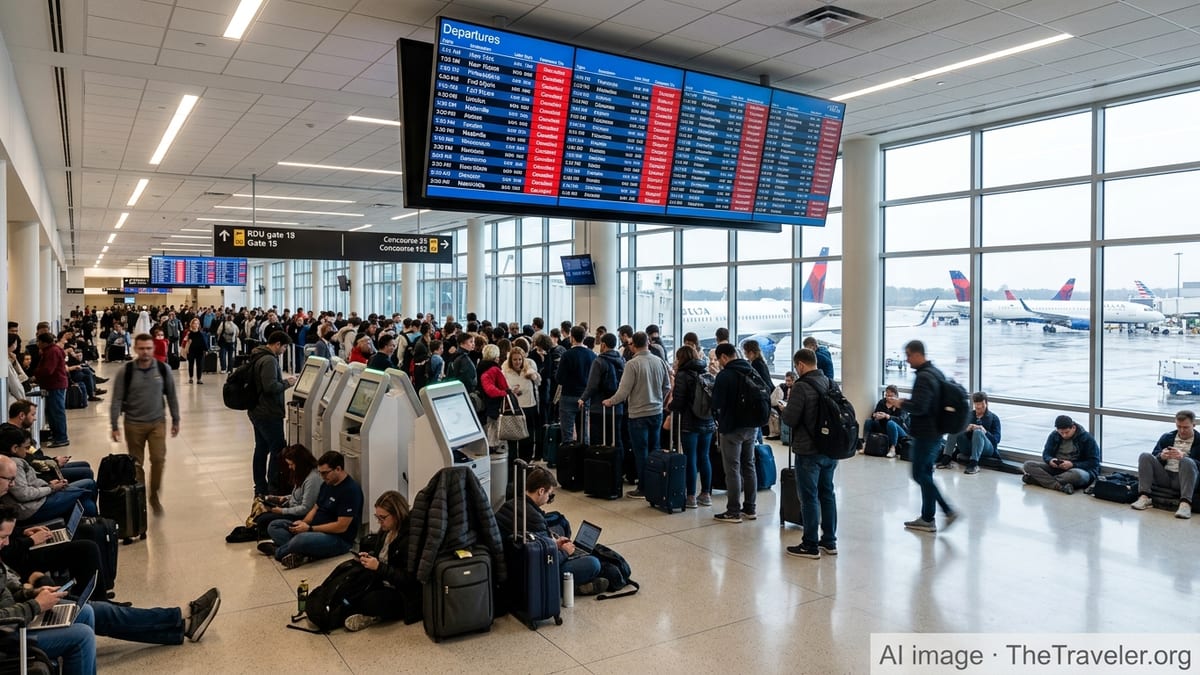
Travelers at Raleigh-Durham International Airport faced significant disruption as at least 17 flights operated by Endeavor Air, Republic Airways, Delta Air Lines, PSA Airlines and Breeze Airways were grounded, with many more delayed across major domestic and transatlantic routes on Thursday, affecting connections to New York, Philadelphia, Fort Myers, London, Nashville and several other cities.
Get the latest news straight to your inbox!
Grounded Flights Ripple Across Key RDU Routes
Publicly available flight-status boards and airline updates on Thursday indicated an unusual cluster of cancellations and extended delays at Raleigh-Durham International Airport, concentrated among regional partners and a growing low-cost carrier presence. Endeavor Air and Republic Airways, which operate flights under major airline brands such as Delta and American, scrubbed a series of departures and arrivals, while PSA Airlines and Breeze Airways also showed grounded services. The pattern left early morning and mid-day banks particularly thin, with several aircraft never departing their gates.
The disruption hit some of RDU’s most heavily used short-haul corridors. Multiple flights to and from New York area airports, including LaGuardia and John F. Kennedy, were removed from schedules or pushed back for hours, interrupting onward connections for business and leisure travelers. Additional cancellations on links to Philadelphia and Nashville further constrained options, especially for passengers relying on regional jets to feed into larger domestic and international networks.
Routes toward sun destinations were not spared. Flights between Raleigh-Durham and Fort Myers faced schedule upheaval, compounding a busy late-winter and early-spring travel period for North Carolina residents heading to Florida’s Gulf Coast. Disruptions also touched services tied to transatlantic connections, with knock-on effects for passengers traveling between RDU and London via major East Coast hubs.
For travelers already in motion, the grounded aircraft translated into missed links at hub airports and extended time in terminals as airlines worked through rebooking queues. Many passengers faced the choice of accepting next-day itineraries, rerouting through alternate hubs, or abandoning trips altogether if time-sensitive plans could not be salvaged.
Weather, Congestion and Operational Strain Combine
The latest turmoil at Raleigh-Durham unfolded against a broader backdrop of unsettled conditions in the eastern United States. Recent winter storms and severe weather systems have repeatedly swept through the Mid-Atlantic and Northeast, disrupting traffic flows around New York and Philadelphia and contributing to a fragile operating environment for regional carriers. When bad weather reduces capacity at already congested airports, smaller aircraft flying shorter segments are often the first to be delayed or cancelled.
Industry data and past government reports show that carriers such as Endeavor Air, Republic Airways and PSA Airlines typically run dense schedules of short-haul flights, leaving little margin to absorb irregular operations. When several aircraft or crews go out of rotation, delays can cascade quickly, spreading from large hubs to spoke airports such as Raleigh-Durham. In this case, publicly visible schedules suggested that aircraft positioning challenges and crew availability may have compounded the impact of weather-related constraints farther up the network.
Operational pressure has been particularly acute for regional operators serving major brands. These airlines are responsible for a significant share of departures labeled under the paint schemes of Delta, American and United, but often work under tight turnaround times. Any disruption at a primary hub can leave outstations like RDU with aircraft arriving late, out of sequence or not at all, resulting in same-day cancellations even when local weather appears calm.
For low-cost and hybrid carriers such as Breeze Airways, which maintain thinner frequencies on individual routes, a single grounded jet can be even more consequential. A cancelled rotation may remove the only nonstop option for that day between Raleigh-Durham and a destination such as Fort Myers or a secondary city, leaving travelers to piece together multi-stop alternatives on different airlines at higher last-minute fares.
RDU’s Expanding Role Increases the Impact
Raleigh-Durham International has steadily grown into a major air travel gateway for North Carolina and the broader Research Triangle region, with more than 80 destinations and a rising count of international links. Recent developments include a crew base for Endeavor Air and a new operating base for Breeze Airways, moves that were expected to deepen connectivity and expand nonstop options from the airport. On busy days, this growth translates into dense schedule banks clustered around morning and evening peaks.
That expansion also means that even a relatively small number of cancellations can have an outsized effect. When 17 flights across multiple operators are grounded on the same day, the losses are spread across different markets and time windows, touching business shuttles to New York as well as leisure services to Florida and key connecting points such as Nashville. Passengers counting on RDU’s widened route map suddenly face fewer choices at precisely the moments they had come to expect more.
The airport’s terminal layout further shapes how disruptions are felt. Airlines such as Breeze and some low-cost competitors operate from one terminal, while major legacy carriers and their regional partners use another. When several carriers experience problems simultaneously, the result can be uneven crowding, with long lines at certain check-in counters and rebooking desks while other areas remain comparatively quiet. Social media posts and traveler anecdotes on Thursday pointed to busy gate areas, shifting departure times and frequent announcements reflecting the unstable schedule.
RDU’s role as a connector, not only to coastal hubs but also to interior markets, also raises the stakes. Delays on short-haul feeders into Atlanta, New York or Philadelphia can jeopardize international departures onward to Europe or Latin America, forcing last-minute hotel stays or wholesale itinerary changes. Travelers bound for London, whether via direct service or through a U.S. hub, faced heightened uncertainty as missed or tightly timed connections became more likely.
Passengers Scramble for Alternatives and Guidance
As cancellations accumulated, travelers at Raleigh-Durham worked through the familiar but stressful sequence of contingency decisions. Airline guidance and standard best practices emphasized checking flight-status tools frequently, enabling app notifications, and arriving at the airport early even if a delay notice had been issued. With schedules in flux, several airlines advised customers to use digital channels for rebooking where possible, reserving in-person counters for those already at the terminal or needing more complex itinerary changes.
For passengers facing cancelled flights to New York, Philadelphia or Nashville, rebooked itineraries often involved connections through alternative hubs or moves to later departures that still had open seats. Those headed for leisure destinations such as Fort Myers weighed whether to push trips back by a day or more, or to seek refunds and reschedule for a less volatile period. Some travelers chose to drive to larger airports within the region if same-day alternatives from RDU proved limited, a pattern commonly seen during past disruption events.
Travel insurance and flexible ticket policies played a critical role in softening the financial blow. Many carriers continue to offer options to change dates or routes without traditional change fees, especially when disruptions are tied to weather systems or networkwide operational issues. Travelers who had built extra time into their itineraries, particularly for international connections via London or major U.S. gateways, were better positioned to absorb missed segments without losing the entire value of their trips.
Nonetheless, for those with time-sensitive commitments such as business meetings, family events or cruise departures, Thursday’s flight disruptions underscored how quickly even a single day of irregular operations can unravel carefully planned journeys. The cluster of grounded flights at RDU served as a reminder that regional airports are deeply exposed to stresses elsewhere in the air travel system, and that passengers benefit from monitoring conditions across the broader network, not just at their origin and destination.
What Travelers Through RDU Should Expect Next
Based on recent patterns during periods of widespread weather and operational strain, recovery at airports such as Raleigh-Durham typically occurs over several days rather than a single news cycle. Airlines will work to reposition aircraft and crews, rebuild their morning and evening banks and restore normal frequencies to core routes like New York, Philadelphia and Nashville. However, residual delays and occasional day-of cancellations are likely to persist as long as storm systems and tight staffing continue to affect the broader East Coast network.
Travelers with upcoming departures from RDU are being encouraged by publicly available guidance to monitor their bookings closely in the 24 to 48 hours before travel, especially if they are scheduled on early morning regional flights that depend on inbound aircraft arriving the prior night. Checking in as soon as online windows open, confirming seat assignments and enabling alerts can provide early warning if a flight’s status begins to shift.
Those connecting through major hubs to long-haul destinations, including London, may wish to consider building in longer layovers or selecting itineraries with multiple daily frequencies, which offer more fallback options in the event of a misconnection. When route networks are under pressure, passengers on the most popular corridors and those who check in earliest often have access to the widest range of alternative flights if something goes wrong.
For now, the wave of cancellations at Raleigh-Durham highlights the fragile balance underpinning modern air travel. Even with new bases and expanded route maps, airports like RDU remain vulnerable to a complex mix of weather, airspace constraints and the operational realities of regional and low-cost carriers. As airlines adapt their schedules and travelers adjust their expectations, Thursday’s turmoil is likely to inform how both groups prepare for the remainder of the busy spring and summer travel seasons.