

More news on this day
Hundreds of flight delays and cancellations at Las Vegas’ Harry Reid International Airport are disrupting travel across the United States, with impacts reported on routes to Los Angeles, Chicago and other major hubs as major carriers struggle to keep schedules intact.
Get the latest news straight to your inbox!
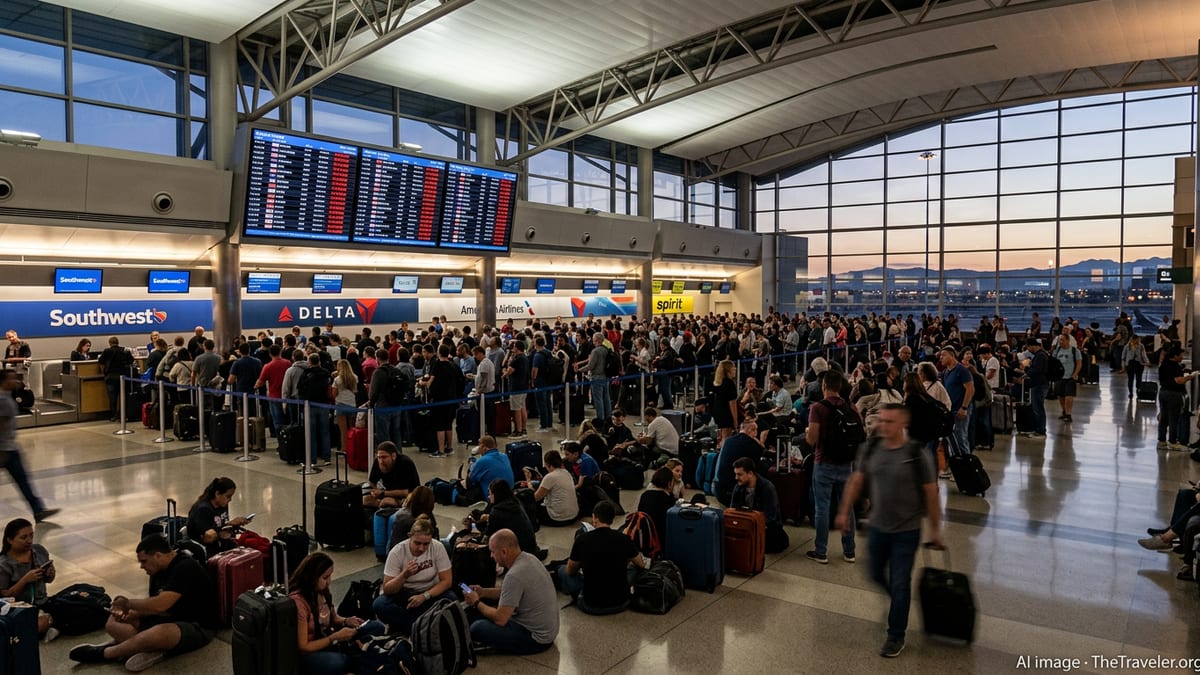
Harry Reid Airport Logs 241 Delays and 48 Cancellations
Publicly available flight-tracking data for Harry Reid International Airport in Las Vegas on Sunday indicates a day of heavy disruption, with 241 delayed departures and arrivals and 48 flights canceled across multiple airlines. The figures put Las Vegas among the more severely affected US airports for the day, underscoring the vulnerability of a major leisure and connections hub when operations go off schedule.
Southwest, Delta Air Lines, American Airlines and Spirit Airlines feature prominently in the disruption tally, reflecting their sizable presence at Harry Reid and on key domestic routes radiating from Las Vegas. The mix of late-arriving aircraft, tight aircraft rotation and crew scheduling challenges contributed to rolling delays that compounded through the day.
Data dashboards used by travelers and aviation analysts show delays clustering in the afternoon and evening banks, when volumes are highest and recovery windows are shortest. As departure times slid back, gate holds and aircraft swaps added to congestion on the ramp and in terminal holding areas.
While the overall number of cancellations remained modest compared with large national meltdowns seen in recent years, the combination of repeated schedule changes and scattered outright cancellations created significant uncertainty for travelers, many of whom were attempting to connect to flights in other cities or return home at the end of weekend trips.
Major Carriers Struggle to Keep Las Vegas Schedules on Track
Southwest Airlines, Harry Reid’s largest carrier by passenger volume, bore a considerable share of the disruption simply by virtue of its schedule footprint. The airline operates dense point-to-point networks linking Las Vegas with major Western markets and mid-continent cities, meaning a delay on one leg often propagates quickly to others.
Delta Air Lines and American Airlines, both of which use Las Vegas primarily as an important leisure and convention destination rather than as a core hub, also reported notable knock-on impacts. Aircraft and crews arriving late from other parts of the country narrowed the margin for on-time turnarounds, increasing the likelihood that individual delays would cascade into downstream flights.
Spirit Airlines, which markets Las Vegas heavily to cost-conscious travelers from cities such as Los Angeles and Chicago, faced its own set of challenges. Low-cost carriers typically operate with fewer spare aircraft and tighter utilization, leaving less flexibility to absorb disruptions without resorting to schedule adjustments or cancellations.
Operational performance data from recent months shows that Las Vegas has experienced recurring bouts of congestion during peak travel periods, driven by a combination of strong demand, limited spare capacity and the airport’s role as a bridge between Western and Midwestern markets. Sunday’s figures suggest that even without a single dramatic trigger event, cumulative small disruptions can push the system into an unstable pattern.
Ripple Effects Hit Los Angeles, Chicago and Other US Cities
The disruption at Harry Reid did not remain confined to Nevada. Because Las Vegas is tied closely to major metropolitan areas across the country, delays there quickly spread to other airports, particularly on heavily trafficked routes to Los Angeles and Chicago.
Flights between Las Vegas and Los Angeles International Airport, as well as those serving other Southern California fields, encountered rolling delays as late departures from Nevada collided with congestion in Southern California airspace. Passengers reported extended waits on the ground and revised departure estimates that shifted repeatedly as crews and aircraft repositioned.
Chicago, another key market for Las Vegas-bound leisure and convention travelers, also felt the impacts. Publicly accessible flight boards for Chicago’s major airports showed a series of delayed arrivals from Las Vegas, followed by corresponding delays on onward departures to other US cities, reinforcing the knock-on nature of the disruptions.
Smaller and mid-sized airports linked to Las Vegas through nonstop services, including regional markets in the Mountain West and Midwest, experienced secondary effects as airlines adjusted rotations. Some flights departed significantly later than scheduled, while others were merged or rebooked to consolidate loads and free up aircraft time.
Underlying Pressures on US Airline Operations
The latest day of turbulence at Harry Reid highlights broader structural pressures in the US airline system. Robust demand for leisure travel to Las Vegas has pushed carriers to operate fuller schedules with high aircraft utilization, a strategy that maximizes revenue but leaves limited slack when conditions deteriorate.
Industry analyses of recent disruption events emphasize that even routine challenges such as localized weather, minor technical issues or brief air traffic control restrictions can create complex chains of delay when schedules are tight. This effect is magnified at airports like Harry Reid that handle a mix of point-to-point and connecting traffic across several large carriers.
Past disruptions involving individual airlines have prompted federal scrutiny of customer service practices and contingency planning, encouraging carriers to strengthen their ability to recover from operational shocks. However, as Sunday’s disruptions in Las Vegas demonstrate, balancing efficiency with resilience remains difficult when airlines are operating near capacity and travelers continue to crowd popular destinations.
Observers note that while major nationwide breakdowns have been less frequent recently, localized disruption days of the kind seen in Las Vegas are becoming a recurring feature of the travel landscape, particularly around weekends, major events and peak holiday periods.
What Travelers Can Expect in the Days Ahead
With aircraft and crews scattered across the network, operational analysts caution that some residual disruption from Sunday’s Las Vegas delays and cancellations may carry into Monday morning departures. Early flights that rely on overnight aircraft positioning or tight connection windows will be most vulnerable to continuing schedule adjustments.
Travelers planning to pass through Harry Reid International or to fly on routes connected to Las Vegas in the near term are likely to face a heightened risk of schedule changes, even if overall conditions improve. Airlines often use the first off-peak periods after a busy disruption day to reset aircraft rotations, which can entail further retiming of select flights.
Publicly available data and past patterns suggest that most US airlines can typically stabilize operations within 24 to 48 hours after a day of concentrated local disruption, provided that no additional weather or airspace constraints emerge. For Las Vegas, the key variables will be clear weather, sufficient staffing at both the airport and airline level, and the absence of additional knock-on shocks elsewhere in the system.
For now, the situation at Harry Reid serves as a reminder that the interconnected nature of US air travel means even a single airport’s difficult day can reverberate widely, affecting travelers who may be hundreds or thousands of miles away from the original source of disruption.