

More news on this day
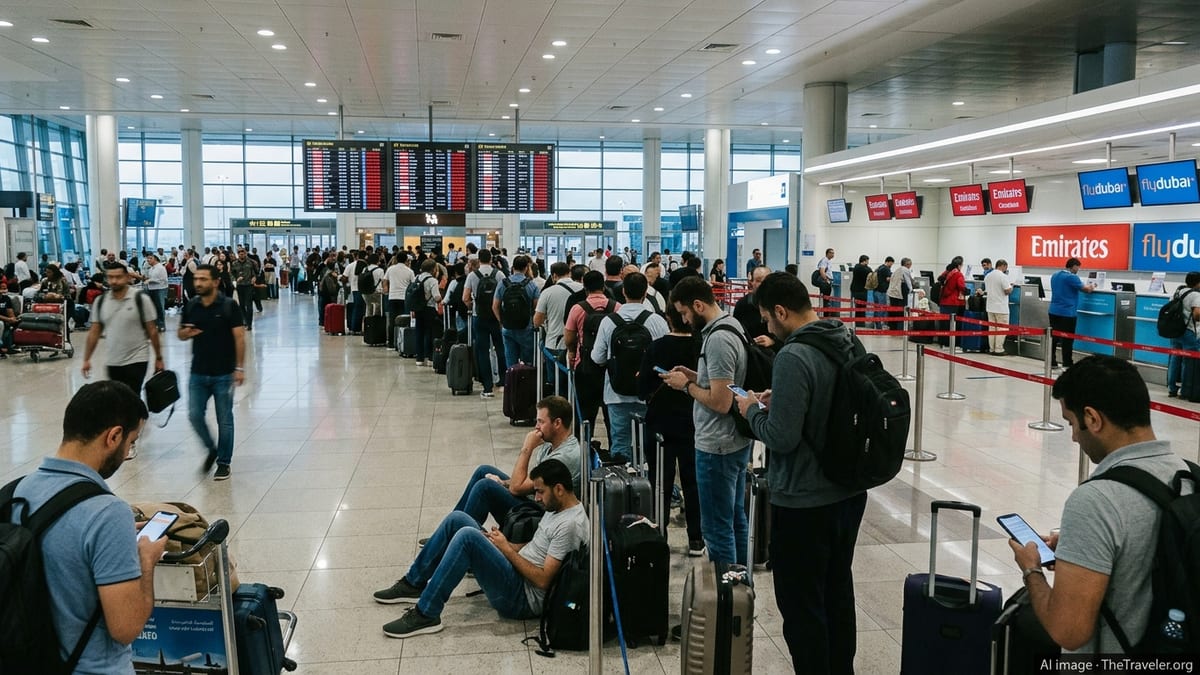
Air travel across the United Arab Emirates has been severely disrupted as Emirates, Etihad Airways, Flydubai and Air Arabia collectively register 164 delayed flights and 26 cancellations, impacting operations at the country’s key hubs in Dubai, Abu Dhabi, Sharjah and Al Ain.
Get the latest news straight to your inbox!
Regional Tensions Trigger Fresh Wave of Flight Disruptions
Published coverage from regional and international media indicates that the latest disruption is tied to ongoing security concerns and airspace restrictions across parts of the Middle East. In recent weeks, periods of temporary airspace closures and route constraints over neighboring countries have repeatedly forced airlines to adjust or suspend services at short notice.
Operational data compiled from airport status updates and airline advisories shows that the four major UAE carriers have responded with rolling schedule changes rather than blanket shutdowns. The tally of 164 delays and 26 cancellations reflects a single, highly disrupted operating window, but aviation analysts note that knock-on effects often continue for days as aircraft and crew are repositioned.
While passenger demand for and through the UAE remains strong, publicly available information shows that carriers are prioritising safety and regulatory compliance over schedule integrity. As a result, even routes not directly overflying affected airspace have experienced late departures, extended diversions and aircraft substitutions.
The disruptions have particular resonance in the UAE, where aviation underpins both tourism and business connectivity. Dubai and Abu Dhabi in particular serve as critical transfer points between Europe, Asia and Africa, magnifying the global impact whenever local operations are constrained.
Dubai and Abu Dhabi Bear Brunt of Operational Strain
Dubai International Airport and Abu Dhabi International Airport have absorbed the bulk of schedule disruptions, reflecting their roles as primary hubs for Emirates and Etihad Airways. Reports from airport status boards and traveler accounts describe clusters of delayed departures, tightly packed rescheduled flights and extended ground times as airlines work through backlogs.
In Dubai, Emirates and Flydubai share infrastructure at one of the world’s busiest international gateways, increasing the complexity of slot allocation during disruption. Reduced runway availability at certain times and the need to sequence wide-body and narrow-body traffic carefully have added additional pressure to an already congested schedule.
Abu Dhabi has faced its own challenges as Etihad Airways adapts long-haul and regional routes to evolving airspace restrictions. Publicly accessible flight information suggests that some services have operated with extended routings or adjusted departure times, while others have been temporarily withdrawn from the schedule to free capacity for stranded passengers on core trunk routes.
Ground handling, baggage processing and security screening have also come under strain at the two largest airports, particularly during peak travel periods. Aviation observers point out that even when cancellations are limited, a high volume of late arrivals can quickly ripple through terminal operations, lengthening queues and boarding times.
Sharjah and Al Ain See Knock-On Effects
Although Dubai and Abu Dhabi remain the focal points of the disruption, secondary UAE airports at Sharjah and Al Ain have also been affected. Air Arabia, based in Sharjah, has faced delays and selective cancellations on routes that intersect constrained airspace or rely on aircraft arriving from more heavily impacted hubs.
Sharjah International Airport normally functions as a key low-cost and regional gateway, absorbing a significant volume of point-to-point traffic. During the current disruption cycle, schedule data indicates that the airport has served both as an origin for curtailed services and as an alternate arrival point for flights rerouted from Dubai or Abu Dhabi when capacity there has tightened.
Al Ain, typically handling lower volumes than the UAE’s coastal hubs, has nonetheless featured in contingency planning. Its location and available infrastructure provide an additional option for diversions or exceptional operations, especially when weather, congestion or airspace measures limit flexibility at busier airports.
Combined, the four airports illustrate how tightly interconnected the UAE’s aviation network has become. A delay or cancellation at one hub can quickly affect crew rotations and aircraft availability at another, contributing to the aggregate count of 164 delays and 26 cancellations across the system.
How Emirates, Etihad, Flydubai and Air Arabia Are Managing Recovery
Each of the UAE’s main carriers has adopted a slightly different operational strategy, shaped by network structure, fleet mix and home-base capacity. Emirates, with its predominantly long-haul wide-body fleet centered on Dubai, has focused on consolidating services and operating fuller flights where possible. Public information from timetable updates shows that some frequencies have been temporarily reduced, with affected travelers rebooked on remaining services.
Etihad Airways, based in Abu Dhabi, has followed a similar pattern, emphasising core long-haul and high-demand regional routes while trimming or postponing selected flights. Where aircraft and crew have been out of position due to earlier disruptions, schedules indicate that the airline has used ferry and repositioning flights to restore operational balance before restoring full commercial services.
Flydubai and Air Arabia, both operating largely narrow-body fleets on high-frequency regional networks, appear to be leveraging route flexibility to manage the disruption. This has included retiming departures, operating limited rotations on affected routes, and prioritising destinations with large numbers of stranded passengers. Because these carriers operate from separate hubs in Dubai and Sharjah, their adjustments have also helped distribute traffic pressure more evenly across the UAE’s airport system.
Aviation industry commentary suggests that all four airlines are attempting to restore predictability step by step rather than committing to full schedules that may not be sustainable while regional airspace conditions remain fluid. This measured approach is designed to minimise last-minute cancellations but inevitably contributes to a higher volume of planned delays.
Guidance for Affected Travelers and Ongoing Outlook
For passengers, the most immediate impact of the disruption has been extended journey times, missed connections and overnight stays in the UAE’s main hubs. Travel forums and consumer-facing advisories consistently recommend that travelers monitor airline apps and airport departure boards closely, as flight statuses can change several times in the hours leading up to departure.
Publicly available guidance from carriers and airports stresses the importance of confirming that a flight is operating before heading to the airport, especially for those transiting through Dubai, Abu Dhabi, Sharjah or Al Ain. In many cases, airlines have encouraged customers to accept complimentary rebooking options to later dates or alternative routings to ease peak-time congestion.
Insurance considerations have also come into sharper focus. Policy documents for many travel insurance products treat airspace closures and security-related disruptions differently from weather or technical delays, and consumer advocates urge passengers to review coverage terms carefully before incurring extra accommodation or rebooking costs.
Looking ahead, the pace of recovery will depend on both regional geopolitical developments and the ability of carriers to clear passenger backlogs without generating new bottlenecks. While the figure of 164 delays and 26 cancellations highlights the immediate scale of disruption, sector analysts note that the UAE’s aviation infrastructure and airline fleets are designed for rapid recovery once airspace and security conditions stabilise, suggesting that schedule reliability could improve relatively quickly once constraints ease.