

More news on this day
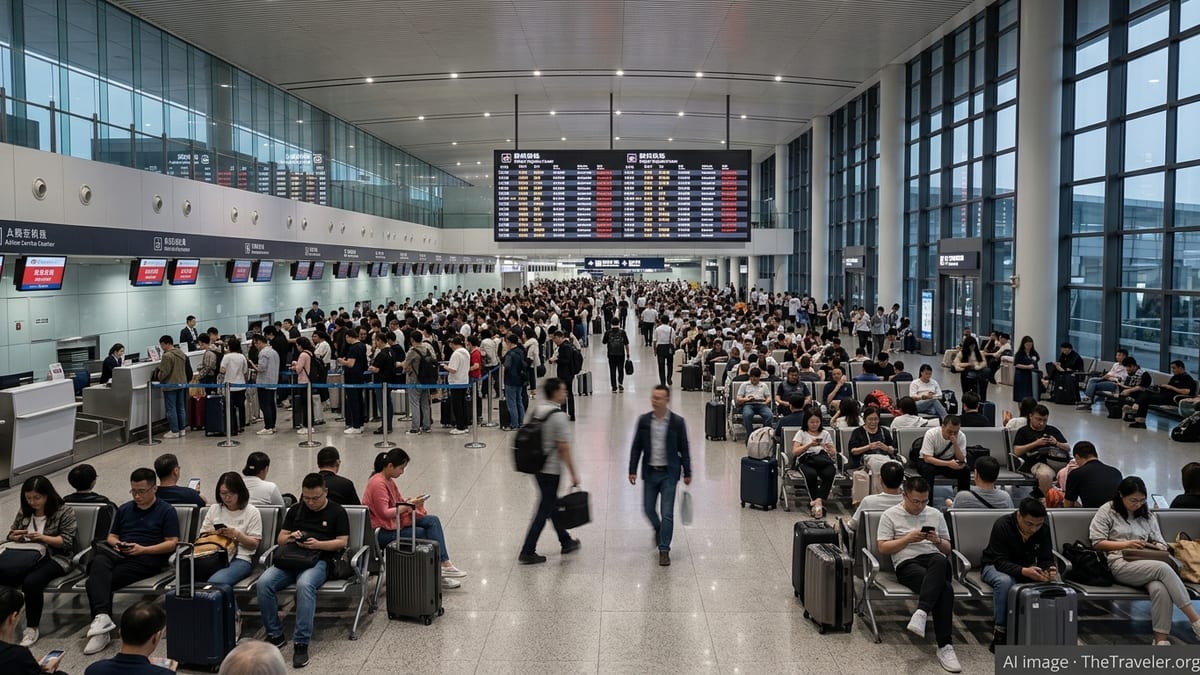
Large numbers of passengers were stranded across major Chinese cities after a wave of cancellations and delays affected 802 flights operated by Air China, China Express and China Eastern, disrupting travel through some of the country’s busiest hubs.
Get the latest news straight to your inbox!
Major Hubs See Cascading Delays
Publicly available tracking data and local media coverage indicate that 31 flights were cancelled and 771 were delayed across China’s domestic network, with the heaviest disruption centered on Beijing, Shanghai, Guangzhou, Chengdu and Wuhan. These cities sit at the heart of the country’s aviation grid, so schedule problems in their terminals tend to propagate quickly to smaller regional airports.
The pattern of disruption shows clusters of delayed departures at peak morning and late afternoon periods, when runways and airspace are already close to capacity. Once aircraft are out of position and crews exceed working-hour limits, recovery typically takes many hours, often stretching into the late evening. Passengers changing planes in these hubs have been particularly exposed, facing missed connections and forced overnight stays.
Operational data for Chinese carriers in recent years show that delays frequently build fastest at the largest multi-airport metropolitan systems, including Beijing’s Capital and Daxing airports, Shanghai’s Pudong and Hongqiao, and Chengdu’s Tianfu and Shuangliu. When congestion spikes in more than one of these city clusters at the same time, the impact can spread throughout the national network.
Air China, China Express and China Eastern Affected
Air China, China Express and China Eastern were among the airlines most visibly affected by the latest wave of delays and cancellations. Publicly accessible schedules and real-time tracking platforms show these carriers accounting for the majority of the 802 impacted flights, reflecting their heavy presence on dense trunk routes linking the country’s largest cities.
As China’s flag carrier, Air China operates an extensive network of domestic and international services, with Beijing and Chengdu as key bases. When disruption hits those hubs, onward flights to secondary cities and cross-border destinations are frequently delayed, compounding the effect on travelers who rely on tight connections.
China Eastern, which has its main base in Shanghai and a significant presence in Wuhan and other central Chinese cities, plays a central role in east–west and coastal connectivity. Delays on its routes can ripple out to business and leisure itineraries that connect through Shanghai’s two airports, where runway slots and terminal space are already highly utilized.
Regional carrier China Express focuses on linking smaller interior cities to major hubs using smaller jets. When its flights are delayed out of Beijing, Shanghai, Guangzhou, Chengdu or Wuhan, regional spokes often lose their only or last connection of the day, leaving passengers with limited alternative options and prolonging the time they remain stranded.
Passenger Experience: Long Queues and Tight Information
Images and accounts circulating on Chinese social media platforms show crowded departure halls, long queues at airline service desks and groups of travelers resting on luggage or terminal benches as they wait for updated departure times. Many passengers reported uncertainty about how long delays would last or whether their flights would eventually depart at all.
China’s aviation regulations and airline policies typically provide for rebooking and, in certain circumstances, meals or accommodation, but the practical experience often depends on whether disruption is attributed to weather, airspace congestion or operational issues. Travelers posting online described difficulty reaching call centers and competing for limited hotel vouchers once flights were pushed into late-night hours.
Delays at multi-airport cities have also complicated ground transport plans. Passengers arriving much later than planned in Beijing or Shanghai have reported missing the last high-speed trains or long-distance buses to nearby provinces, forcing unplanned overnight stays or costly last-minute car hires. Families traveling with children and elderly passengers have appeared particularly affected, judging from images and descriptions shared publicly.
Travel planning platforms and local consumer commentators have reiterated practical advice that has emerged from previous bouts of disruption, including allowing generous connection times when changing between domestic and international flights, monitoring airline apps closely, and preparing contingency plans for overnight stays when traveling through major Chinese hubs during busy periods.
Underlying Pressures on China’s Aviation Network
China’s domestic aviation market has expanded rapidly over the past decade, and industry analyses have highlighted how demand has at times outpaced available capacity in airspace and at key airports. Research on congestion at Chinese hubs points to recurring delay patterns around metropolitan airport clusters, where multiple large facilities share the same terminal control area and air routes.
Beijing, Shanghai, Guangzhou and Chengdu have each added runways, terminals or entirely new airports in recent years, but air traffic management and weather-related constraints continue to limit how tightly flights can be scheduled, particularly during peak hours. When summer storms, winter fog or low cloud develop over these cities, arrival and departure rates can drop quickly, triggering the kind of rolling delays seen in the latest disruption.
Academic work examining operational data from airports such as Guangzhou Baiyun and the Beijing and Shanghai airport systems has found that once delays pass certain thresholds, recovery can be slow without active schedule adjustments or tactical reductions in flight volume. These findings align with the way today’s cluster of delays spread beyond the largest hubs to smaller regional airports connected by spokes operated by carriers such as China Express.
Industry observers note that continued growth in domestic travel, combined with a gradual rebuilding of international routes, is likely to keep pressure on China’s major airports. Investments in air traffic control modernization, improved schedule planning and better passenger information tools are frequently cited in policy and academic discussions as ways to mitigate the impact of similar disruption events in the future.
Implications for Travelers Planning Routes Through China
The latest wave of cancellations and delays serves as a reminder for travelers planning itineraries through Chinese hubs to build in additional resilience. Travel advisers and online planning resources often suggest avoiding very tight connections, particularly when changing between different tickets or between domestic and international sectors at large airports such as Shanghai Pudong, Beijing Capital or Guangzhou Baiyun.
Passengers connecting from high-speed rail to flights, or vice versa, have been encouraged to leave extra buffer time, as rail schedules can also be affected by weather and peak-season congestion. The experience of those stranded in Beijing, Shanghai, Guangzhou, Chengdu and Wuhan shows how quickly disruption in one mode of transport can cascade into another when timings are tightly aligned.
The episode may also influence how airlines refine schedules and contingency plans ahead of upcoming travel peaks, such as national holidays and major events that put additional pressure on air and ground transport networks. Any adjustments that create more realistic turnaround times and better recovery margins could help reduce the scale of passenger strandings during future disruption.
For now, passengers whose flights are still scheduled are being advised by local travel platforms and online commentators to check status updates repeatedly on airline apps, consider earlier departures where possible, and prepare for potential re-routing within the domestic network if their original flights become heavily delayed or cancelled.