

More news on this day
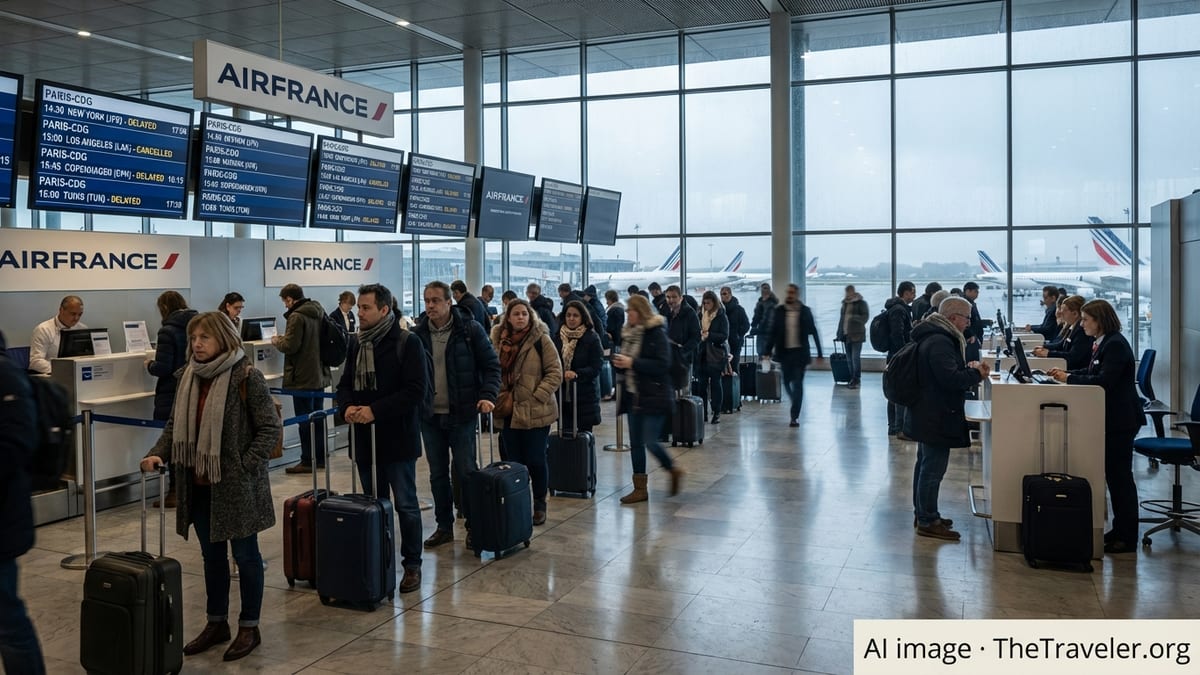
Hundreds of travellers were left facing long queues, missed connections, and last minute itinerary changes across France today as major airports serving Paris, Lyon, Marseille, and Nice registered 538 delayed flights and 21 cancellations, disrupting operations for Air France, Vueling, Transavia France, Lufthansa, Ryanair, and several other airlines.
Get the latest news straight to your inbox!
Delays Concentrated at France’s Busiest Gateways
The disruption has been most visible at the country’s primary gateways, with Paris area airports, Lyon Saint Exupéry, Marseille Provence, and Nice Côte d’Azur all reporting elevated delay levels. Publicly available operational data for 12 April 2026 indicate that the vast majority of affected services were delayed rather than cancelled, but the sheer volume of late departures has still caused knock on effects across domestic and European networks.
Monitoring by flight tracking platforms shows pressure building around the morning and evening departure banks, when dense clusters of short haul services typically depart within narrow windows. As aircraft and crews cycle through rotations touching multiple French hubs in a single day, a delay originating in Paris or Lyon has increasingly been feeding into late running departures in Marseille, Nice, and onward destinations across Europe.
While only 21 flights were cancelled outright, the 538 delayed services have been enough to create a ripple effect across the wider system, with missed connections and rebookings affecting passengers far beyond the four headline airports. Industry focused reporting on Europe’s wider spring schedule has already highlighted an uptick in operational strain this month, and today’s figures in France align with that broader pattern.
Multiple Airlines Caught in Operational Snarl
The disruption has not been confined to a single carrier. Data compiled from airport boards and flight tracking services show Air France bearing a significant share of the delays at Paris Charles de Gaulle, Paris Orly, and Marseille, reflecting its role as France’s largest network airline. Low cost and leisure oriented operators including Vueling, Transavia France, and Ryanair have also seen their French services affected, particularly on short haul routes linking France to Spain, Italy, the United Kingdom, and other nearby markets.
Lufthansa and other European network airlines have encountered secondary impacts where their schedules intersect with French hubs. Delays on feeder flights into Paris, Lyon, Marseille, or Nice have, in some cases, translated into tight or missed connections for long haul services operated from partner hubs such as Frankfurt and Munich. Travel industry analysis published in recent days has already noted similar patterns on 9 and 10 April, when a wave of delays across several European countries put extra strain on connection heavy itineraries.
Published operational statistics for individual airlines suggest that, despite the visible disruption, cancellation rates remain lower than during peak strike periods in previous years. The emphasis has been on keeping flights operating, even if many are departing significantly behind schedule. That approach helps reduce the number of passengers needing full rebookings or overnight accommodation, but it extends the period during which travellers must cope with crowded terminals and shifting departure times.
Underlying Pressures: Staffing, Weather and Airspace Constraints
Reports from aviation analysts point to a combination of factors behind the latest day of disruption in France. Staffing constraints in air traffic control and ground handling, already identified as a vulnerability during the busy spring and summer periods, appear to be intersecting with lingering weather and airspace issues across parts of Europe. Earlier in the 2025 to 2026 winter season, strong windstorms moving across Western Europe triggered temporary capacity reductions at several hubs, including in France.
Although today’s operational picture is not dominated by a single named storm, the system remains sensitive to even modest bouts of adverse weather, particularly during peak traffic hours. When visibility or wind conditions briefly fall outside preferred operating ranges at one airport, holding patterns and minor flow restrictions can quickly stack up into delays across multiple French hubs that share the same air traffic control sectors.
In parallel, route adjustments linked to regional airspace restrictions in parts of the Middle East and Eastern Europe continue to add complexity to long haul flight planning. While those factors may not directly cause the 15 to 60 minute delays frustrating many domestic and intra European travellers in France today, they have reduced overall scheduling flexibility, leaving airlines and air navigation services with less room to recover when problems arise.
Impact on Travellers and Knock On Effects Across Europe
For passengers flying through Paris, Lyon, Marseille, and Nice, today’s figures have translated into familiar on the ground challenges. Travellers have faced extended waits at security and check in, crowded gate areas, and rolling revisions to departure boards. For those with onward connections, particularly via major hubs such as Paris Charles de Gaulle, even relatively short delays on feeder flights have been enough to jeopardise carefully timed transfers.
Disruptions in France have also spilled over into neighbouring countries. Flights arriving late into airports in Spain, Germany, Italy, and the United Kingdom from French hubs have in turn pushed back subsequent departures, as aircraft and crews try to work back towards their original schedules. Aviation data providers tracking Europe wide performance in early April have already reported that delays originating in one country are increasingly propagating across the continent as aircraft rotate through multi leg daily schedules.
Rail links and ground transport have offered only partial relief. Although France’s high speed rail network remains a strong alternative on some domestic corridors, recent timetable adjustments and capacity constraints have limited the extent to which passengers can fully switch away from disrupted short haul flights at short notice. As a result, many travellers caught up in today’s delays have had little choice but to wait out the backlog at the airport.
What Passengers Can Do if Their Flight Is Affected
Consumer advocates point out that passengers affected by today’s disruptions have several avenues for mitigation and, in some cases, compensation. Under European passenger protection rules, travellers on eligible itineraries may be entitled to assistance and, depending on the cause and length of delay, financial compensation or refunds. The level of entitlement can vary based on flight distance, delay duration, and whether the disruption is deemed within the airline’s control.
Public guidance from aviation agencies and consumer organisations generally encourages travellers to monitor flight status closely on the day of departure, using both airline channels and independent tracking tools. Early awareness of an extended delay or a cancellation increases the chances of securing alternative routings before available seats are exhausted, especially on busy domestic links between Paris and regional cities such as Lyon, Marseille, and Nice.
Travel industry advice also stresses the importance of keeping documentation such as booking confirmations, boarding passes, and receipts for meals or accommodation if a delay stretches into many hours. These records are often required when submitting claims for reimbursement or compensation after the disruption has passed. With Europe’s spring travel season just beginning to ramp up, today’s events in France serve as a reminder that even relatively modest levels of cancellation, combined with widespread delays, can significantly affect travel plans in one of the continent’s busiest aviation markets.