

More news on this day
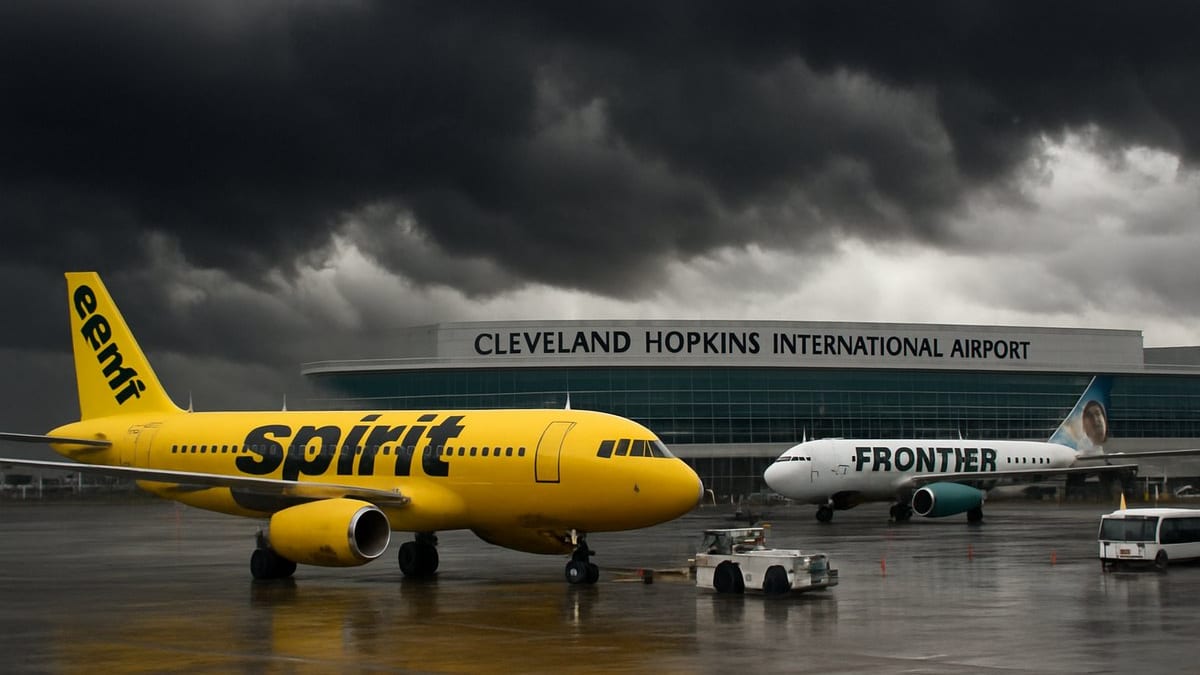
Cleveland Hopkins International Airport is grappling with a fresh wave of operational disruption as a volatile mix of severe spring weather and wider network strain triggers delays and cancellations for ultra-low-cost carriers Spirit Airlines and Frontier Airlines, unsettling travel plans for passengers across Northeast Ohio.
Get the latest news straight to your inbox!
Storm Systems Expose a Fragile Spring Travel Pattern
The latest turbulence at Cleveland Hopkins comes as powerful storm systems sweep across the eastern United States, repeatedly disrupting aviation schedules at major hubs. Recent national tallies compiled from flight-tracking data show thousands of delays and hundreds of cancellations on key spring travel days, with Spirit and Frontier among the carriers experiencing elevated disruption levels.
While Cleveland has not seen the same volume of disruption as the largest coastal hubs, the airport has been caught inside the national ripple effect. Flights routed through storm-hit cities, including connections for Spirit and Frontier, have faced rolling delays that cascade into later departures and arrivals at Cleveland Hopkins. For passengers, even a modest number of local cancellations can translate into missed connections and lengthy rebookings when aircraft and crews are already stretched elsewhere in the system.
Publicly available information indicates that in several recent weather-driven disruption events, Spirit has recorded higher-than-average cancellation and delay counts across its network, while Frontier has also reported dozens of delayed flights. These network stresses are magnified at secondary airports such as Cleveland, where ultra-low-cost carriers often operate with thinner schedules and fewer backup options than at their primary bases.
The timing of this pattern is especially problematic for travelers in northern Ohio. Spring break demand and early-season leisure travel combine with unstable weather to create what aviation analysts routinely describe as one of the least forgiving periods of the year for flight reliability.
Spirit’s Network Strain Collides With Its Cleveland Exit
The operational chaos at Cleveland Hopkins is unfolding just as Spirit Airlines prepares to exit the airport. Publicly available airport and industry reports show that Spirit plans to cease service at Cleveland in April 2026 as part of a broader restructuring of its network following financial headwinds and a reorganization process.
That looming withdrawal means that each disrupted Spirit flight at Cleveland carries an added layer of uncertainty for travelers. With the carrier already winding down its presence, there are fewer future departures to accommodate rebookings, and alternative options often involve switching to other airlines at higher last-minute fares or adjusting itineraries through different hubs.
Recent coverage of Spirit’s operations nationally highlights a stretch of heightened cancellations and delays across the carrier’s domestic network, driven by a mix of weather, aircraft availability, and crew scheduling constraints. When those issues intersect with Cleveland’s shrinking menu of Spirit departures, even a single cancelled or heavily delayed flight can leave passengers with limited same-day alternatives.
The exit also underscores a longer-running shift in Cleveland’s airline mix. Previous passenger statistics released by the airport already pointed to reduced seat capacity from several airlines, with Spirit identified as a key contributor to the decline. The latest round of flight chaos is likely to reinforce perceptions among local travelers that ultra-low fares can come with heightened exposure to operational volatility, particularly during a period of corporate restructuring.
Frontier’s Growth at CLE Tested by Rolling Delays
Frontier has expanded its footprint at Cleveland Hopkins in recent years, to the point where it has overtaken legacy carriers in monthly passenger totals. That growth has positioned the airline as a critical connector for price-sensitive travelers in Northeast Ohio, especially on leisure-oriented routes.
However, the same weather systems and network pressures battering Spirit have also tested Frontier’s resilience. Industry-wide disruption tallies from late March indicate Frontier flights facing dozens of delays and multiple cancellations across the United States, with knock-on effects at outstations such as Cleveland.
Ultra-low-cost carriers typically operate tight schedules, with aircraft flying multiple legs per day and limited spare capacity. When storms or congestion delay a departure early in the day, the resulting backlog can cascade through the rest of the schedule. At Cleveland, where Frontier operates a focused but not hub-level operation, this can mean extended gate holds, rolling departure times, or aircraft swaps that shift disruptions from one route to another.
For passengers, the outcome has been a patchwork of late departures and challenging rebooking scenarios. Travel forums and social media posts in recent weeks describe long queues, shifting departure boards, and limited same-day alternatives when Frontier flights are affected, particularly on popular leisure routes that do not have many competing carriers.
Local Impact at Cleveland Hopkins and Passenger Options
Within the terminal at Cleveland Hopkins, the impact of this turbulent period is being felt in crowded gate areas, slower-than-usual turnaround times, and a visible uptick in travelers seeking assistance at service counters. Even when the airport’s own operations, such as security and ground handling, remain steady, airline-specific disruptions can quickly translate into localized congestion.
Publicly available coverage of recent national disruption days shows Cleveland appearing in industry roundups with a smaller but notable tally of delayed and cancelled flights. For an airport that has worked to rebuild traffic and stabilize its route network, repeated mentions in disruption reports are an unwelcome development at the start of the busy spring and summer seasons.
The strain is compounded by structural changes behind the scenes. Separate industry reporting has documented reductions in ground-handling capacity at Cleveland in recent years, including changes affecting service contracts for Frontier and Spirit. Such shifts can leave airlines more reliant on lean staffing models and less able to absorb irregular operations when storms or technical issues arise.
Travelers facing disruption at Cleveland are being advised by consumer advocates and travel industry analysts to lean heavily on real-time tools, such as airline apps and flight-tracking platforms, to monitor evolving departure times. Flexible itineraries, early arrivals at the airport, and a willingness to consider nearby airports or alternative carriers are emerging as practical strategies for minimizing the impact of last-minute schedule changes.
What the Turbulent Spring Signals for Cleveland’s Air Service
The convergence of weather-driven chaos, Spirit’s impending departure, and heightened strain on Frontier’s schedule raises broader questions about connectivity for Northeast Ohio in the months ahead. With Spirit stepping away from Cleveland Hopkins, the airport is set to rely more heavily on Frontier and legacy carriers to maintain affordable leisure options and nonstop access to key sun destinations.
Airport planning documents and recent public communications have emphasized efforts to diversify the carrier mix and attract new routes, including additional low-cost and leisure-focused services. However, the current wave of operational disruption illustrates that simply adding seats is not enough; reliability and resilience are becoming just as important to travelers as headline fares.
In the short term, the expectation among industry observers is for continued volatility. Spring weather patterns typically remain active into April, while network adjustments linked to Spirit’s restructuring and Frontier’s schedule refinements will take time to stabilize. For Cleveland Hopkins, this means that the next several weeks are likely to remain challenging, with day-to-day conditions heavily influenced by storms and bottlenecks far beyond Ohio.
For travelers planning to fly from Cleveland this season, the message from recent events is clear. Booking early flights, building in longer connection times, and closely monitoring flight status before heading to the airport can reduce the risk of being caught in the next wave of disruption as Spirit winds down service and Frontier navigates a choppy spring.