

More news on this day
Travelers across the eastern United States faced a day of disrupted plans on March 8 as delays and cancellations at Myrtle Beach International Airport rippled through major hubs including Atlanta, Boston and New York, stranding passengers, scrambling airline operations and underscoring how quickly a localized issue can spread through the national air network.
Chain Reaction From a Coastal Airport
While Myrtle Beach International Airport is a mid-sized regional gateway, its role as a feeder to major hubs meant that a cluster of disruptions there had outsized consequences. Over the course of Sunday, at least 20 departures and arrivals were delayed and 18 flights were canceled, according to real-time tracking services and airport operations reports. Many of those flights were bound for or arriving from high-traffic hubs such as Atlanta, Boston and New York, where schedules were already tight following a turbulent early March for air travel.
Several Myrtle Beach services to Atlanta’s Hartsfield-Jackson airport were scrubbed on March 8 after a difficult weekend of weather-related problems in Georgia. Data from multiple carriers showed regional and codeshare flights between Myrtle Beach and Atlanta, including services marketed by large network airlines, listed as canceled on Sunday after earlier disruptions in the Atlanta system. Passengers booked onward from Atlanta to destinations across the Midwest and Northeast suddenly found themselves without a way to leave the South Carolina coast.
Flights linking Myrtle Beach and Boston also experienced knock-on effects as New England continued to work through residual congestion from recent winter storms. While some Myrtle Beach–Boston services remained scheduled, travelers reported lengthy queues at customer service desks as they tried to rebook missed connections in both directions. With limited daily frequencies on many of these routes, losing even a small number of flights significantly reduced options for same-day recovery.
Connections into the New York area were similarly affected, with Myrtle Beach-originating travelers bound for airports serving the nation’s largest city facing long delays or last-minute changes to itineraries. For visitors wrapping up weekend breaks on the Grand Strand and heading home to the Northeast, the combination of constrained capacity and mounting weather-related schedule adjustments elsewhere meant that a simple point-to-point trip turned into an all-day ordeal.
Atlanta, Boston and New York Feel the Strain
The timing of the Myrtle Beach cancellations was especially problematic for Atlanta, which was still contending with hundreds of weather-related delays and cancellations over the preceding 48 hours. Thunderstorms and hail near Hartsfield-Jackson on March 7 triggered ground delays, aircraft inspections and widespread schedule reshuffling. By Sunday, even as conditions improved around Atlanta, outstations like Myrtle Beach were still absorbing the aftershocks in the form of blocked aircraft and crews out of position.
In Boston and across New England, recent severe winter weather and a series of late-season systems have kept airlines on edge. Although conditions on March 8 were more manageable than during the height of recent storms, the network remained fragile. When Myrtle Beach flights feeding into Boston were canceled or heavily delayed, it compounded existing congestion at Logan Airport, where airlines have been juggling de-icing demands, runway constraints and high passenger loads typical of late-winter weekends.
New York’s airports, which frequently rank among the nation’s most delay-prone during adverse weather, also felt the pressure. Carriers rely heavily on feeder traffic from secondary leisure destinations such as Myrtle Beach to fill aircraft on trunk routes to and from LaGuardia and other New York-area fields. When multiple Myrtle Beach segments were cut from the schedule, airlines had to decide whether to consolidate remaining passengers onto limited seats, re-route them through alternative hubs or hold departures to wait for misconnecting travelers.
The result for passengers was a patchwork of experiences: some travelers reported relatively smooth rebookings, while others described long waits for available seats and difficulty finding hotel rooms near major hubs already crowded with stranded flyers from previous days’ storms. At several airports, customer-service queues snaked through concourses as agents worked flight by flight to rebuild disrupted itineraries.
What Caused the Disruptions
Weather was the primary driver of the latest wave of travel chaos, but operational vulnerabilities amplified its impact. Thunderstorms and hail around Atlanta on March 7 prompted airlines to hold or divert flights, with some aircraft required to undergo inspections for possible hail damage before returning to service. That created a shortage of available planes and crews on Sunday morning, particularly on regional routes that connect secondary cities to hub airports.
At the same time, the broader network was still recovering from a punishing winter season in the Northeast and Mid-Atlantic. Major storms earlier in the year had already forced tens of thousands of cancellations across the United States, consuming spare capacity and stretching staffing rosters. By early March, many carriers were operating with little margin to absorb additional shocks, especially on weekends when schedules are dense and leisure demand peaks.
Myrtle Beach’s status as a primarily leisure-focused airport also played a role. Many routes operate with just one or two daily frequencies, often using regional jets or narrowbody aircraft that cycle through multiple cities each day. When a single leg in that chain is canceled because an inbound aircraft or crew cannot arrive on time, it can cascade quickly, affecting flights to multiple hubs. With 18 cancellations in a short window, Myrtle Beach’s normally manageable schedule became a chokepoint in the broader system.
Airlines have invested in new tools to predict and manage weather-related disruptions, but the events of March 7 and 8 illustrate the limits of even sophisticated planning when severe weather intersects with tight staffing and heavy demand. For travelers, the distinction between a storm over Atlanta or the Northeast and a canceled flight out of Myrtle Beach is largely academic: the outcome is the same, and the experience on the ground often feels chaotic.
Impact on Passengers and Traveler Reactions
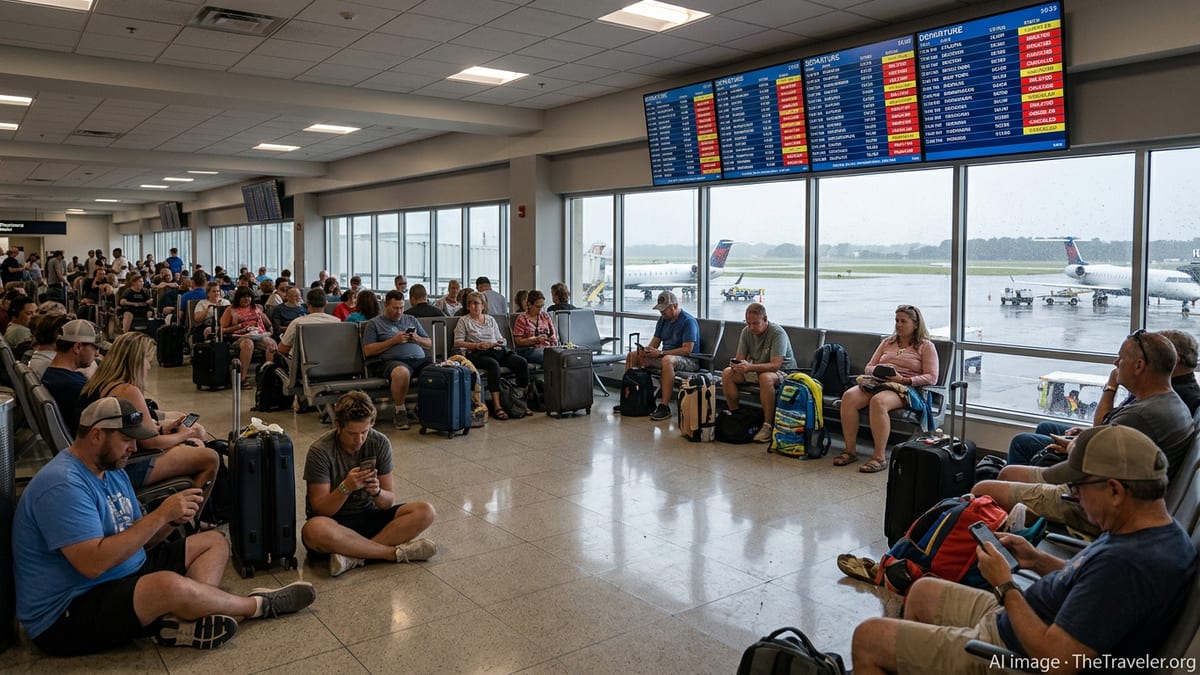
For passengers, Sunday’s disruptions translated into missed vacations, delayed returns home and unplanned expenses for food and lodging. At Myrtle Beach, families with young children could be seen sprawled across departure lounge floors, waiting for updates as departure times repeatedly slid later into the day. Some travelers chose to rent cars and drive to larger hubs such as Charlotte or Atlanta in hopes of catching alternative flights, only to discover that those airports were already grappling with their own backlogs.
At major hubs, frustration was widespread. In Atlanta, Boston and New York, passengers arriving from Myrtle Beach or attempting to depart there reported long waits at customer-service counters and limited available rebooking options. Because many flights were already heavily booked for the weekend, re-accommodating stranded travelers often meant pushing them to flights one or even two days later, particularly on popular routes to Florida, the Midwest and the Northeast corridor.
Social media posts from stranded passengers painted a picture of confusion and inconsistent communication. Some customers praised individual gate agents for doing what they could under pressure, while others complained of sparse updates, difficulties reaching airline call centers and limited information about their rights to refunds or meal vouchers. For leisure travelers on tight schedules, even a few hours of uncertainty could mean losing nonrefundable hotel nights or paid activities at their destination.
Local tourism businesses in Myrtle Beach also felt the ripple effects. Hotels reported a mix of last-minute extension requests from guests unable to depart and cancellations from new arrivals whose flights were scrubbed. Airport-area restaurants and rideshare drivers saw an unexpected surge in demand as travelers weighed whether to wait out the disruption or seek alternative routes home by road.
What Travelers Should Do Next
With weather patterns still unsettled in early March and airline networks stretched thin from a difficult winter season, travel experts say passengers flying to or from Myrtle Beach and major hubs such as Atlanta, Boston and New York should prepare for potential continued volatility. That means building extra time into itineraries, particularly for connections, and monitoring flight status closely from 24 hours before departure through the time you leave for the airport.
Travelers are urged to download their airline’s mobile app and enable notifications so they can receive the earliest possible alerts about delays or cancellations. In many cases, rebooking through an app or website can be faster than waiting in airport lines, especially when widespread disruptions occur. It is also advisable to keep contact information current in airline profiles and to verify that reservations include alternative contact methods such as text messages in case email updates are delayed.
Those with critical travel plans, such as cruises departing from nearby ports or important events in major cities, may wish to consider flying a day earlier than strictly necessary or booking itineraries that avoid tight connections at weather-prone hubs. While this approach adds cost and time, it can provide a buffer when storms or operational issues arise at airports like Myrtle Beach that rely heavily on single-hub connections.
Finally, passengers should familiarize themselves with airline policies on refunds, vouchers and overnight accommodations during disruptions. While compensation rules vary by carrier and are often more generous in cases of controllable operational problems than for weather events, knowing in advance what to ask for at the airport can make a significant difference. As the events of March 8 demonstrate, when a regional gateway like Myrtle Beach encounters trouble, its effects can reach far beyond the South Carolina coast and into the nation’s busiest air corridors.