

More news on this day
Passengers across the United Arab Emirates, Egypt and Afghanistan are facing another bruising round of travel disruption as a cluster of cancellations and delays on routes operated by Royal Jordanian (RJA), EgyptAir (MSR) and flydubai (FDB) leaves travelers stranded in Abu Dhabi, Cairo, Kabul and onward connecting hubs.
Get the latest news straight to your inbox!
Regional Conflict Keeps Pressure on Airline Schedules
The latest disruption involving 12 canceled and 17 delayed flights comes against the backdrop of a wider aviation crisis that has gripped the Middle East since late February, when conflict involving Iran and several regional states triggered rolling airspace restrictions and temporary airport shutdowns. Publicly available aviation advisories and industry briefings describe a patchwork of closures and rerouting that continues to complicate operations into and out of the Gulf.
Major hubs such as Dubai and Abu Dhabi have already endured periods of near-total suspension of commercial traffic, with only limited repatriation and cargo services permitted at certain points. Even as some flights resume, operators are rebuilding schedules cautiously, often with reduced frequencies and extended block times to accommodate longer routings around restricted airspace.
Royal Jordanian, EgyptAir and flydubai are among the carriers adjusting their networks in response. Recent travel updates and schedule notices show that services touching Abu Dhabi, Cairo and Kabul remain vulnerable to short-notice operational changes, with airlines citing ongoing security assessments, slot constraints and crew-rotation challenges.
Industry analysts note that the three affected carriers all rely, to varying degrees, on Middle Eastern corridors that have been repeatedly opened and closed in recent weeks. That exposure helps explain why clusters of cancellations can materialize quickly when a new restriction is imposed or when air traffic management systems in the region become saturated.
Abu Dhabi: Hub Rebuilding Amid Stop-Start Operations
Abu Dhabi’s Zayed International Airport continues to function as a key pivot in the unfolding disruption. Published airline advisories indicate that departures from the UAE capital have moved from outright suspension in early March to a limited commercial schedule, with frequencies and destinations gradually added when conditions allow. This fragile recovery leaves the hub especially sensitive to any new constraint on airspace or ground capacity.
In the latest wave of disruption, several flights operated or marketed by Royal Jordanian, EgyptAir and flydubai that were due to connect through Abu Dhabi were either canceled or pushed back, contributing to growing crowds of transit passengers seeking rebooking options. Social media posts and online travel-agency alerts describe long queues at transfer desks and repeated schedule changes posted within hours of departure.
Travel-management advisories highlight that carriers operating from Abu Dhabi are prioritizing safety margins and regulatory compliance over schedule reliability, a stance that can produce abrupt cancellations when new risk assessments are issued. For passengers, that means even flights listed as “on time” can be retimed or removed entirely with little warning, particularly on routes intersecting sensitive corridors to and from the Levant and South Asia.
Abu Dhabi’s role as a connecting hub also magnifies the impact of each disruption. A single canceled departure can cascade across multiple onward itineraries, leaving travelers bound for Europe, Africa or Southeast Asia temporarily stranded despite holding confirmed tickets.
Cairo Feels Knock-On Effects Despite Open Airspace
While Egyptian airspace itself has remained broadly open through the crisis, EgyptAir has implemented significant schedule changes on regional routes, especially those linking Cairo with Gulf destinations. Recent public statements and media coverage point to a phased restoration of services to the United Arab Emirates after earlier suspensions, with new frequencies added cautiously as regional airspace conditions evolve.
The cluster of cancellations and delays affecting MSR flights underscores how vulnerable even open airports are to turbulence elsewhere in the network. When corridors over neighboring states are restricted or when Gulf hubs reduce capacity, Cairo-bound and Cairo-originating flights can still be pulled from the schedule due to aircraft and crew imbalances.
Travelers in Cairo reported on digital platforms that some flights to Abu Dhabi and other Gulf cities have been subject to rolling delays of several hours, followed in some cases by day-of-departure cancellations. Published travel advisories recommend that passengers holding EgyptAir tickets on regional routes check status repeatedly within the 24 hours before travel and remain prepared for involuntary rebooking or overnight stays.
For Egypt’s national carrier, maintaining connectivity to the Gulf is commercially important but operationally complex under current conditions. Each new advisory from aviation regulators or neighboring states can force timeline adjustments, which then reverberate through Cairo’s banks of departures and arrivals.
Kabul Links Disrupted as Flydubai Adjusts Network
Kabul, already an operationally challenging destination due to security and infrastructure constraints, has seen its international connectivity further strained by the regional crisis. Flydubai, which plays a central role in linking Afghanistan to the United Arab Emirates and onward destinations such as Egypt, has publicized a reduced and frequently updated schedule while regional airspace remains volatile.
Timetables and booking channels show that services linking Kabul with the Gulf and North Africa have been subject to repeated timing changes, and that certain rotations have been canceled outright on specific days as aircraft are reassigned. When those adjustments coincide with wider disruptions in Abu Dhabi and other hubs, passengers find themselves stranded not only in Kabul but also in transit points en route to Cairo and beyond.
Reports from regional travel agents describe Afghanistan–Egypt itineraries that formerly relied on predictable hub connections now requiring last-minute rerouting, extended layovers or temporary ground stops. Travelers who had planned straightforward one-stop journeys via the Gulf are being offered multi-stop alternatives that add many hours to total travel time or are being encouraged to postpone trips altogether.
Limited alternative capacity into and out of Afghanistan compounds the problem. With relatively few carriers serving Kabul, the loss or delay of even a handful of flights can translate into days of waiting for the next available seat, particularly for passengers without flexible tickets or access to premium booking channels.
Stranded Passengers Face Long Queues, Limited Options
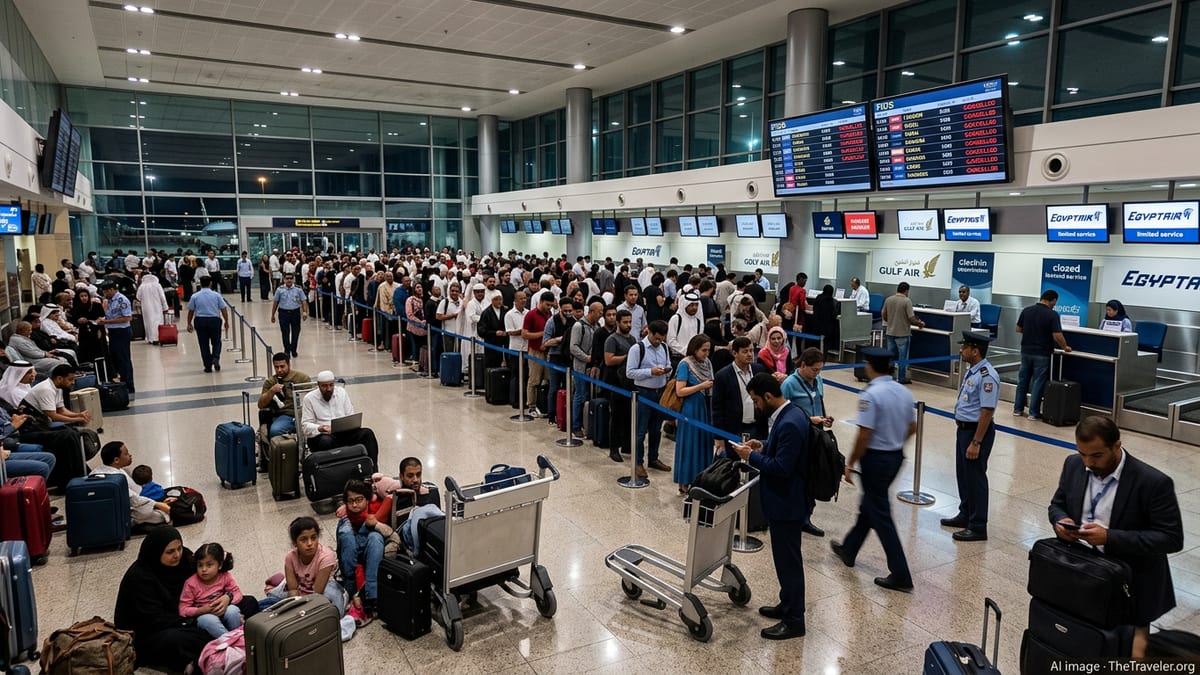
Across Abu Dhabi, Cairo and Kabul, the immediate human impact of the latest 12 cancellations and 17 delays is visible in crowded terminals, overflowing seating areas and long lines at customer-service counters. Passenger accounts shared on public forums describe uncertainty around rebooking timelines, with some travelers learning of cancellations only after passing security checkpoints.
Travel-advisory bulletins compiled by corporate travel managers and online agencies stress that many airlines in the region, including RJA, MSR and FDB, are offering flexible options such as fee-free date changes, rerouting where space permits and, in some cases, refunds. However, the sheer number of travelers affected by weeks of rolling disruption makes it difficult to secure prompt alternatives, particularly on peak routes between the Gulf, Europe and South Asia.
Consumer advocates warn that standard rights frameworks, such as European passenger-compensation rules, may not apply when cancellations are tied to security restrictions or airspace closures classified as extraordinary circumstances. That leaves many stranded travelers reliant on airline goodwill policies, travel insurance provisions or employer assistance rather than statutory payouts.
Practical guidance circulating among travel professionals emphasizes early and repeated status checks, proactive engagement with airlines via digital channels and a willingness to consider secondary routings that bypass the most impacted hubs. For those already stuck in terminals from Abu Dhabi to Kabul, the priority remains securing a confirmed onward seat as airlines continue to balance safety, regulatory demands and limited operational capacity.