

More news on this day
Florida lawmakers have approved a landmark measure to rename Palm Beach International Airport as President Donald J. Trump International Airport, setting the stage for a politically charged rebranding of one of South Florida’s busiest gateways and raising fresh questions for travelers, tourism leaders and local officials in Palm Beach County.
A Landmark Vote Reshapes a Major Florida Gateway
The Republican-controlled Florida Legislature this week passed a bill that would formally change the name of Palm Beach International Airport to President Donald J. Trump International Airport, following days of heated debate in Tallahassee. The measure cleared the House in an 81 to 30 vote and then passed the Senate 25 to 11, strictly along party lines according to multiple legislative reports.
The bill now heads to the desk of Governor Ron DeSantis, who has not yet publicly committed to signing it but has frequently aligned himself with Trump on high-profile cultural issues. If the governor approves the legislation and federal regulators give their consent, the name change is scheduled to take effect in July 2026, giving state and local authorities just over a year to rebrand one of South Florida’s key transportation hubs.
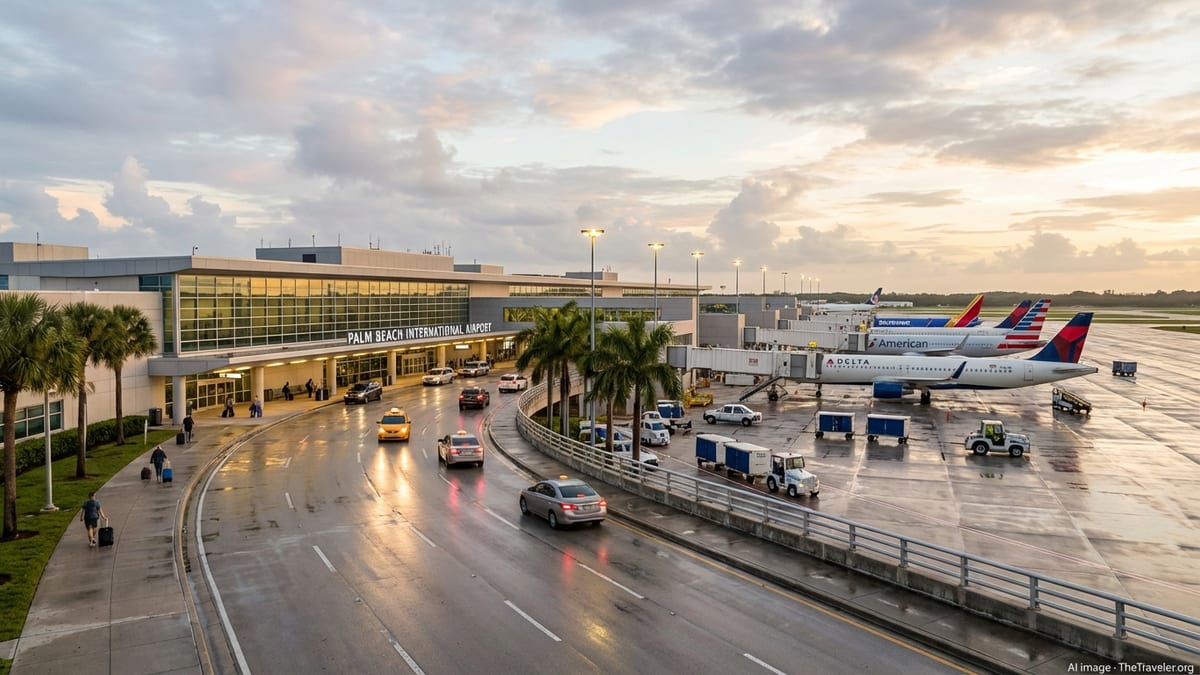
Palm Beach International Airport, located just west of West Palm Beach and a short drive from Trump’s Mar-a-Lago estate, handled more than 5 million departing passengers in 2025, bucking regional trends by avoiding the traffic declines seen at nearby Miami and Fort Lauderdale airports. The rebranding would effectively cement Trump’s presence over an airport he has long used for both political and personal travel.
Supporters in the Legislature framed the vote as a historic recognition of a sitting president who has made Palm Beach County his home and political base. Opponents countered that the move bypasses local input and risks politicizing a critical piece of public infrastructure that serves residents and visitors across the political spectrum.
State Power Versus Local Control in the Airport’s Identity
Central to the controversy is the way the bill shifts authority over airport naming from local governments to the state. The legislation places the power to name Florida’s seven major commercial airports in the hands of the Legislature, effectively stripping Palm Beach County commissioners of their traditional influence over Palm Beach International’s branding and identity.
While the law codifies existing names at other major airports in Miami, Fort Lauderdale, Orlando, Tampa, Jacksonville and Fort Myers, Palm Beach is the only facility targeted for an immediate rebrand. Democratic lawmakers and local officials have accused state leaders of singling out the county to advance a political tribute, arguing that residents and county leaders were sidelined in the process.
Palm Beach County’s delegation has been divided. Some Republican legislators representing parts of the county backed the measure, pointing to Trump’s residency at Mar-a-Lago and his frequent use of the airport as justification for the honor. Prominent Democrats, including Representative Lois Frankel, whose district includes the airport, have criticized the bill as “misguided and unfair,” saying the Legislature ignored community sentiment and treated local leaders as an afterthought.
The clash reflects broader tensions between Florida’s state leadership and local governments on issues ranging from pandemic restrictions to land use and transportation policy. By asserting naming authority over airports, the Legislature has not only decided the fate of Palm Beach’s aviation brand but also signaled that other local icons could be reshaped by state-level politics.
Costs, Contracts and the $5.5 Million Rebranding Question
Beyond the political symbolism, the airport renaming carries a tangible price tag. Preliminary estimates from airport officials place the cost of rebranding at around 5.5 million dollars, covering everything from exterior signage to uniforms, marketing materials, digital systems and overhead announcements. Lawmakers backing the bill have argued that new state funding will offset most of these expenses, but details on how the money will flow remain under discussion.
The rebrand will touch nearly every facet of the traveler experience. Terminal signs, roadway markers, wayfinding systems and emergency messaging will need to be updated to reflect the new name, as will airline schedules, airport websites, mobile apps and third-party booking systems. Equipment from baggage tugs to shuttle buses may require repainting or new decals, and staff will need training to ensure consistent use of the new branding in customer communications.
Industry analysts say the cost figure is relatively modest for a large-scale rebranding of a major airport but note that indirect expenses, such as staff time and potential confusion among travelers, can be harder to quantify. In the short term, travel agents, navigation apps and airline reservation platforms will have to manage the transition carefully to prevent misbookings and misrouted passengers when the name change formally takes effect.
County officials have warned that if state appropriations fall short, local taxpayers or airport revenues could be tapped to fill any gap. For an airport that has prided itself on strong passenger growth and a comparatively smooth experience for travelers, the coming year may bring an unusual mix of construction work, signage swaps and public-relations messaging targeted at reassuring visitors that their familiar gateway is still functioning as normal, even as its name changes.
Travelers, Tourism and the Trump Effect on the Palm Beaches
The new name is expected to have ripple effects across Palm Beach County’s tourism industry, where upscale resorts, golf courses and oceanfront neighborhoods market the region as a refined, sun-drenched retreat. Tourism officials are bracing for questions from both domestic and international visitors who may be unfamiliar with the politics behind the change but will immediately recognize the Trump brand.
Supporters of the renaming argue that the Trump association could bolster Palm Beach’s global profile, drawing additional attention from loyal supporters and political tourists interested in visiting the president’s adopted hometown. They point out that Mar-a-Lago has already become a magnet for political events, fundraisers and rallies, and that an airport bearing Trump’s name could further reinforce the county’s image as a power center in conservative politics.
Critics in the travel and hospitality sectors worry that the new name could alienate potential visitors who prefer to avoid overt political symbolism when choosing leisure destinations. Travel planners say some corporate event organizers and international tour operators may take a more cautious view, particularly if clients perceive the branding as polarizing. For travelers connecting through South Florida, the Trump name on one airport and not others could become a factor in which hub they choose.
For now, airlines serving Palm Beach International are monitoring the situation but have not indicated any plans to change service levels based solely on the rebranding. Carriers will need to revise timetables, route maps and advertising materials, and they may also field passenger questions as the name appears in booking engines and boarding passes. Hotels, rental car agencies and tourism boards across Palm Beach County are preparing new marketing copy that acknowledges the name change while trying to keep the focus on beaches, culture and climate rather than partisan politics.
Community Reactions in a Politically Shifting County
Reactions across Palm Beach County have been deeply mixed, reflecting the area’s shifting political landscape. Historically a Democratic stronghold, the county has moved rightward in the past decade as wealthy conservatives, influencers and donors have flocked to Palm Beach and nearby communities. Trump’s residence at Mar-a-Lago, coupled with a wave of high-profile conservative media figures relocating to the region, has reshaped local politics and donor networks.
Residents opposed to the renaming have staged small demonstrations and organized petition drives, emphasizing that the airport belongs to the entire county, not just Trump’s supporters. Some have highlighted the president’s past legal clashes with the airport over flight paths and noise near Mar-a-Lago, arguing that it is inappropriate to name the facility after a figure who once sued over its operations.
Backers of the change say the airport is simply acknowledging reality. They argue that Trump has brought unprecedented global attention to Palm Beach, attracting visitors and investment, and that honoring him on the airport is no more controversial than naming other major airports after presidents such as John F. Kennedy or Ronald Reagan. To them, criticism of the renaming reflects lingering partisan resentment rather than a principled objection to civic honors.
In neighborhoods near the airport, many residents express a more practical concern: whether the political fight will affect flight schedules, noise abatement programs or planned infrastructure upgrades. Local officials have sought to reassure communities that the renaming will not alter runway expansion plans, flight paths or ongoing efforts to manage noise, even as new signage and branding roll out across the property.
Trademark Moves by the Trump Organization Raise Questions
The Trump Organization has moved quickly to secure the commercial underpinnings of the proposed rebrand. In the days leading up to the final legislative vote, the company filed trademark applications for names associated with Trump-branded airports, including variations of President Donald J. Trump International Airport, covering a wide array of aviation-related uses and merchandise.
Company representatives have said publicly that the filings are intended to protect the Trump name from misuse by third parties rather than generate profit from the Florida renaming itself. They have suggested that any licensing for the Palm Beach airport name could be provided at no cost, though no binding commitment has been written into state law. That omission has fueled criticism from Democrats who warn that the airport’s public branding could ultimately bolster Trump’s private business interests.
Trademark experts note that naming rights for large public facilities are typically accompanied by detailed agreements outlining how logos, fonts and other brand elements can be used, and whether any royalties or side deals apply. The Legislature’s bill requires an agreement between Palm Beach County and the holder of the Trump trademarks before the airport can formally adopt the new name, leaving negotiators to hammer out the details in the months ahead.
Those talks are likely to draw scrutiny from ethics watchdogs and political rivals who argue that any benefit to Trump’s personal brand should be publicly disclosed and carefully limited. For travelers, the outcome will determine how prominently Trump’s stylized branding appears across terminal interiors, advertising campaigns and official airport merchandise once the new name goes live.
Regulatory Hurdles: Governor’s Signature and FAA Approval
Even after the Legislature’s approval, key steps remain before travelers see President Donald J. Trump International Airport on their boarding passes. First is the political decision in Tallahassee: Governor DeSantis must sign the legislation for it to become law. While he has backed Trump on numerous issues, he has also charted his own national ambitions, leading some observers to watch closely for any daylight between the two Republicans on such a high-visibility move.
Once signed, the change will require formal approval from the Federal Aviation Administration. The FAA reviews airport naming and code changes to ensure clarity and safety across the national airspace system. In this case, the airport’s three-letter code, PBI, is expected to remain unchanged, minimizing disruption to airlines and aviation databases, but the agency will still need to verify that the new name is properly integrated into navigation charts and official records.
Federal approval is widely anticipated but not guaranteed, especially given the political attention surrounding the issue. Aviation regulators typically avoid wading into symbolic disputes, focusing instead on operational and safety considerations. However, the prominence of the Trump name and the unusual nature of renaming a major airport for a sitting president could spur closer scrutiny than usual.
If all approvals proceed on schedule, the rebranding will roll out in phases leading up to the July 2026 target. Travelers arriving next season may first notice temporary signage and dual-name references before permanent monuments, roadway signs and digital assets are fully updated. For a time, at least, Palm Beach International Airport will exist in the public imagination alongside its future identity as Trump’s namesake gateway to South Florida.
What Travelers Should Expect in the Months Ahead
For travelers planning trips to Palm Beach County, the most immediate advice is to watch the name but not worry about the logistics. Airline tickets, frequent-flier accounts and ride-share apps will continue to recognize the familiar PBI airport code even as the new name is phased in. Navigational systems rely on those codes rather than full airport names, which helps ensure continuity through branding changes.
In the months leading up to the official switch, visitors may encounter a patchwork of names as airlines, hotel chains and online travel agencies update their systems at different speeds. Some platforms are likely to refer to “Palm Beach International Airport, soon to be President Donald J. Trump International Airport” during the transition, while others may adopt the new name as soon as state and federal approvals are complete.
On the ground, construction crews will be installing new monument signs at airport entrances, replacing terminal lettering and updating wayfinding displays. Travelers should be prepared for occasional detours or temporary closures of curbside lanes and pedestrian walkways as work proceeds, particularly during overnight hours when traffic is lighter.
For the broader travel industry, the renaming will serve as a case study in how deeply politics now intertwine with place branding. Whether President Donald J. Trump International Airport becomes a point of pride, a source of controversy or simply another name on a boarding pass, the Florida Legislature’s vote has ensured that this corner of South Florida will sit at the intersection of aviation, tourism and national politics for years to come.