

More news on this day
Florida transportation planners are examining a non-stop train link between Miami International Airport and PortMiami, a high-profile proposal intended to ease chronic traffic congestion and streamline connections for millions of cruise and air travelers each year.
Get the latest news straight to your inbox!
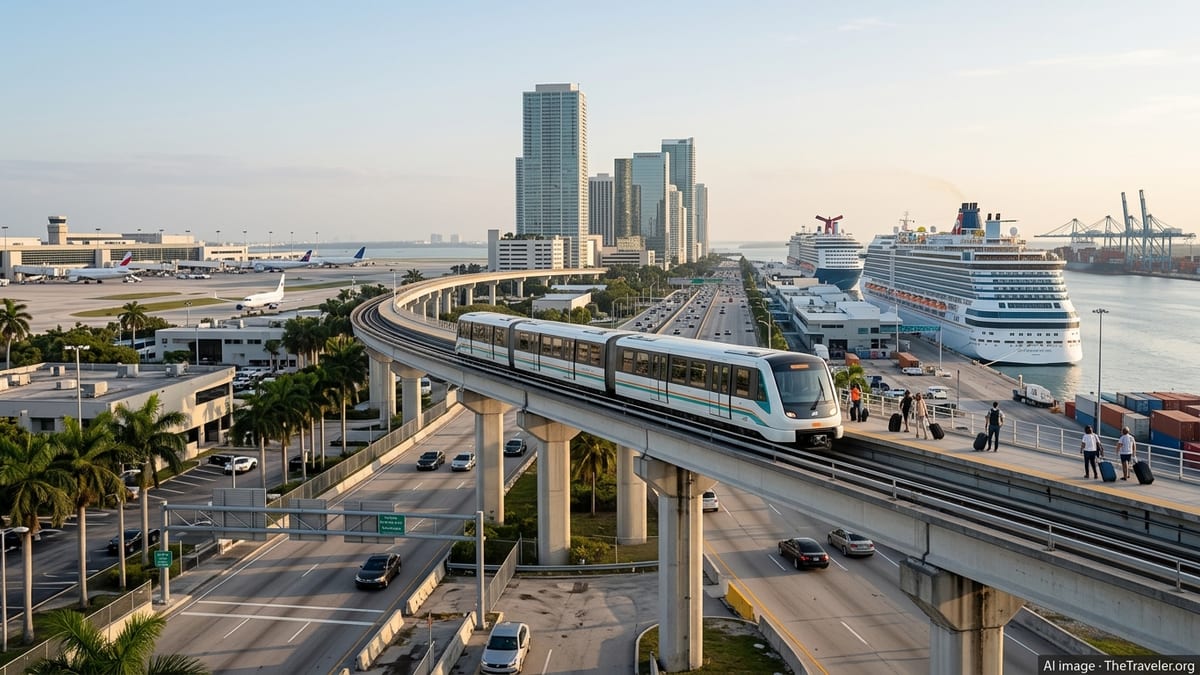
A Direct Rail Link for Two Global Gateways
The concept of a dedicated rail connection between Miami International Airport, one of the busiest international gateways in the United States, and PortMiami, the world’s leading cruise port by passengers, has gained new momentum as part of Miami-Dade County’s broader transit planning efforts. Publicly available planning documents and recent local coverage indicate that a non-stop or transfer-free train is under active study, with officials looking at how best to connect the two hubs without adding to downtown gridlock.
At present, there is no single-seat public transit option linking arriving cruise passengers directly to the airport. Travelers typically rely on a patchwork of taxis, rideshare vehicles, hotel shuttles, buses, and private coaches, all competing for limited roadway space near the port, on the MacArthur Causeway, and around the airport road network. A dedicated rail shuttle is being positioned as a way to simplify that journey and provide a predictable connection that is not as vulnerable to traffic incidents.
The proposed airport-to-port train is separate from intercity rail projects such as the private Brightline service, which already links Miami to Orlando via a downtown station. Instead, the Miami link is being framed as a local premium transit service, intended specifically to bridge two high-volume passenger nodes that anchor South Florida’s tourism economy.
Planning materials show the airport-port concept nested within the Strategic Miami Area Rapid Transit program, a county initiative that bundles multiple transit corridors and studies. By tying the station pair into an existing program, Miami-Dade aims to position the project for state and federal funding opportunities once a preferred alignment and technology are selected.
Traffic Relief and Cruise Growth Pressures
Traffic congestion around both Miami International Airport and PortMiami has intensified in recent years, fueled by rebounding tourism, expanding cruise fleets, and continued population growth across South Florida. Weekend surges, when multiple large ships turn over passengers on the same day, can overwhelm port access roads and downtown arterials, while airport access roads see spikes around peak flight banks.
A non-stop rail shuttle is being framed as a targeted response to these pressure points. By moving a portion of air-cruise transfer trips from road to rail, Miami-Dade planners hope to reduce the number of buses and rideshare vehicles that must circulate through crowded terminal areas. Advocates argue that even a modest shift in mode share could improve traffic flow on key corridors and free curb space for local travelers and employees.
The study effort also reflects long-term expectations for continued cruise growth. PortMiami has pursued new terminals and partnerships with major cruise brands, supporting ever-larger ships and higher passenger volumes. A reliable airport-to-port rail link is seen by many in the tourism sector as infrastructure that can help sustain that growth without proportionally increasing road congestion or requiring large new highway projects in the urban core.
Beyond congestion relief, planners are weighing potential benefits for emissions and air quality. Shifting short urban trips from diesel shuttles and private vehicles to electric or low-emission rail vehicles could contribute to local climate and resilience goals, particularly around Miami’s waterfront and dense urban neighborhoods.
How the Train Could Work
The details of the proposed connection remain in flux, and Miami-Dade’s transit studies outline multiple alignments and technologies. Options under discussion include heavy rail, light rail, and automated people-mover style systems, each with tradeoffs in capacity, speed, construction complexity, and integration with existing networks.
One scenario drawing attention would leverage or parallel existing transportation corridors between the airport and downtown waterfront, reducing the need for new right of way. Planners are also studying how a PortMiami station could integrate with the elevated Metromover system that already serves downtown and is slated for an extension toward Miami Beach, potentially creating a broader rail spine across the bay.
The term “non-stop” is being used in local discussion to describe a service that would run directly between the airport precinct and the port without intermediate stops. Some transportation advocates have noted that the project might ultimately operate as a “direct” or “transfer-free” service even if operational details evolve. A priority in the planning work is to avoid requiring passengers with luggage to make multiple transfers across different modes.
Any final design will also have to fit within the constrained urban environment of downtown Miami, where existing tunnels, bridges, cruise terminals, freight rail lines, and roadways all compete for limited space. Early-stage concepts emphasize grade separation where possible, in order to maintain reliability and avoid conflicts with port trucking and cruise terminal traffic.
Tourism, Equity, and Regional Connectivity
While cruise passengers and international tourists are an obvious target market for the airport-port train, Miami-Dade transportation plans also highlight the importance of serving local workers and residents. Thousands of people commute daily to both the airport and the port, many on varying shift schedules, and a fast, frequent rail link could provide a more reliable option for these trips.
Regional rail projects in South Florida, including Tri-Rail’s access to downtown Miami and Brightline’s Orlando extension, are gradually knitting together a patchwork of services into a more coherent network. A Miami International Airport to PortMiami train would add another key segment, potentially allowing smoother connections between intercity rail, local transit lines, and cruise or flight departures.
Equity considerations are increasingly present in public transportation planning across Florida, and the airport-port proposal is being discussed in that broader context. A premium non-stop shuttle that primarily serves higher-income cruise passengers could draw criticism if not integrated with more affordable services and fare structures. As a result, scenario planning is examining how the new link could mesh with existing bus and rail routes to offer benefits beyond the tourist market.
Tourism industry observers note that seamless ground transport is playing a larger role in how travelers choose between competing cruise homeports and airports. By improving the “last mile” connection between ship and plane, Miami hopes to consolidate its position as a global cruise capital in the face of growing competition from other ports in Florida and the Caribbean.
Next Steps and Funding Questions
The non-stop train concept is still in the study phase, and several key decisions remain before any construction can begin. Miami-Dade’s ongoing feasibility work will feed into choices about technology, alignment, station locations, and how the service would be operated and maintained. The county’s broader transit program sets out a multi-year timeline for advancing priority projects from conceptual planning to environmental review and, eventually, procurement.
Funding is likely to be a central hurdle. Large urban rail projects in the United States often rely on a mix of local sales tax proceeds, state transportation funds, and competitive federal grants. Florida’s evolving stance on public participation in privately led rail ventures, such as extensions of the Brightline network, has already shaped other corridors and may influence how Miami-Dade structures any future partnership for the airport-port link.
Observers expect that the project’s backers will point to the national focus on tourism infrastructure and port resilience as they pursue support from Washington. A direct rail connection between a major international airport and the world’s busiest cruise port aligns with broader federal priorities around multimodal connectivity, but must compete with numerous other transit and freight initiatives across the country.
For now, the Miami International Airport to PortMiami train remains a high-profile idea on the planning table rather than a shovel-ready project. The coming rounds of technical analysis, cost estimation, and public discussion will determine whether the vision of a swift, non-stop rail transfer between plane and ship becomes a defining feature of Miami’s transportation landscape or remains an aspirational concept in the city’s long list of transit proposals.