

More news on this day
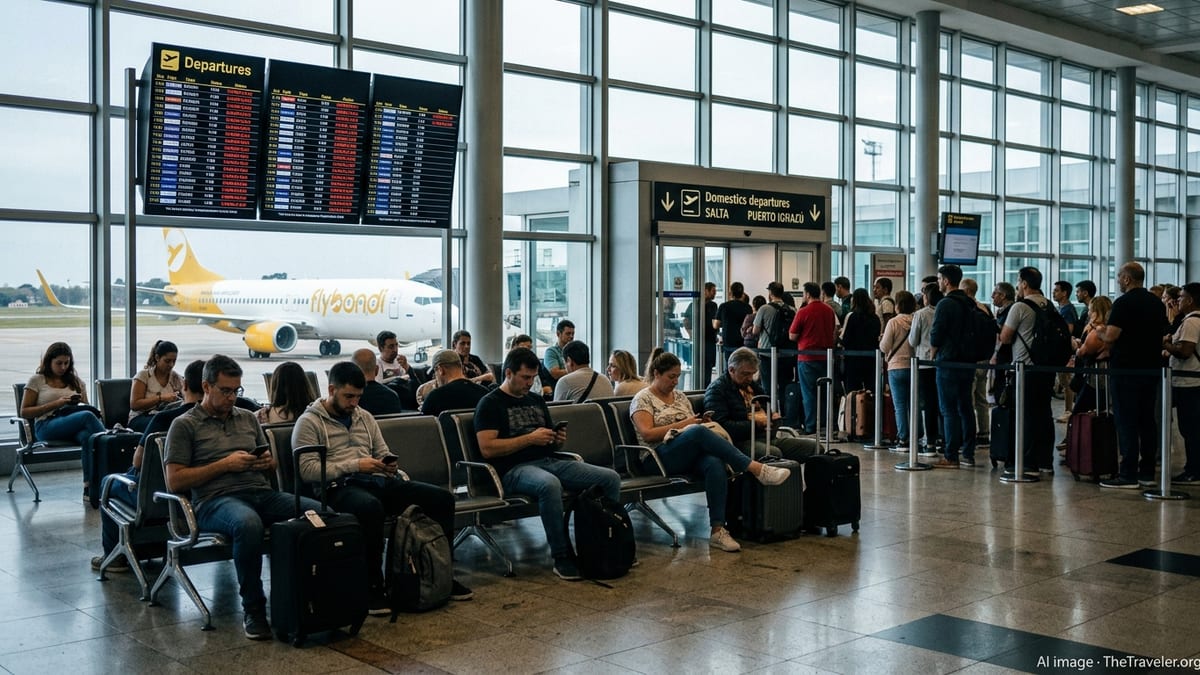
Argentina’s domestic air network has been hit by a fresh wave of disruption, with reports of widespread delays across several airlines and more than a dozen Flybondi flights canceled on key tourist routes linking Buenos Aires, Salta and Puerto Iguazú.
Get the latest news straight to your inbox!
Wave of Disruptions Hits Key Tourist Corridors
Publicly available flight-tracking data and local media coverage indicate that Argentina’s main domestic corridors have faced a sharp spike in operational disruption in recent days, affecting thousands of travelers moving through Buenos Aires and popular northern destinations such as Salta and Puerto Iguazú.
Reports point to a combination of chronic scheduling strains, aircraft availability issues and knock-on effects from earlier cancellations that have cascaded into today’s timetables. Passengers on multiple carriers have described extended waits at departure gates and last-minute schedule changes on Buenos Aires departures and arrivals.
Within this broader turbulence, low-cost carrier Flybondi has emerged as a focal point. According to press coverage and traveler accounts shared on public forums, the airline has canceled more than a dozen services on routes linking Buenos Aires with Salta and Puerto Iguazú, with some travelers learning of changes only shortly before departure.
The cancellations have disrupted itineraries at the height of Argentina’s late-summer travel period, when domestic tourism typically remains strong and demand for flights to the Iguazú Falls region and the northwest is particularly high.
Flybondi Under Renewed Scrutiny Over Reliability
Flybondi, founded in 2016 as one of Argentina’s first low-cost airlines, has faced periodic scrutiny over its operational reliability. Publicly available profiles of the carrier note a pattern of frequent cancellations and extended delays in recent years, alongside regulatory pressure to present plans to stabilize its schedule performance.
Travelers posting on widely used discussion platforms in March 2026 describe recent Flybondi experiences that include abrupt flight cancellations, lengthy disruptions on routes to and from Buenos Aires and difficulties obtaining timely rebooking or clear information. These first-hand reports echo earlier complaints from passengers who documented sudden schedule changes, long lines and challenges securing refunds after cancellations.
Past reporting on Argentina’s aviation sector shows that Flybondi has already faced official sanctions over service disruptions, including fines linked to alleged shortcomings in customer communication and adherence to consumer protection rules during earlier waves of cancellations. The current cluster of route cuts and delays is likely to feed into an ongoing public debate about the role of low-cost carriers in the domestic market.
For many travelers, Flybondi’s aggressive pricing remains attractive, particularly on tourist routes where full-service airlines can be significantly more expensive. The latest disruptions, however, appear to be prompting more visitors and residents to weigh potential savings against the risk of last-minute cancellations on time-sensitive itineraries.
Knock-on Effects at Buenos Aires, Salta and Puerto Iguazú Airports
The concentration of cancellations and delays along northern routes has produced visible pressure at key airports, especially in Buenos Aires, where domestic flights operate from the centrally located Aeroparque Jorge Newbery as well as the larger Ministro Pistarini International Airport. Reports from travelers suggest crowded check-in lines, backed-up security queues and gate areas filling with stranded passengers awaiting updates.
At Salta’s Martín Miguel de Güemes Airport and Puerto Iguazú’s international terminal, both important gateways for domestic and international tourism, disrupted schedules have complicated onward travel for visitors who often connect to tours, bus services and pre-booked excursions. Local tourism operators have posted public advisories urging visitors to build extra flexibility into their schedules in light of recent flight irregularities.
While other airlines in Argentina’s domestic market have also experienced weather-related and operational delays, the clustering of Flybondi cancellations on popular leisure routes has heightened uncertainty for travelers planning multi-stop itineraries. Travel forums in recent days feature multiple questions from visitors reassessing whether to book low-cost flights for connections to Patagonia and the northwest following their experiences in the north.
The strain on airport infrastructure is compounded by the geography of Argentina, where distances between major destinations such as Buenos Aires, Salta and Puerto Iguazú are substantial. With flying often the only practical option for short trips, cancellations can leave travelers facing either costly last-minute alternatives or significant changes to their plans.
Travelers Weigh Alternatives and Legal Protections
Published consumer guidance on Argentina’s aviation regulations outlines a framework of rights for passengers facing extended delays and cancellations. Under national rules, airlines operating domestic routes are expected to provide options such as rebooking on the next available service, a full refund or alternative ground transport in the event of significant schedule disruptions.
Recent passenger accounts, however, suggest that navigating these options in practice can be challenging. Some travelers have described turning to credit card chargebacks when they felt that refund processes stalled, while others report being rebooked on later flights after long waits at airport counters. The uneven experiences highlight gaps between formal protections and on-the-ground implementation.
As the latest disruptions unfold, a growing number of visitors are re-evaluating how they structure domestic trips. Travel planners and seasoned visitors contributing to open forums commonly recommend allowing at least a full buffer day between domestic flights and long-haul departures, particularly when using low-cost carriers. For time-critical connections, many advise favoring airlines with more extensive fleets and multiple daily frequencies on key routes.
In parallel, some travelers are turning to overnight buses and other long-distance ground options as a back-up, particularly on routes like Buenos Aires to Puerto Iguazú or Salta where road connections are frequent. While significantly slower than air travel, these alternatives can provide a measure of certainty when flight schedules appear unstable.
Tourism Sector Braces for Reputational Impact
The timing of the latest wave of delays and cancellations is of particular concern to Argentina’s tourism sector, which has been seeking to consolidate a post-pandemic recovery. High-profile destinations such as Iguazú Falls, Salta and Buenos Aires depend heavily on reliable domestic air links to sustain visitor flows from abroad and from within the country.
Travel industry observers note that recurring reports of disrupted flights risk undermining promotional efforts that highlight Argentina’s natural landscapes and urban culture. When travelers share negative experiences widely across social media and travel forums, perceptions of the destination’s accessibility can shift, even if hotel quality and on-the-ground experiences remain strong once visitors arrive.
Local coverage indicates that industry groups are closely watching how airlines adjust their operations in response to the current disruption. Any sustained pattern of cancellations on flagship tourist routes could encourage more tour operators to build additional slack into itineraries, potentially shortening stays in some locations to accommodate wider margins for travel delays.
For now, Argentina remains firmly on the radar of international travelers, but the latest turbulence in its skies serves as a reminder that air connectivity is a critical part of the visitor experience. How carriers like Flybondi and their competitors respond in the coming days will be closely monitored by both the tourism industry and would-be visitors planning trips for the Southern Hemisphere autumn and winter seasons.