

Flydubai is deepening its bet on Southeast Asia with the launch of double-daily flights between Dubai and Bangkok from 15 September 2026, a move that strengthens the carrier’s growing network to Thailand and Malaysia and promises smoother one-stop connectivity for travellers across the region.
Bangkok Joins Krabi as Flydubai’s Second Gateway to Thailand
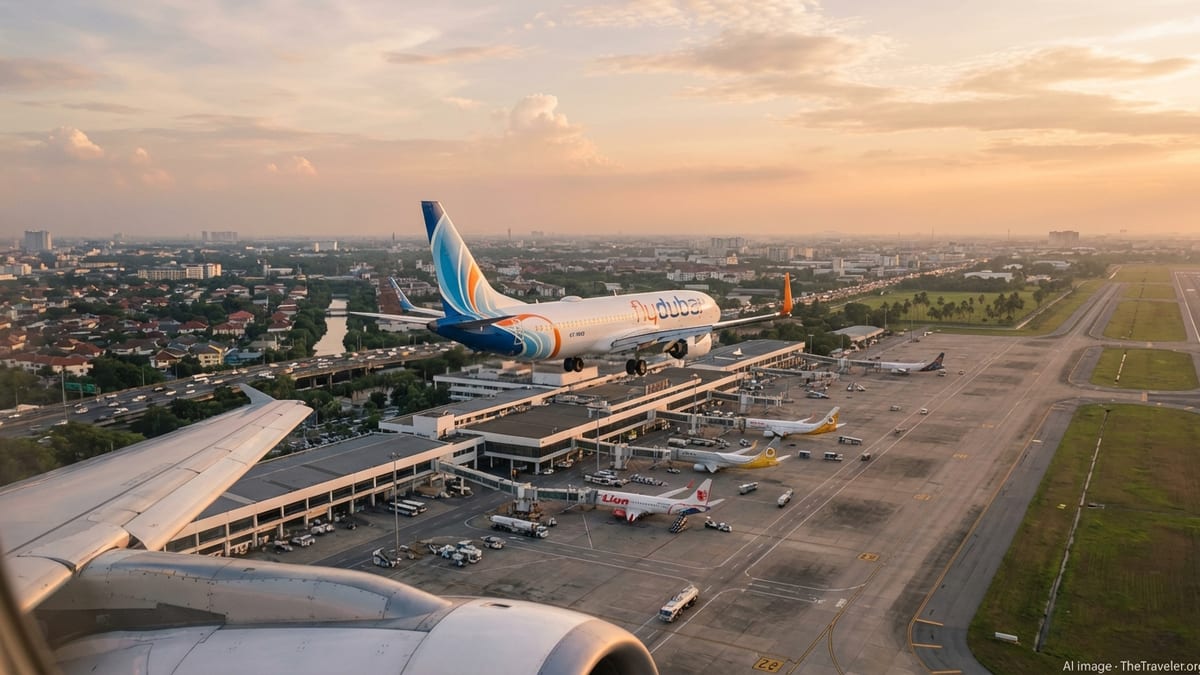
The new route will see flydubai operate two daily services from Dubai International’s Terminal 3 to Don Mueang International Airport, positioning Bangkok as a second Thai gateway alongside the airline’s existing flights to Krabi. The expansion will lift the carrier’s total operations to Thailand to 28 weekly departures, reflecting sustained demand from leisure and business travellers between the Gulf and the kingdom.
Bangkok’s addition comes as Thailand consolidates its role as a key market for Gulf low cost and hybrid carriers. For flydubai, the double-daily pattern is designed to offer flexible departure and arrival times, catering to passengers connecting onward into Southeast Asia, as well as those flying point to point between Dubai and the Thai capital. Industry observers say the move also signals renewed confidence in long haul leisure flows after several years of uneven demand.
The choice of Don Mueang, Bangkok’s older but increasingly busy international airport, aligns the airline with a major hub for regional operators and low cost carriers serving secondary Thai cities and neighbouring countries. That positioning is expected to appeal particularly to travellers using Bangkok as a springboard for multi-stop itineraries across mainland Southeast Asia.
Flydubai has highlighted Thailand’s enduring popularity among its customer base, pointing to strong bookings to Krabi and growing interest from Europe, the Gulf and Africa in combining Dubai stays with Thai beach and city holidays. The double-daily Bangkok launch is framed as a natural next step in a network that is steadily pivoting toward high-growth Asian markets.
Strategic Use of Dubai Terminal 3 and the Emirates Partnership
Operating from Terminal 3 at Dubai International allows flydubai to plug the new Bangkok flights directly into the broader Emirates network. The two airlines already maintain a close partnership with extensive codesharing, coordinated schedules and shared customer touchpoints, effectively creating a joint proposition for travellers moving between Europe, the Middle East, Africa and Asia via Dubai.
For passengers, the benefit will be the ability to book a single ticket that combines a long haul Emirates leg with a regional sector on flydubai, with coordinated baggage handling and minimum connection times. In practice, this means that travellers from cities such as London, Frankfurt or Riyadh will be able to connect in Dubai onto flydubai’s Bangkok, Krabi, Penang or Langkawi services with the same ease as transferring to another Emirates flight.
The use of Terminal 3 also underscores Dubai’s strategy of leveraging its main hub infrastructure to support both premium full service operations and value-driven point to point services. While flydubai has historically been associated with Terminal 2, the shift of selected routes into Terminal 3 is increasingly common on sectors where connectivity with Emirates is a primary driver of demand.
Analysts note that the Bangkok move fits a wider pattern in which Gulf carriers seek to deepen their presence on busy Southeast Asian city pairs, where competition from regional low cost airlines is intense but demand for one stop links to Europe and the Middle East remains robust. By blending Emirates’ long haul reach with flydubai’s narrowbody flexibility, Dubai is aiming to capture a larger share of that traffic.
Krabi, Langkawi and Penang Anchor a Beach-Focused Network
Bangkok is the latest, but not the first, pillar in flydubai’s Southeast Asia strategy. The carrier has already established itself in Krabi, a resort gateway on Thailand’s Andaman coast, offering direct access to popular islands and beach destinations that are difficult to reach in a single hop from Europe or the Gulf. Those flights have helped channel higher spending visitors into southern Thailand, supported by tourism partners keen to diversify beyond traditional source markets.
Further south, flydubai’s entry into Malaysia with services to Langkawi and Penang has created a twin-hub structure on the country’s northwest coast. The airline operates Boeing 737 MAX aircraft on a routing that links Dubai to Penang and onward to Langkawi, providing a daily connection that tourism authorities describe as a significant boost to international access. The flight pattern effectively connects two of Malaysia’s most iconic island and heritage destinations into the Dubai hub.
Langkawi, known for its beaches, rainforests and duty free shopping, has benefited from a growing influx of visitors from West Asia, Europe and Africa arriving on flydubai-operated services. Local tourism officials have credited the route with adding valuable seat capacity and raising Langkawi’s profile among travellers who may previously have focused on more established regional hotspots.
Penang, by contrast, offers a blend of UNESCO-listed heritage architecture, street food and creative industries, appealing to city break and cultural travellers who might spend shorter stays but at a higher daily spend. Together, Krabi, Langkawi and Penang give flydubai a distinctive presence in sun and sand markets that complement Dubai’s own positioning as a year round leisure hub.
Enhanced Connectivity Across Southeast Asia and Beyond
With the addition of double-daily Bangkok services to an existing portfolio in Krabi, Langkawi and Penang, flydubai is marketing a web of connections that reaches far beyond the immediate city pairs it serves. Travellers can now use Dubai as a connecting point not only to reach Thailand and Malaysia, but also to link those destinations with cities in Europe, the Caucasus, Central Asia and parts of Africa that remain underserved by direct Southeast Asia flights.
For example, passengers originating in markets such as Baku, Tbilisi, Sarajevo or secondary Russian cities can connect in Dubai onto flydubai’s Southeast Asian network, accessing Bangkok or Krabi without transiting through traditional mega hubs in East Asia. Similarly, travellers from Gulf Cooperation Council states can combine shorter Dubai stopovers with holidays split between Thai and Malaysian resorts, using the airline’s regional coverage to move efficiently between them.
Bangkok’s Don Mueang airport opens additional options. As a major base for regional low cost carriers serving destinations across Thailand, Laos, Cambodia, Vietnam and southern China, it allows flydubai passengers to self-connect onto short haul services deeper into mainland Southeast Asia. While these onward links are not part of a formal alliance, their sheer density amplifies the practical reach of the new Dubai Bangkok flights.
Tourism boards in both Thailand and Malaysia are watching this trend closely, seeing in it an opportunity to attract higher yielding multi destination trips rather than simple point to point holidays. Packages that combine Bangkok with Krabi, or Penang with Langkawi and a Dubai city break, are already being promoted by regional tour operators eager to capitalise on the enhanced connectivity.
Fleet, Onboard Product and Route Economics
Flydubai’s Southeast Asian services are operated primarily by Boeing 737 MAX aircraft, configured with both Economy and Business Class cabins. The type’s operating economics and range characteristics make it well suited to long narrowbody sectors from Dubai to destinations such as Bangkok, Krabi and the Malaysian islands, which typically fall into the six to seven hour flight time bracket.
From a cost perspective, the use of a single aircraft family across the network allows the airline to keep maintenance, training and scheduling efficiencies tight, an important consideration on routes where competition from low cost Asian carriers exerts downward pressure on fares. At the same time, the inclusion of a full flat or recliner Business Class product on many aircraft gives flydubai an edge among corporate travellers and higher yielding leisure passengers.
The double-daily Bangkok schedule is likely to improve aircraft utilisation, enabling the carrier to sweat its assets while offering departure times that align with banks of connecting flights at both ends of the route. Aviation consultants point out that such frequencies are also critical in attracting corporate travel contracts and high value tour series, which typically demand flexibility and back up options should one flight be disrupted.
In the cabin, flydubai’s offering is positioned as a hybrid between classic low cost and full service. Passengers can expect complimentary or buy on board catering depending on the fare type, modern inflight entertainment and Wi Fi on selected aircraft, and a service model that borrows elements from both segments of the market. This positioning has helped the airline bridge the gap between price sensitive travellers and those seeking extra comfort without the price tag of a traditional full service airline.
Competitive Landscape in the Thailand and Malaysia Corridors
Flydubai’s expansion in Southeast Asia comes against a backdrop of intensifying competition on routes linking the Gulf with Thailand and Malaysia. Airlines such as Emirates, Qatar Airways and Etihad already offer extensive networks into Bangkok, Phuket and Kuala Lumpur, while carriers including Air Arabia and IndiGo have been increasing their own capacities into Thai destinations from the Gulf and India respectively.
In Thailand, a growing number of services now operate into both Bangkok airports, Suvarnabhumi and Don Mueang, as airlines experiment with dual airport strategies that mirror the city’s domestic and regional traffic flows. Flydubai’s selection of Don Mueang is widely seen as an attempt to tap into the same low cost and secondary city demand that regional carriers have cultivated, differentiating its product from the predominantly long haul, widebody operations into Suvarnabhumi.
In Malaysia, competition is more concentrated on Kuala Lumpur, leaving airports such as Penang and Langkawi relatively underserved by intercontinental carriers. Flydubai’s decision to operate directly into these smaller gateways, rather than funnelling all traffic through the capital, has been welcomed by local authorities as a chance to diversify inbound tourism and reduce congestion at the country’s main hub.
While this competitive environment can put pressure on yields, it also suggests confidence in the underlying demand. Forward booking trends reported by regional tourism organisations show sustained appetite for travel between the Middle East and Southeast Asia, particularly among younger, experience-driven travellers and families willing to travel outside traditional peak periods.
Implications for Regional Tourism and Trade
The reinforced Dubai Thailand Malaysia air bridge is expected to deliver wider economic benefits beyond the aviation sector. Tourism bodies in Krabi, Langkawi and Penang have highlighted the role of direct flights in extending visitor stays, boosting hotel occupancy and supporting local businesses ranging from restaurants to activity providers and transport operators.
Bangkok’s double-daily connection is likely to amplify these effects at scale, given the city’s status as both a destination and a key node in Southeast Asia’s transport and commercial networks. Increased seat capacity between Dubai and the Thai capital is anticipated to support meetings, incentives, conferences and exhibitions, as well as student mobility and medical tourism flows, all of which rely heavily on reliable air links.
On the trade side, the new frequencies provide additional belly hold cargo capacity for high value, time sensitive goods moving between the Gulf and Southeast Asia, including electronics, perishables and fashion items. For small and medium sized enterprises, easier access to direct flights can reduce shipping times and complexity, making participation in cross border supply chains more viable.
Dubai itself stands to gain from inbound traffic originating in Southeast Asia and using the emirate as either a final destination or a short stopover. Authorities there have been promoting multi night transit packages that encourage passengers to break their journey, spending on hotels, retail and attractions before continuing onwards to Europe, Africa or the Americas.
Positioning Flydubai as a Mid-Market Connector
As flydubai prepares to launch its double-daily Bangkok operation while ramping up services to Krabi, Langkawi and Penang, a clearer picture is emerging of the airline’s role within Dubai’s broader aviation ecosystem. Rather than competing directly with long haul widebody operators, the carrier is carving out a niche as a mid market connector, using fuel efficient narrowbody aircraft to stitch together city pairs that might not justify larger aircraft but collectively represent substantial demand.
This approach aligns with a wider industry trend in which network airlines are increasingly relying on smaller jets to open new routes and increase frequencies, particularly in regions where traffic is growing but volatile. For Southeast Asia, the result is a dense mesh of services that link secondary and tertiary destinations more closely with global hubs, offering travellers more choice and often shorter overall journey times.
For travellers, the practical outcome of flydubai’s Southeast Asia focus is a richer menu of itinerary options. Whether planning a beach holiday in Krabi, a heritage and food tour in Penang, an island retreat in Langkawi or a city and shopping break in Bangkok, passengers from across the Middle East, Europe and parts of Africa will increasingly be able to access these experiences via a single connection in Dubai.
As the airline readies for the September 2026 start of its double-daily Bangkok service, industry stakeholders will be watching load factors and booking patterns closely. Yet if performance on Krabi, Langkawi and Penang is any indication, flydubai’s latest bet on Southeast Asia looks well timed to capture a new wave of regional and long haul demand.