

More news on this day
Dozens of Flydubai flights have been cancelled or heavily delayed in recent days, stranding passengers across the United Arab Emirates, Romania, Turkey and other destinations as regional airspace restrictions and security concerns continue to upend travel plans.
Get the latest news straight to your inbox!
Regional Tensions Trigger Fresh Wave of Disruptions
Publicly available flight data and news coverage show that Flydubai’s network has been hit hard since late February 2026, when strikes on the United Arab Emirates prompted temporary closures and capacity cuts at Dubai International Airport. Although limited operations have resumed, the carrier continues to operate on a reduced schedule, with numerous short-haul and medium-haul services cancelled at short notice.
Reports indicate that airspace restrictions over parts of the Gulf and neighboring countries are forcing airlines to reroute or suspend services altogether. This has created a ripple effect across Flydubai’s point-to-point network, which links Dubai with secondary cities in Eastern Europe, the Caucasus and Turkey. Flights that would usually operate multiple times per day are instead running at sharply reduced frequencies, if at all.
Travel advisories and industry updates describe a patchwork of operating corridors and last-minute operational decisions driven by safety and regulatory considerations. For travelers, this has translated into uncertainty around departure times, rolling delays and abrupt cancellations that can change within hours.
Dubai Hub Under Strain as Passengers Queue and Rebook
Dubai International Airport, Flydubai’s main hub, remains at the center of the disruption. While the airport has partially reopened and some carriers have restored a portion of their schedules, Flydubai is still operating “limited flights” on many routes, and passengers are being urged in public notices to check flight status before leaving for the airport.
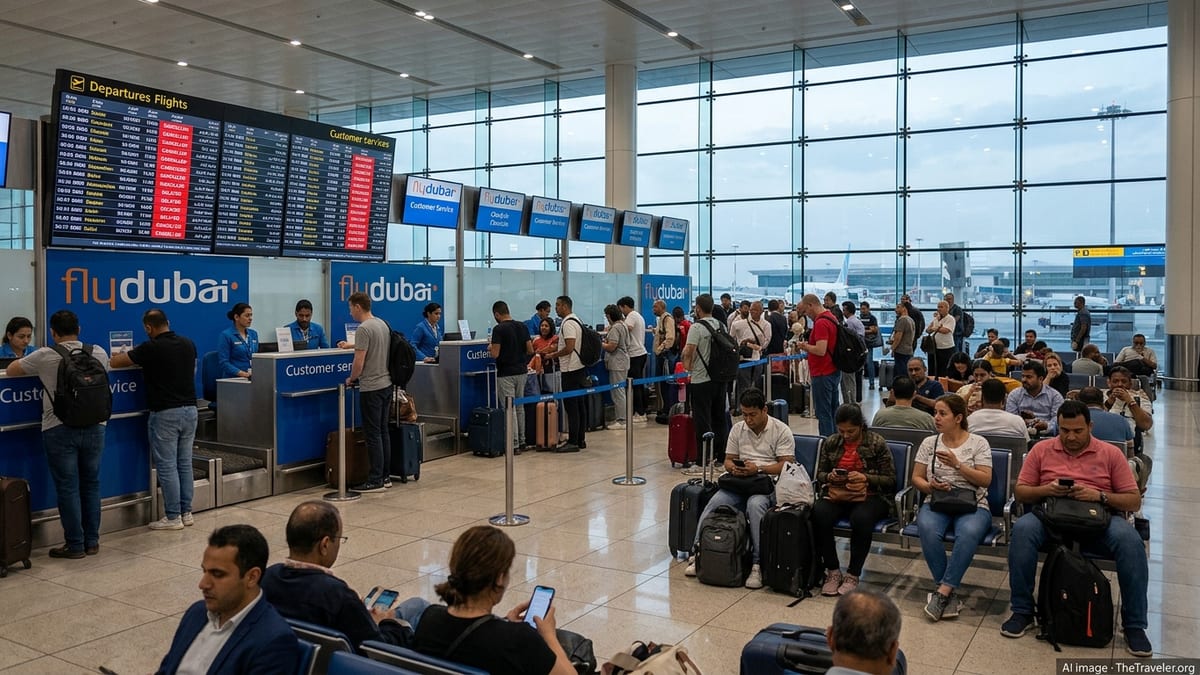
Travelers have described long queues at customer service desks, crowded departure halls and difficulty securing updated information as schedules shift throughout the day. With airport access in Dubai at times restricted to passengers with confirmed, operating flights, many travelers have been turned back or advised to remain at their accommodation until they receive direct confirmation from their airline.
Available guidance from travel companies and aviation forums consistently warns passengers not to go to the airport without a rebooked or reissued ticket. Instead, travelers are being told to use online booking management tools, airline call centers and travel agents to confirm revised itineraries or seek refunds.
Knock-On Effects in Bucharest, Istanbul and Beyond
The impact of Flydubai’s reduced operations is being felt far beyond the UAE. Routes linking Dubai with Bucharest and airports in Turkey have seen repeated cancellations and schedule changes, leaving passengers stranded on both sides of the network. Travelers with onward connections to other European or Middle Eastern destinations are among the hardest hit, as missed links cascade into multi-day delays.
In Romania, local media coverage and social media posts highlight travelers stuck in Bucharest after departures to Dubai were removed from departure boards, sometimes after multiple schedule revisions. Similar patterns are reported at Turkish airports, where Flydubai services that normally funnel leisure and business traffic through Dubai have been pulled back.
The disruption is not limited to point-to-point passengers. Many travelers had booked itineraries that combined Flydubai legs with other carriers, using Dubai as a connecting hub. With Flydubai segments now cancelled or operating sporadically, entire journeys between Europe, the Gulf and Asia have been thrown into doubt, forcing holidaymakers and expatriate workers to search for scarce alternative seats.
Refunds, Vouchers and Confusion Over Passenger Rights
As cancellations have mounted, questions over refunds and rebooking options have intensified. According to discussions on consumer and expatriate forums, some Flydubai customers report receiving travel vouchers in place of cash refunds when their flights were cancelled, even when they do not expect to use the airline again in the near term.
Several passengers have described challenges reaching customer support channels due to high call volumes and backlogs. Others note that they have been able to submit refund requests through online forms linked in cancellation emails, but are still awaiting confirmation or processing. The inconsistent experiences are adding to frustration for travelers already grappling with unexpected accommodation, meal and alternative transport costs.
Travel experts and passenger-rights advocates quoted in broader media coverage of the Middle East disruption emphasize the importance of understanding the rules that apply to each ticket. Protections can differ substantially depending on the departure and arrival countries, whether the journey falls under specific regional regulations, and whether the booking was made directly with the airline or via an intermediary.
What Travelers Should Expect in the Coming Days
With regional airspace still subject to evolving restrictions as of late March 2026, industry observers warn that Flydubai’s schedule is likely to remain volatile in the short term. Airlines across the Gulf are gradually rebuilding their networks, but publicly available updates suggest that full restoration of pre-crisis timetables will take time.
Passengers booked on upcoming Flydubai services between Dubai, Bucharest, Turkish cities and other regional destinations are being advised in published guidance to assume that plans may change up to the last minute. Monitoring flight status tools frequently, ensuring contact details are updated in the booking, and having contingency plans for accommodation and onward travel are being widely recommended.
For those already stranded, the immediate priority is securing confirmed seats on any operating flight, whether with Flydubai or another carrier. Travel agencies and airline desks at major hubs such as Dubai International are working through backlogs of disrupted itineraries, but capacity constraints and uneven route resumptions mean that some passengers may face several more days of uncertainty.
As the situation develops, the Flydubai disruptions have become a focal point in a wider regional travel crisis. For now, travelers across the UAE, Romania, Turkey and beyond are left balancing urgent personal and professional commitments against a rapidly shifting aviation landscape.