

More news on this day
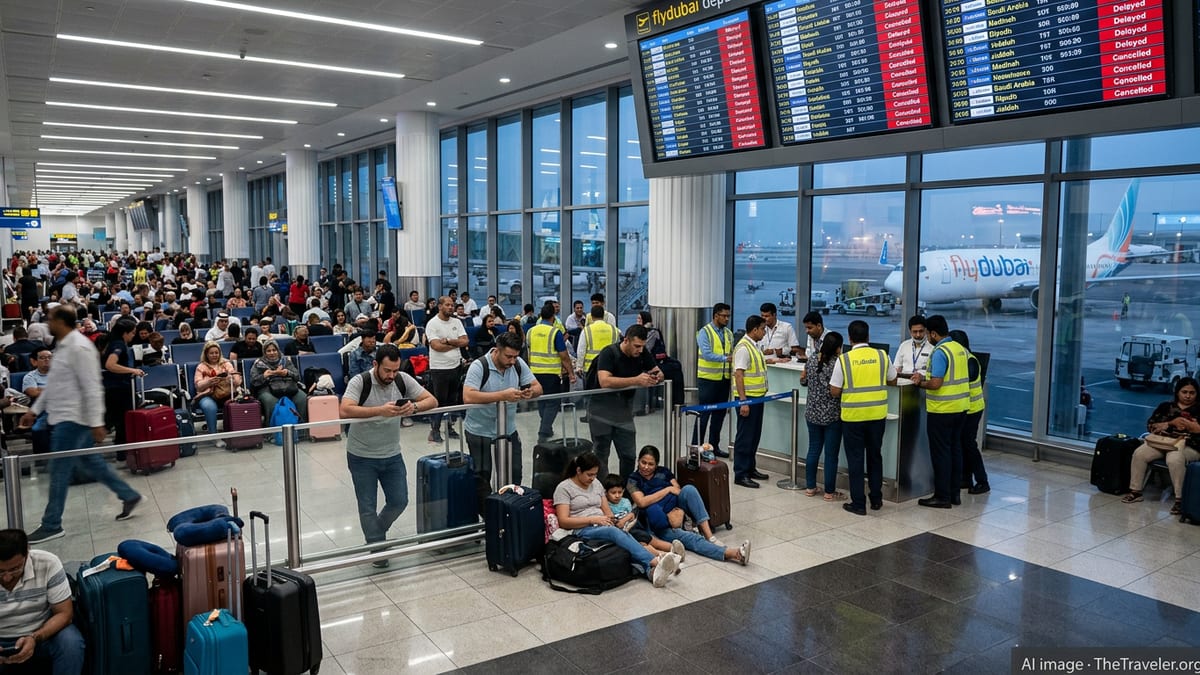
Hundreds of travelers across Saudi Arabia and the United Arab Emirates are facing severe disruption after FlyDubai cancelled seven flights and delayed 66 more, leaving passengers stranded at airports in Madinah, Dubai and other key transit hubs amid an ongoing regional airspace crisis.
Regional Airspace Crisis Hits Gulf Carriers
The latest wave of disruption follows days of turbulence for Gulf aviation after regional hostilities forced temporary closures and tight controls across key Middle East air corridors. Authorities in the UAE and Saudi Arabia have been coordinating closely with airlines as traffic resumes only gradually and under strict capacity limits.
FlyDubai, Dubai’s low-cost carrier, has been operating a reduced schedule since a near-total shutdown of services earlier in the month. While operations have partially resumed, the airline’s latest update confirmed a fresh cluster of cancellations and extensive delays, particularly on routes linking Dubai with Saudi cities including Madinah.
Other major Gulf carriers, including Emirates, Etihad Airways and Air Arabia, are also running curtailed timetables, prioritising passengers with existing bookings and confirmed onward connections. Industry analysts say the region remains in a phase of “managed disruption,” with schedules changing hour by hour as airspace restrictions evolve.
Airports in Dubai, Abu Dhabi and across Saudi Arabia are working under defined operating windows, with movements capped to maintain safety within newly established safe corridors. This has left airlines juggling crews, aircraft and slots, often at short notice, with low-cost carriers such as FlyDubai particularly exposed to cascading delays.
Chaos on the Ground in Madinah and Dubai
At Prince Mohammad bin Abdulaziz International Airport in Madinah, passengers reported being held in terminal areas for hours as departure boards cycled through rolling delay announcements. For many, the eventual confirmation that flights had been cancelled or significantly rescheduled came only after extended waiting times and limited access to clear information.
In Dubai, one of the world’s busiest international hubs, the knock-on effects have been equally acute. Travelers connecting through Dubai International Airport with FlyDubai reported missed onward links, overnight holds and long queues at service desks as staff worked through a backlog of disrupted itineraries.
Passengers say the combination of short-notice operational changes and packed terminals has amplified frustration. Some described learning of cancellations only through airport screens rather than direct messages, while others struggled to secure hotel vouchers or meal support as ground teams faced overwhelming demand.
Dubai Airports has repeatedly urged travelers not to proceed to the airport unless they hold a confirmed, operating booking, warning that walk-in passengers and those on speculative standby are likely to face lengthy waits with limited prospects of same-day departure.
FlyDubai Response and Passenger Options
FlyDubai has advised affected customers to monitor their booking status through official channels and to avoid heading to airports until they receive confirmation that their specific flight will operate. The carrier is prioritising rebooking for passengers whose journeys were previously cancelled when operations were fully suspended, before moving on to newly affected travelers.
The airline is also encouraging passengers to update their contact details so that schedule changes and disruption alerts can be delivered promptly by text message or email. However, high call volumes and heavy traffic on digital platforms have led to delays in customer support responses, further testing the patience of stranded travelers.
Travel advisors note that under prevailing regulations, passengers whose flights are cancelled by the airline are generally entitled to either a full refund, a free rebooking on the next available service or, in some cases, a travel voucher. In practice, the scale of the disruption and the limited number of operating flights mean that “next available” options can be several days away, especially on popular Gulf–Asia and Gulf–Europe routes.
Insurance specialists are urging customers to review their policies for coverage related to conflict-linked disruptions, warning that not all plans treat airspace closures and regional security incidents in the same way. Travelers are being told to retain boarding passes, booking confirmations and any written communications from the airline to support potential claims.
Saudi and UAE Authorities Manage Staggered Recovery
Authorities in both Saudi Arabia and the UAE have framed the current phase as a controlled recovery, rather than a return to normal operations. Civil aviation regulators have authorised only partial use of regional airspace, with traffic flowing through designated safe corridors that limit the number of hourly take-offs and landings.
In the UAE, the General Civil Aviation Authority has highlighted safety as the overriding priority as it works with airports and airlines on phased increases in capacity. Limited services by Emirates, Etihad and FlyDubai have been ramped up cautiously, with priority given to repatriation flights and passengers who were stranded when airspace was first closed.
Saudi aviation officials have taken a similar approach, particularly at religious gateways such as Madinah, where large numbers of pilgrims and family travelers transit at any given time. Capacity constraints have forced airlines to focus on core regional routes, leaving some secondary destinations temporarily without direct services.
Industry observers say that while the Gulf’s hub-and-spoke model is well suited to rapid scaling in normal times, it also means that outages in shared corridors can quickly ripple across multiple countries. The present disruptions have underlined the reliance of Saudi and UAE airports on a small number of busy airways linking the Gulf to Europe and Asia.
Outlook for Travelers in the Coming Days
Aviation analysts expect further irregularities in the short term, even if the overall trend is toward gradual normalisation. FlyDubai’s latest cancellations and delays are viewed as a symptom of constrained airspace and tight fleet utilisation, rather than isolated operational failings.
Passengers with imminent travel plans through Dubai, Abu Dhabi or Saudi gateways such as Madinah and Jeddah are being urged to treat any itinerary as provisional until it has been reconfirmed within 24 hours of departure. Travelers relying on tight connections are particularly vulnerable, with many airlines declining to accept transit customers unless every leg of their journey is already confirmed operating.
Tourism boards in both the UAE and Saudi Arabia are working with carriers and hotels to reduce the longer-term impact on visitor confidence, stressing that the current turmoil reflects exceptional regional circumstances rather than structural weaknesses in Gulf aviation. Still, the scenes of crowded terminals and stranded passengers over recent days are likely to linger in the minds of many would-be visitors.
For now, the message from officials and airlines is one of cautious patience. With FlyDubai’s network still constrained and further schedule adjustments likely, travelers are being advised to stay flexible, keep communication channels open and prepare for the possibility of extended waits before reaching their destinations.