

More news on this day
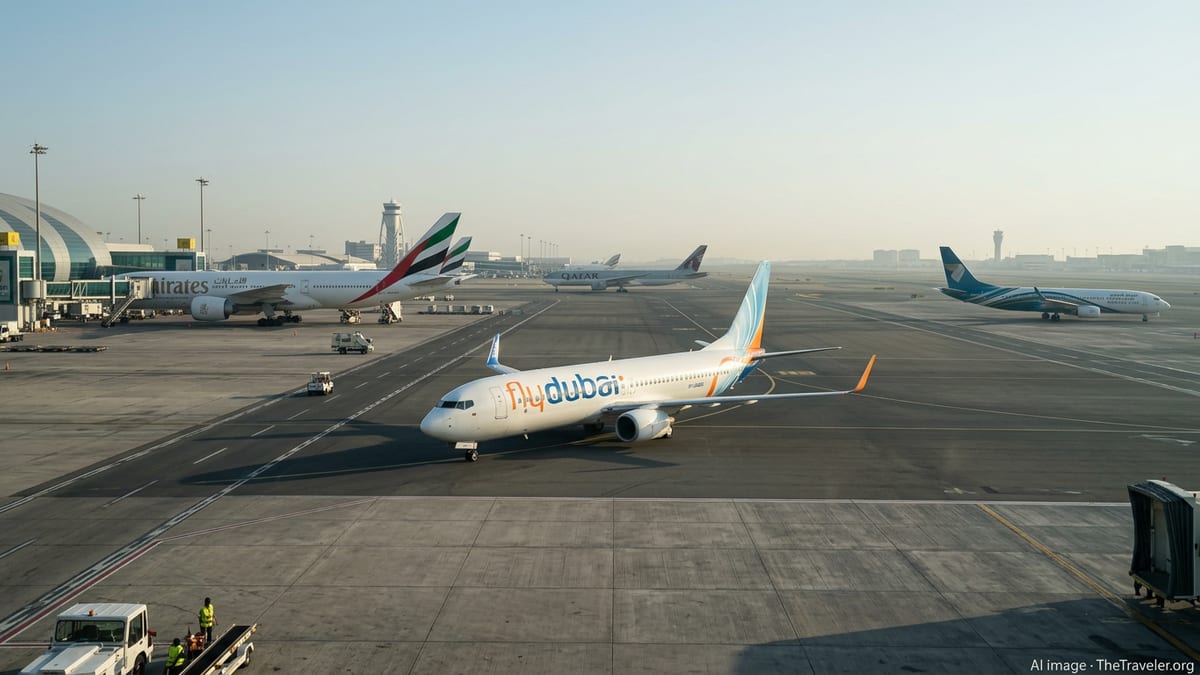
Middle Eastern aviation is undergoing a structural shift as Flydubai accelerates its network growth and deepens integration with Emirates, joining regional heavyweights such as Qatar Airways and Oman Air in offering travellers a web of new connections and increasingly competitive fares across the Gulf, Europe, Asia and Africa.
Get the latest news straight to your inbox!
A Hybrid Low-Cost Model at the Heart of Dubai’s Hub Strategy
Flydubai has emerged as one of the region’s most influential low-cost carriers, blurring the line between budget and full-service operations. While officially positioned as a low-cost airline, it operates in close coordination with Emirates, funnelling passengers through Dubai and handling a growing share of connecting traffic as the emirate seeks to cement its role as a mega-hub.
Industry analysis shows that Flydubai now carries a significantly higher proportion of transfer passengers than it did just a few years ago, with connecting traffic rising from under one-third of its customers in 2019 to well over two-fifths by 2024. This shift illustrates how the airline has become a vital feeder for long-haul services while still maintaining its appeal to price-sensitive travellers looking for point-to-point routes within the wider region.
The carrier has also invested in hard product and reliability to differentiate itself in an increasingly crowded market. Its fleet of Boeing 737 aircraft features a mix of high-density economy cabins and lie-flat business class seats on select routes, allowing it to serve everything from short Gulf hops to longer sectors into Central and Eastern Europe, the Indian subcontinent and East Africa without abandoning its cost-focused DNA.
This hybrid approach is central to Dubai’s broader aviation strategy. By combining Emirates’ widebody long-haul strength with Flydubai’s nimble narrowbody network, the city can open thinner routes that would not justify a large aircraft, while still feeding premium cabins and loyalty programmes at the top of the market.
Unmatched Connectivity: New Routes and Codeshare Synergies
Connectivity is where Flydubai’s recent expansion is most evident. Across the Middle East, low-cost and hybrid carriers now account for close to one-third of seat capacity, more than double their share a decade ago, as they push deeper into secondary cities and underserved markets. Analysts estimate that low-cost operators represented roughly 29 percent of regional capacity by mid-decade, highlighting just how quickly travel options have multiplied for consumers.
Flydubai’s ongoing growth is being driven by a sustained order book for next-generation narrowbodies and a steady stream of new destinations. The airline has been particularly active in opening routes into Central and Eastern Europe, Central Asia and North Africa, often becoming the first UAE carrier to serve mid-sized cities that previously required multiple connections. These additions effectively extend Dubai’s reach into communities that would struggle to support a daily widebody service.
The strategic codeshare and schedule coordination with Emirates magnify this effect. Passengers booking through either carrier can often combine a Flydubai-operated regional leg with a long-haul Emirates flight on a single itinerary, with through check-in and aligned connection times at Dubai International. For many travellers, this creates a seamless experience that feels closer to a traditional network carrier, but with the pricing flexibility traditionally associated with budget airlines.
Beyond the UAE, similar connectivity plays are unfolding across the Gulf. In Saudi Arabia, flynas and flyadeal are pursuing aggressive expansion tied to tourism and pilgrimage demand, while in Abu Dhabi, Air Arabia Abu Dhabi has been carving out a role as a low-cost counterpart to Etihad. Together with Flydubai, these carriers are building an intricate web of point-to-point and connecting options that would have been unthinkable in the region just a decade ago.
Qatar Airways, Emirates and Oman Air Raise the Bar on Network Depth
While Flydubai is reshaping the budget and hybrid end of the market, full-service giants such as Qatar Airways and Emirates remain central to the region’s connectivity story. Both carriers have restored large portions of their global networks and continue to refresh capacity on high-demand trunk routes between Europe, Asia, the Americas and Africa, underpinning the long-haul side of the Gulf’s hub model.
Qatar Airways is emphasizing breadth and schedule density across more than 170 destinations, coupled with periodic global fare promotions and tactical price cuts to stimulate demand in key markets. At the same time, it is refining its Hamad International Airport hub as a high-end transit point, betting that passengers will continue to pay a modest premium for smoother connections and strong onboard service, even as low-cost competition intensifies.
Emirates, for its part, has doubled down on its role as a super-connector. The airline is in the midst of a major retrofit and product upgrade programme, adding premium economy cabins and refreshing first and business class across hundreds of aircraft. These enhancements are designed to keep Dubai attractive as a transfer point even as rivals in Turkey, Saudi Arabia and Europe invest heavily in their own hub strategies.
Oman Air has taken a different route to boosting connectivity, joining the oneworld alliance in 2025 and plugging its Muscat hub into a global network of partner airlines. The move instantly expanded the reach of the Omani carrier’s loyalty programme and allowed passengers to combine Oman Air flights with those of oneworld members on a single ticket, with reciprocal benefits and lounge access. For travellers, it is another example of how Middle Eastern airlines are using partnerships to provide more options without necessarily adding large volumes of new capacity overnight.
Affordability and Choice in a Tighter Operating Environment
The surge in connectivity is unfolding against a more challenging operational backdrop. In early 2026, several Middle Eastern airlines, including Flydubai, Emirates and Qatar Airways, have been operating reduced or disrupted schedules due to regional airspace restrictions and rerouting requirements. These constraints have added flying time and fuel burn on some routes, complicating efforts to keep costs down even as competition on fares remains fierce.
Despite these headwinds, the underlying pricing trend is still favourable for many travellers. The rapid growth of low-cost and hybrid carriers has created intense pressure on average fares for short and medium-haul flights, particularly within the Gulf, to South Asia and into parts of Eastern Europe and North Africa. Analysts say the rise of budget operators has encouraged consumers to mix and match carriers and cabin classes, trading down on short legs in order to spend more on comfort or flexibility for long-haul segments.
Flydubai exemplifies this new calculus. Travellers can often secure relatively low base fares on the airline’s regional services, then add paid extras such as seat selection, checked baggage or onboard Wi-Fi according to their budget. When combined with a long-haul connection on Emirates or another network carrier, the total journey cost can be significantly lower than a legacy full-service itinerary booked end-to-end in one cabin.
At the same time, full-service airlines are using targeted discounts, dynamic pricing and loyalty promotions to remain competitive without fully embracing the low-cost model. Qatar Airways and Emirates periodically roll out limited-time global sales, while Oman Air and other regional players leverage partnerships and alliances to offer value through mileage earning, redemptions and status perks rather than headline-low ticket prices.
What This Means for Travellers Planning 2026 and Beyond
For passengers plotting trips through or within the Middle East in 2026, the landscape looks simultaneously richer in choice and more complex to navigate. On the positive side, there are more non-stop routes than ever before connecting mid-sized cities in Europe, Central Asia, the Indian subcontinent and Africa directly to Gulf hubs. The combination of Flydubai’s expanding network with those of Emirates, Qatar Airways and Oman Air offers a dense array of one-stop options between continents that previously required two or even three connections.
However, the current airspace and operational constraints mean that schedules are more fluid than in previous years. Travellers are being advised by agents and airlines alike to build in longer connection buffers, pay close attention to schedule changes in the weeks before departure, and consider the benefits of booking on a single ticket through partnerships and codeshares to protect their itineraries in the event of disruption.
For budget-conscious flyers, the sweet spot often lies in using low-cost or hybrid carriers such as Flydubai for shorter segments, then leveraging the reach and reliability of network airlines for long-haul legs. The increasing interdependence between these models in the Middle East means that passengers no longer have to choose strictly between “cheap but basic” and “expensive but convenient.” Instead, they can assemble journeys that balance price, comfort and risk according to their own priorities.
As the region’s aviation sector continues to evolve, one thing is clear: Flydubai’s rise alongside giants like Qatar Airways, Emirates and Oman Air has fundamentally changed what is possible for travellers using Gulf hubs. The combination of expanded connectivity, sharper pricing and deeper alliances is redefining how people move across the Middle East and beyond, even in an era of heightened geopolitical and operational uncertainty.