

More news on this day
Flydubai has joined fellow Middle Eastern carriers Emirates, Etihad Airways and Qatar Airways in cautiously resuming a limited number of flights, as large swathes of regional airspace remain restricted amid an escalating conflict that has upended travel across the Gulf and wider Middle East.
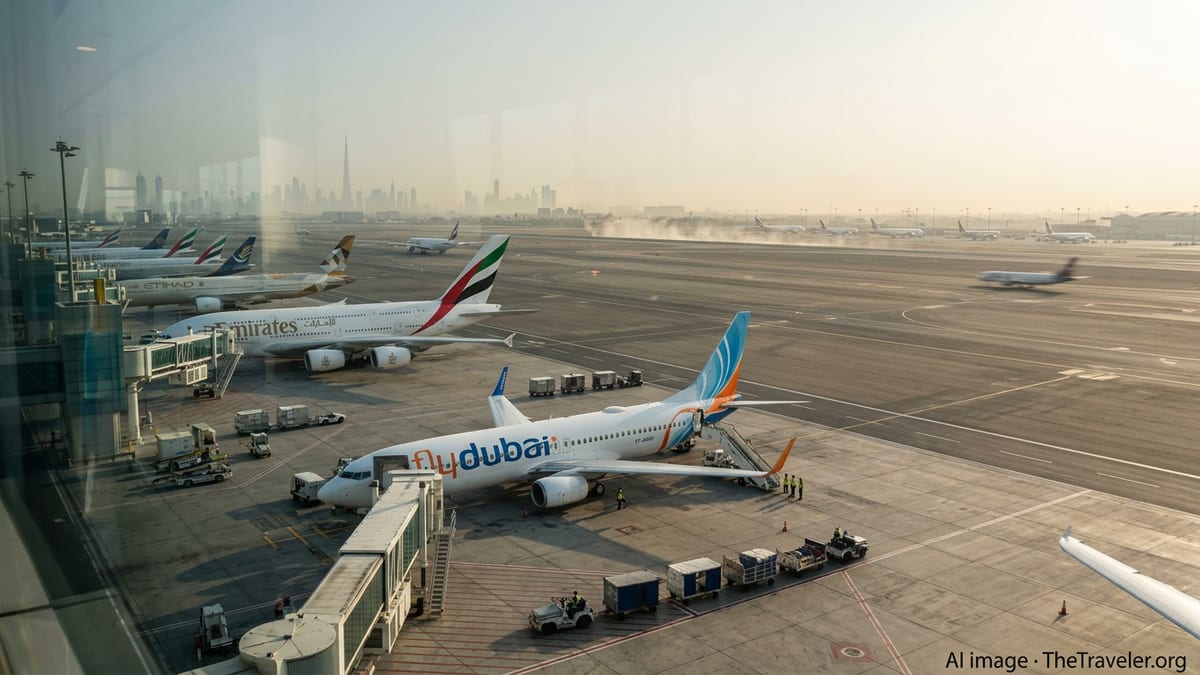
Patchwork Reopening After Widespread Groundings
The resumption of select services by Flydubai and other Gulf airlines comes after several days in which much of the region’s skies were effectively off limits to civilian aviation. Closures followed a sharp escalation in hostilities involving Iran, Israel and U.S. forces, prompting authorities across multiple states to shut or heavily restrict their airspace for security reasons.
Dubai-based Emirates and Flydubai, along with Abu Dhabi’s Etihad Airways and Doha’s Qatar Airways, initially halted almost all passenger operations as strikes and retaliatory attacks rippled across the region. Thousands of flights were cancelled or diverted, stranding passengers at major hubs including Dubai International, Abu Dhabi International and Doha Hamad International, as well as at outstations in Europe, Asia and Africa.
In recent days, government-approved corridors have begun to reopen on a limited basis, allowing carriers to move some aircraft and crew back into position and to operate tightly controlled services on specific routes. However, these partial reopenings are far from a return to normal. Airlines are stressing that schedules remain highly fluid and that new restrictions or tactical airspace closures are possible at short notice as the security situation evolves.
For now, the result is a patchwork of operations in which a small number of flights depart from Gulf hubs each day, while many more remain grounded. Industry analysts say the pattern reflects a balance between mounting pressure to move stranded travelers and a determination by civil aviation authorities to avoid putting aircraft at risk.
Flydubai’s Limited Network and Operational Priorities
Flydubai, which operates an all narrowbody fleet focused largely on short and medium haul routes, has framed its restart as a cautious, safety-led move that prioritizes essential travel. The airline is operating only a fraction of its normal schedule, with early services focused on key regional gateways and cities with high numbers of stranded passengers.
Operationally, Flydubai is coordinating closely with the United Arab Emirates’ General Civil Aviation Authority and with air navigation providers across the Middle East to secure safe routing that avoids active conflict zones. In many cases, this means significant detours, increased flight times and more complex crew planning, all of which further constrain the number of flights that can be mounted on any given day.
Industry sources say the carrier has also been deploying repositioning flights to recover aircraft and crews that were left out of place when the initial wave of airspace closures forced diversions and unscheduled stopovers. These non-scheduled sectors, combined with priority repatriation and essential commercial services, are likely to dominate Flydubai’s operations in the near term.
For regular passengers, that translates into heavily restricted availability, with many previously sold flights still cancelled and new bookings subject to last-minute changes. Customers are being urged to check flight status repeatedly before leaving for the airport and to expect long wait times for call centers and airport customer service desks.
Emirates, Etihad and Qatar Airways Balance Repatriation and Safety
Full-service Gulf giants Emirates, Etihad Airways and Qatar Airways are following similar playbooks as they tentatively reintroduce flights under tight operational constraints. Each carrier has highlighted repatriation and essential connectivity as primary goals, while stressing that no service will operate without explicit regulatory clearance and favorable security assessments along the entire route.
From Abu Dhabi, Etihad has begun operating a limited roster of services to major European and Asian cities, including London, Paris, Amsterdam and several key South Asian destinations. These flights are often heavily oversubscribed as travelers who were stranded during the shutdown try to secure seats home, and some governments work with airlines to prioritize vulnerable citizens or organized evacuation groups.
Emirates, whose global network and large widebody fleet make it one of the world’s most important long haul carriers, is likewise restarting a small number of departures from Dubai. The airline is focusing on trunk routes where alternate routing can be arranged without overflying closed or high-risk airspace. Schedules remain skeletal compared with normal operations, and many of the carrier’s flagship long haul services to Europe and the Americas continue to face disruption, with rerouting adding hours to some journeys.
Qatar Airways faces an even more complicated picture, as Qatari airspace has been among those most restricted during the crisis. The airline has intermittently operated select services using tightly controlled corridors and cooperation with neighboring states, but its overall schedule remains severely curtailed. Aviation observers say Qatar’s role as a global connecting hub has been particularly hard hit, with knock-on effects for passengers transiting between Europe, Africa and Asia.
Regional Airspace Still Heavily Restricted
Despite headline-grabbing reports of flights finally departing major Gulf airports, the underlying airspace picture across the Middle East remains highly constrained. Authorities in countries including Iran, Iraq, Israel, Qatar, Bahrain and Kuwait have maintained full or near-full closures, while others such as the United Arab Emirates and Saudi Arabia are operating under partial or time-limited restrictions.
These closures not only affect point-to-point services into the region but also many of the world’s key long haul corridors. Routes linking Europe and Asia, for example, often rely on airways that pass over or near the Gulf and surrounding states. With those paths blocked or narrowed, airlines are being forced to adopt longer trajectories over the eastern Mediterranean, the Caucasus or the Arabian Sea, adding significant flight time and fuel costs.
Cargo operations, a lifeline for supply chains that run through Gulf hubs, have also been disrupted. While some dedicated freighter flights are resuming in tandem with passenger services, restricted routings, congested corridors and complex overflight permissions continue to limit capacity. Logistics specialists warn that shippers should brace for elevated rates, delays and sudden changes of schedule as airlines juggle scarce slots and dynamic risk assessments.
Aviation authorities across the region are monitoring the security situation on a near-continuous basis and have signaled that further adjustments are likely in the coming days. Industry insiders caution that any renewed escalation in the conflict, or incidents involving civilian aircraft, could prompt a rapid tightening of restrictions once again.
Global Ripple Effects and Advice for Travelers
The disruption in Middle Eastern airspace is cascading well beyond the region itself, as airlines on multiple continents alter schedules, suspend routes or implement significant detours to avoid conflict zones. European and Asian carriers that had relied on overflight rights through Iran and neighboring countries are among those most affected, adding hours to some long haul services and straining crew duty limitations and aircraft availability.
For travelers, the picture remains volatile. Even where Flydubai, Emirates, Etihad or Qatar Airways list flights as operating, last-minute operational decisions driven by security intelligence or air traffic control capacity can still lead to cancellations or additional delays. Travel agents and corporate travel managers are reporting intense demand for alternative routings, while some governments continue to urge citizens to leave certain countries on the first available commercial flights.
Passengers currently booked to travel to, from or through major Gulf hubs are being advised to maintain flexible plans, allow extra time for connections where possible and stay closely in touch with their airline or booking channel. Many carriers have introduced temporary waivers allowing changes or refunds without penalties, but processing times can be lengthy amid the high volume of disrupted itineraries.
Analysts say that while the gradual restart of flights by Flydubai and its regional peers signals a modest easing of the immediate crisis, the broader outlook for Middle East aviation will depend heavily on how the conflict develops. Until airspace restrictions are lifted more broadly and consistently, the Gulf’s role as one of the world’s most important crossroads for global travel will remain constrained, with implications for tourism, business travel and international trade well beyond the region.