

More news on this day
Operational disruption at Dubai International Airport has triggered widespread cancellations and severe delays across FlyDubai and a growing list of global carriers, creating a cascading travel hazard for thousands of passengers transiting one of the world’s busiest aviation hubs.
Get the latest news straight to your inbox!
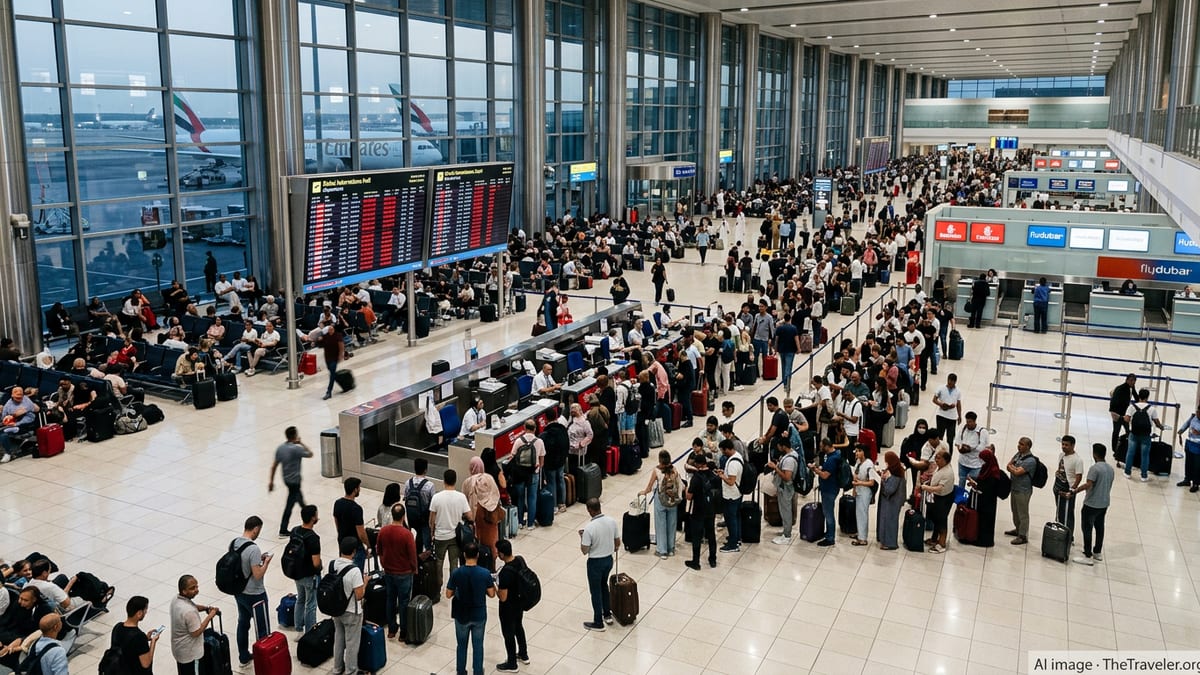
Severe Operational Strain Hits Dubai International
Dubai International Airport, a key global connecting hub, has been grappling with major operational disruption that has rippled through its tightly packed flight schedule. Publicly available data and recent coverage show that a combination of airspace restrictions, knock-on congestion and capacity limits has led to rolling delays and large-scale cancellations across multiple days, disrupting both inbound and outbound traffic.
Airport operations at Dubai International depend on high-intensity runway use, with hundreds of daily movements compressed into narrow departure and arrival banks. When that schedule is disturbed, even for a few hours, recovery often takes days as carriers struggle to re-time aircraft, crew and connections. Reports indicate that the current disruption is among the more severe episodes in recent years, with schedules cut back and recovery flying constrained by both operational and regulatory factors.
Flight-tracking feeds and airline advisories suggest that the impact has been spread across all terminals, affecting short-haul regional links, long-haul intercontinental routes and onward connections for passengers originating in Asia, Europe, Africa and the Americas. The result has been crowded terminals, long rebooking queues and significant uncertainty for travelers attempting to transit through Dubai.
FlyDubai Halts Departures and Slashes Its Schedule
FlyDubai, the Dubai-based low-cost carrier closely linked with Emirates, has emerged as one of the most visibly affected airlines in the current crisis. Publicly available travel advisories show that the airline temporarily halted all departures from Dubai at the height of the disruption, effectively freezing its point-to-point and connecting network and leaving many passengers seeking alternative arrangements.
The airline’s updates indicate an evolving pattern of cancellations, rolling delays and last-minute schedule changes as it works within the constraints of reduced airport capacity. In some cases, flights have been dropped entirely from schedules, while in others, departure times have shifted repeatedly throughout the day as slots at Dubai International are reassigned.
Previous weather-related disruption in 2024 demonstrated how quickly FlyDubai’s dense network can be thrown off balance when operations at Dubai International are interrupted. Then, as now, recovery required days of retiming and aircraft repositioning. The latest wave of cancellations suggests that the carrier is once again prioritizing stabilizing its core operations rather than attempting to operate an unreliable full timetable.
Emirates, IndiGo, Gulf Air, Air France and Others Cut Back
FlyDubai is not alone in retrenching its schedule. According to recent published coverage, Emirates has cancelled and delayed a significant number of flights, trimming frequencies on selected routes and consolidating services where possible. The airline has publicly advised travelers not to proceed to the airport without a confirmed booking and to expect longer than usual response times on customer service channels.
Regional and international carriers operating into Dubai have also been affected. IndiGo, which operates high-density routes between India and Dubai, has reported cancellations and substantial delays on flights to and from the United Arab Emirates, with passengers urged to monitor flight status closely. Gulf Air and other Gulf-based airlines have adjusted operations as airspace and airport constraints complicate scheduling across the wider region.
European carriers are likewise feeling the strain. Air France and several other long-haul airlines have seen rotations disrupted, leading to delayed departures from their home hubs and, in some cases, aircraft and crew out of position for subsequent flights. Because many of these carriers rely on tight turnaround times and onward connections through Dubai, each cancellation sends shockwaves throughout their networks, sometimes affecting flights days later and thousands of kilometers away.
Cascading Travel Hazards for Stranded Passengers
For passengers, the operational disruption has translated into a challenging and often confusing travel experience. Public reports from social platforms and travel forums describe travelers stuck in long lines at check-in and transfer desks, facing minimal seat availability on alternative flights as multiple airlines reduce capacity at the same time.
Many travelers with onward connections through Dubai have seen entire itineraries collapse when a single leg was cancelled. With both local and connecting traffic affected, passengers have reported missed events, disrupted holidays and unexpected overnight stays near the airport as they wait for rebooking options. Some accounts also point to difficulties obtaining clear information about entitlements to refunds, vouchers or accommodation, especially when disruptions are attributed to airspace or operational constraints rather than airline-controlled issues.
The strain is particularly acute for families, elderly travelers and those without flexible visas, who may be limited in their ability to leave the airport area while awaiting new flights. Crowded departure halls and limited seating during peak disruption windows have heightened discomfort, while the sheer volume of affected travelers has stretched airport and airline staff capacity.
Guidance for Travelers Navigating the Disruption
Publicly available travel advisories from Dubai-based carriers and airport briefings share several consistent recommendations for travelers currently booked to or through Dubai. Passengers are urged to check their flight status repeatedly on airline websites or mobile applications before leaving for the airport, as schedules can change multiple times within a short period. Many airlines are also encouraging customers to update contact details within their bookings so that notifications about cancellations or rebookings can be delivered quickly.
Travel information sources advise against arriving at Dubai International more than a few hours before a confirmed flight, noting that access controls, heavy road congestion and limited terminal space can worsen crowding if large numbers of passengers show up without active bookings. Travelers already at the airport are generally advised to remain in close proximity to departure screens and to use official airline channels for rebooking, as call centers and social media teams may be operating under considerable pressure.
For those with flexible plans, some carriers are offering one-time waivers on change fees or providing options to rebook travel to later dates when operations are expected to be more stable. Travel-insurance providers may also extend coverage for additional accommodation or alternative transport where policies include disruption clauses linked to airspace closures or operational shutdowns. However, passengers are being reminded to read the terms carefully and keep receipts for any extra expenses they aim to claim.
As Dubai International and its resident airlines gradually work to rebuild schedules, the situation remains fluid. Travelers with imminent plans through the hub are being encouraged to treat flight times as provisional, allow for significant buffers in any onward arrangements and prepare for the possibility that their journey may take longer than originally expected.