

More news on this day
Dubai-based carrier flydubai has reported record 2025 results, lifting annual revenue to AED 13.6 billion and carrying 15.7 million passengers as it accelerates its growth from low-cost upstart to global network player.
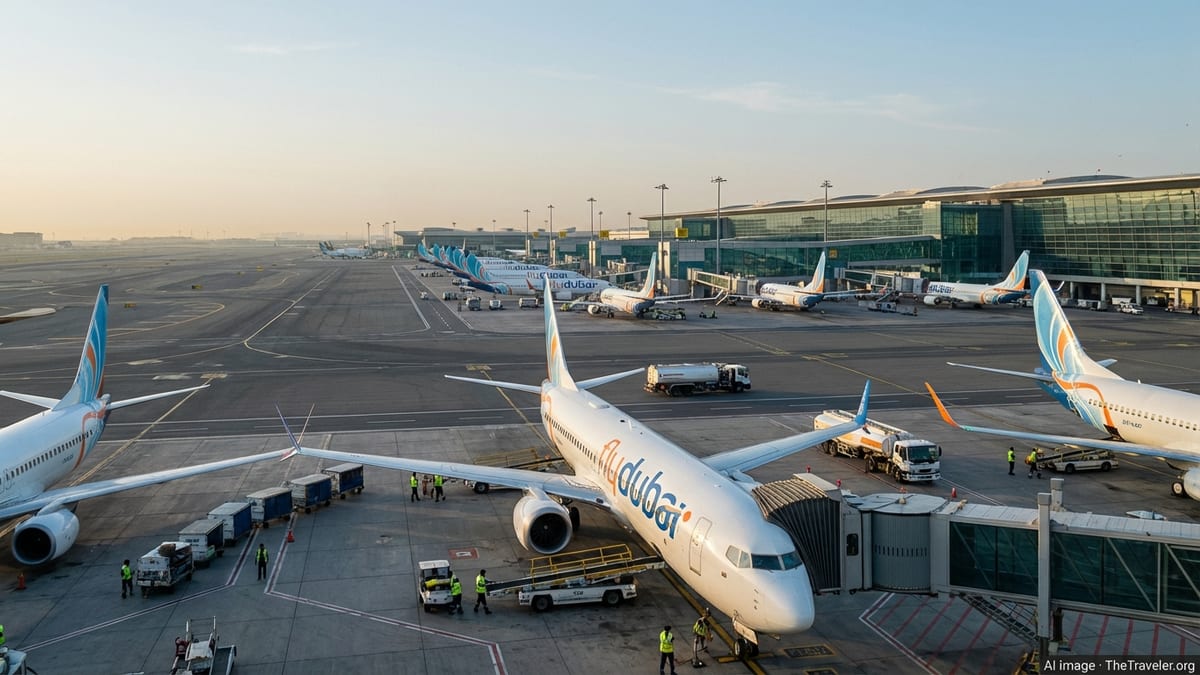
Record Revenue and Traffic Cement Flydubai’s Rise
Flydubai’s full-year 2025 figures, released in Dubai this week, underline how quickly the airline has climbed into the top tier of regional carriers. Total revenue for the 12 months to 31 December 2025 reached AED 13.6 billion, up 6 per cent on the previous year and the highest turnover in the airline’s 15-year history. Passenger numbers rose to 15.7 million, a new record that confirms its position as Dubai’s second-largest carrier by volume after Emirates.
Profitability eased slightly from 2024’s peak but remained robust by industry standards. The airline reported profit before tax of AED 2.2 billion and profit after tax of AED 1.9 billion, supported by an EBITDA of AED 4.0 billion. Executives said the result reflected continued demand for both business and leisure travel, even as the carrier absorbed higher maintenance costs and navigated a more complex operating environment.
Management framed 2025 as a year of consolidation after several cycles of double-digit growth. While headline profit retreated from the record set a year earlier, the company stressed that sustaining a double-digit net margin while expanding capacity and adding new routes demonstrated the resilience of its business model.
For Dubai’s broader aviation sector, the performance underscores the continued strength of the emirate as a global hub. Flydubai’s growth is increasingly complementary to that of Emirates, feeding medium- and short-haul traffic into one of the world’s busiest international airports and supporting the city’s ambitions in tourism, trade and logistics.
Network Expansion and Underserved Markets Drive Growth
A key engine of flydubai’s 2025 performance was an aggressive but targeted network strategy. The carrier expanded its footprint to 140 destinations across 58 countries, launching nine new routes and resuming flights to three cities that had previously been suspended. New services included Al Alamein on Egypt’s Mediterranean coast, leisure-focused Antalya in Türkiye, and the Baltic capitals of Riga and Vilnius, alongside Nairobi and additional points in Iran, Pakistan and Romania.
The airline’s route map continues to lean heavily into underserved and secondary markets, particularly across the Middle East, Africa, Central and Eastern Europe and the Indian subcontinent. Passenger growth in 2025 was led by the Middle East, where traffic increased by double digits, followed closely by Africa and Europe. Executives say this strategy allows the carrier to tap into pent-up demand while avoiding overcrowded trunk routes already dominated by larger legacy airlines.
Codeshare and interline partnerships, especially the tie-up with Emirates, further amplified this reach. Millions of passengers now use Dubai as a connecting point between short- and medium-haul flydubai services and long-haul flights operated by partner carriers. This connectivity has helped drive sustainable demand for both point-to-point and connecting traffic, even as competition intensifies across the Gulf.
Operationally, the airline operated 126,604 flights in 2025, increasing capacity as measured in available seat kilometres by around 6 per cent. Revenue passenger kilometres grew at a similar pace, with a modest improvement in passenger yield indicating that the carrier has been able to support growth without heavy discounting.
Fleet Growth, Retrofit Programme and Major Aircraft Orders
Behind the strong traffic numbers is a rapidly expanding and modernising fleet. In 2025, flydubai took delivery of 12 Boeing 737 MAX 8 aircraft and retired three older 737-800s, bringing its total fleet to 97 aircraft with an average age of around five and a half years. This young narrow-body fleet, focused on fuel-efficient jets, has become a cornerstone of the airline’s cost and network strategy.
The carrier also advanced a multi-year retrofit programme aimed at harmonising the onboard experience. By the end of 2025, eight additional 737-800s had been upgraded, taking the total number of retrofitted aircraft to 25. The work has focused on aligning cabins with the airline’s latest product, including improved seating, in-flight entertainment and Business Class amenities, helping close the gap with full-service rivals while maintaining a lean cost base.
Longer term, flydubai has set the stage for a step-change in scale. At the Dubai Airshow, the airline announced headline orders for 150 Airbus A321neo aircraft and 75 additional Boeing 737 MAX jets. The mix of types will diversify a fleet that has so far been built entirely around the Boeing 737 family, giving the carrier more flexibility in terms of range, capacity and route deployment.
Industry analysts say these commitments signal confidence in sustained demand growth through the next decade. They also give flydubai the tools to deepen its presence on busy regional routes, add longer sectors into Europe and Asia, and further integrate its operations with partners based at Dubai’s airports.
Premium Demand, Customer Upgrades and Operational Efficiency
One of the most striking shifts in flydubai’s 2025 performance was the continued strength of premium demand. Business Class uptake rose by high double digits compared with the previous year, reflecting both product improvements and changing traveller expectations. The carrier has steadily moved away from the stripped-back low-cost model of its early years, offering lie-flat or recliner Business Class seating on many aircraft and expanding lounge and ground services at key airports.
Enhancements in Economy Class also played a role. Complimentary in-flight entertainment and meals are now available across much of the network, and the airline has invested in refreshed cabin interiors designed to narrow the perceived gap with traditional full-service competitors. An agreement to roll out high-speed satellite connectivity from 2026 is expected to further lift the onboard experience and appeal to business travellers and digital nomads.
Operationally, management emphasised that efficiency remained a central focus in 2025. On-time departure performance improved compared with 2024, even as the carrier operated more flights and contended with supply chain constraints and rising maintenance costs. Fuel accounted for about a quarter of operating expenses, a meaningful outlay but lower as a proportion than in some earlier years, partly thanks to the growing share of newer, more efficient aircraft.
The airline ended the year with cash and bank balances, including pre-delivery payments, in the mid-single-digit billions of dirhams, giving it a cushion to manage volatility while continuing to invest in technology, training and infrastructure. Leadership has flagged digitisation and the use of artificial intelligence in areas such as revenue management, operations planning and customer service as priorities for the next phase of growth.
Strategic Role in Dubai’s Aviation and Tourism Ambitions
Flydubai’s latest results arrive as Dubai pushes ahead with long-term plans to cement its status as one of the world’s foremost aviation and tourism centres. By connecting 140 airports to the city, many of them in secondary or previously underserved markets, the airline is helping funnel a new wave of visitors, entrepreneurs and investors into the emirate.
Tourism officials point to the carrier’s growing reach into Central and Eastern Europe, Africa and South Asia as a key enabler of visitor growth beyond traditional source markets. Affordable fares combined with improved service levels are drawing first-time visitors as well as repeat travellers who may previously have flown via competing hubs in the region.
The airline’s performance also carries implications for Dubai’s role as a trading and logistics gateway. Increased frequencies to regional commercial centres and emerging markets support cargo flows alongside passenger growth, while tight coordination with airport and tourism authorities aims to smooth the overall travel experience.
With record revenue, a swelling passenger base and a deep order book of new aircraft, flydubai enters 2026 positioned as a pivotal player in the Gulf’s competitive aviation landscape. The challenge now will be to sustain profitable growth as capacity ramps up, new aircraft arrive and rivals pursue expansion plans of their own across the region.