

More news on this day
UAE–Thailand air links are set for a major lift in September 2026, with flydubai confirming it will launch double-daily flights between Dubai International and Bangkok’s Don Mueang International Airport, significantly expanding capacity on one of the region’s busiest leisure and business corridors.
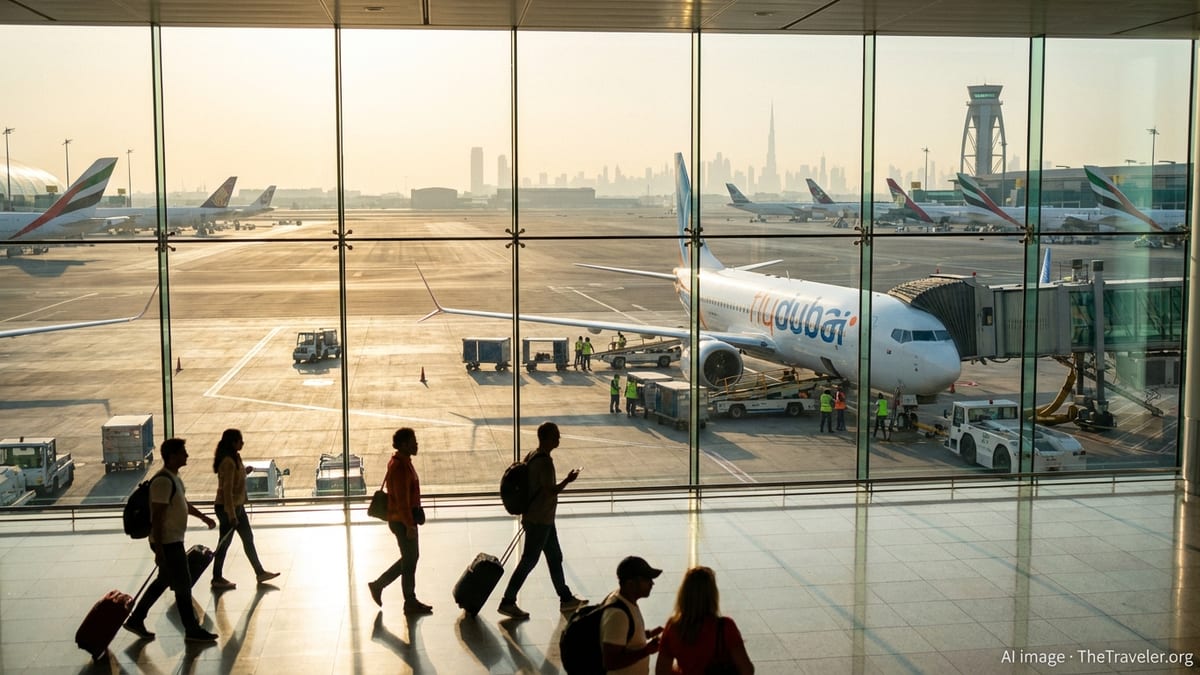
New Double-Daily Service from 15 September 2026
Dubai-based carrier flydubai has filed schedules and formally announced the start of a new double-daily service between Dubai International Airport and Bangkok’s Don Mueang International Airport from 15 September 2026. The move will add a second Bangkok gateway to the airline’s Thai network and sharply increase options for travellers moving between the Gulf and Southeast Asia.
The route will be operated with Boeing 737 MAX 8 aircraft and is currently planned at two flights per day in each direction. According to the operational schedule filed by the airline, one service will depart Dubai late at night and arrive in Bangkok late morning, while a second daylight departure from Dubai will reach Don Mueang in the evening. Return flights are timed to leave Bangkok around midday and just before midnight, arriving back into Dubai in the afternoon and early morning, respectively.
Flight numbers assigned to the rotation include FZ1335 and FZ1345 from Dubai to Don Mueang, and FZ1336 and FZ1346 on the return leg from Thailand to the United Arab Emirates. All services will operate daily, providing a consistent timetable designed to suit both point-to-point passengers and those connecting over flydubai’s growing Dubai hub.
By choosing Don Mueang rather than Bangkok’s larger Suvarnabhumi Airport for this new operation, flydubai is aligning its Bangkok presence with the rapid expansion of low-cost and hybrid carriers that already use the older airport. The decision positions the airline to tap into a dense regional network of short-haul services and to appeal to price-conscious leisure travellers.
Thailand Capacity Rises to 28 Weekly Flights
The new double-daily Don Mueang operation will lift flydubai’s total Thailand schedule to 28 weekly flights once fully implemented in late September 2026. The carrier already serves Thai leisure destinations such as Krabi and Pattaya, and the addition of Bangkok as a second point in the country cements Thailand as one of flydubai’s strongest Southeast Asian markets.
From a capacity standpoint, 28 weekly frequencies represent a substantial commitment to Thailand, especially for a narrowbody operator. With the Boeing 737 MAX 8 seating in the region of 160 to 180 passengers in flydubai’s typical configuration, the new timetable will support many thousands of additional seats per month in each direction between Dubai and Thailand.
The uplift reflects robust two-way demand. Outbound travellers from the Gulf and wider Middle East continue to see Thailand as a favoured holiday destination, while inbound flows from Thailand and neighbouring countries use Dubai as a gateway to Europe, Africa and the broader Middle East. The airline’s strategy leverages both of these trends by adding frequency on a trunk route that underpins its Southeast Asia network.
The decision also signals confidence in Thailand’s tourism recovery and long-term growth prospects. Visitor numbers from the Middle East to Thailand have been trending upward, supported by liberal visa policies and aggressive destination marketing in the Gulf. Doubling daily connectivity to Bangkok positions flydubai to capture a larger share of this demand and to support year-round travel rather than relying solely on peak-season spikes.
Stronger UAE–Thailand Aviation Ties
Flydubai’s Don Mueang expansion deepens an already strong aviation relationship between the United Arab Emirates and Thailand. Full-service carriers and low-cost operators from both sides have steadily increased frequencies over the past decade, mirroring rising trade volumes, tourism flows and labour mobility between the two countries.
Dubai has emerged as a key hub for Thai nationals working across the Gulf and for Thai businesses connecting to markets in Europe and Africa, while Thailand remains a premier long-haul leisure destination for residents of the UAE. Additional flights, particularly on a double-daily pattern, help to smooth demand across the week and give travellers more flexibility on trip length and timing.
The new service is also consistent with broader policy efforts by both governments to deepen economic engagement. Thailand has been actively courting investment and tourism from the Gulf Cooperation Council states, and improved air access is a central pillar of that strategy. For the UAE, adding lower-fare and high-frequency options into Bangkok supports its role as a global aviation crossroads and reinforces aviation as a key driver of non-oil growth.
Industry observers note that competitive capacity on the Dubai–Bangkok corridor has long been dominated by full-service widebody operators. The arrival of a double-daily narrowbody service into Don Mueang introduces a different price point and airport combination, likely spurring further competitive responses and potentially bringing down average fares on certain travel dates.
Hub Connectivity via Dubai International Terminal 3
The Don Mueang flights will operate from Terminal 3 at Dubai International Airport, the same terminal used by Emirates. This arrangement is central to the commercial logic of the new route, since it enables smooth connections onto a vast network of onward destinations operated by both carriers under their existing codeshare and interline arrangements.
By timing one Bangkok-bound departure just after midnight and a second late in the morning, flydubai is able to feed passengers arriving in Dubai on overnight long-haul and early morning regional services. In the opposite direction, inbound flights from Bangkok are scheduled to reach Dubai in the afternoon and early morning, aligning with evening and morning departure banks to Europe, Africa and North America.
Passengers will benefit from through-ticketing and through-checked baggage across many itineraries that combine flydubai and Emirates services. For business travellers, this reduces transit friction and maximises productivity, while leisure passengers gain access to a one-stop proposition from Bangkok to a wider range of secondary cities across the Middle East, Caucasus, Central Asia and Eastern Europe.
For Dubai International, the additional flows help to sustain its status as one of the world’s busiest international airports. As more point-to-point and connecting traffic funnels through Terminal 3, the broader airport ecosystem, including retail, food and beverage, and airport hospitality providers, stands to gain.
Why Don Mueang Matters in Bangkok’s Airport Landscape
Bangkok’s Don Mueang International Airport, located roughly 22 to 25 kilometres north of the city centre, has re-emerged over the past decade as a major hub for low-cost and hybrid carriers. While Suvarnabhumi Airport remains Thailand’s primary international gateway, Don Mueang has taken on the role of a key base for regional airlines serving domestic and short-haul international routes across Asia.
Positioning its Bangkok operation at Don Mueang allows flydubai to plug directly into this landscape. The airport is a major base for Thai AirAsia and other budget operators, which collectively offer an extensive network of flights to provincial Thai cities and neighbouring countries. Travellers arriving on flydubai’s services will be able to make self-connect itineraries onto these carriers, effectively extending the reach of the Dubai–Bangkok link deep into Southeast Asia.
From a passenger-experience perspective, Don Mueang is often seen as more compact and navigable than Suvarnabhumi, with shorter walking distances and, for some travellers, quicker processing times. For price-sensitive tourists and backpackers, the combination of competitive fares, a dense low-cost network and proximity to central Bangkok’s transport links is particularly attractive.
The airport’s resurgence also reflects broader infrastructure dynamics in the Thai capital. As Suvarnabhumi continues to handle heavy long-haul and full-service traffic and undergoes capacity expansions, Don Mueang has become the natural home for value-focused operators. Flydubai’s decision to join that ecosystem underscores the importance of price-competitive, high-frequency services in sustaining Thailand’s tourism and regional travel growth.
Fleet, Product and Schedule Strategy
The Dubai–Bangkok Don Mueang route will be flown with flydubai’s Boeing 737 MAX 8 fleet, a type that combines the economics of a single-aisle aircraft with sufficient range to reach deep into Southeast Asia from Dubai. The choice allows the airline to sustain double-daily frequencies while managing fuel burn and operating costs tightly on a roughly six-hour sector.
On board, flydubai offers a two-class product on many of its longer routes, including a dedicated business cabin with recliner or, on some aircraft, lie-flat seats, as well as an economy cabin tailored to price-conscious travellers. While exact seating layouts can vary by aircraft, the overall product aims to bridge the gap between traditional low-cost and full-service offerings, particularly on flights of this length.
From a scheduling standpoint, the airline has clearly prioritised connectivity. The overnight Dubai departure arriving in Bangkok in late morning is ideal for travellers who prefer to maximise their first day in Thailand, while the daytime departure supports more relaxed itineraries or business trips. Return flights timed around midday and late at night give passengers the option of day-of-departure checkouts from hotels or extended final evenings in the city.
By maintaining daily operations on all four legs, flydubai can build strong brand visibility in the Bangkok market and offer predictable, easy-to-understand timings. This consistency is particularly valued by tour operators and corporate travel managers, who can plan packages and contracts around stable flight patterns rather than seasonal or sporadic services.
Tourism and Economic Impact for Both Markets
For Thailand’s tourism sector, the new double-daily link represents both a direct influx of visitors and an indirect marketing boost in the Gulf and beyond. Travel companies in the United Arab Emirates are likely to ramp up Thailand-focused packages built around flydubai’s schedule, while the airline’s extensive regional footprint means secondary cities in the Middle East can also feed traffic into the Bangkok route.
Hotels, resorts and tourism operators in Bangkok, Pattaya, Phuket and secondary Thai destinations stand to benefit from the increased accessibility. The timing of the launch in September 2026 positions the service ahead of the traditional high season that runs through the northern winter, giving the airline and its partners time to build awareness and calibrate pricing.
On the UAE side, the route supports Dubai’s ambition to remain the primary long-haul connecting hub for Southeast Asian travellers heading to Europe and Africa. By offering a competitively priced alternative to full-service widebody flights, flydubai may attract new segments of travellers from Thailand and neighbouring countries who previously connected through other hubs in the region.
The economic impact extends beyond tourism. Enhanced seat capacity and frequency also facilitate business travel, including for small and medium-sized enterprises in sectors such as hospitality, food exports, retail and healthcare, where ties between Thailand and the Gulf are deepening. For these companies, additional direct flights shorten travel times, increase schedule flexibility and make in-person engagement more feasible.
Part of a Wider Southeast Asia Growth Story
Flydubai’s Bangkok expansion comes as the carrier continues to invest in its Southeast Asia network. In recent years, the airline has launched or expanded services to destinations such as Penang and Langkawi in Malaysia, alongside its existing presence in Krabi and Pattaya in Thailand. Together, these routes illustrate a deliberate strategy to link Dubai with high-potential leisure markets that have historically been underserved by Gulf-based narrowbody operators.
The wider backdrop is a sustained recovery in Asia-Pacific travel demand following the pandemic and an acceleration of middle-class growth across the region. As more travellers seek affordable long-haul options, airlines that can offer efficient one-stop connections via hubs like Dubai are well positioned to capture incremental traffic.
On the operational side, flydubai is simultaneously expanding its infrastructure to support a larger fleet and more complex network. The airline has broken ground on a new maintenance centre at Dubai South, a multimillion-dollar facility scheduled for completion in the final quarter of 2026. Once operational, this hub is expected to reduce maintenance turnaround times and enhance fleet reliability, both critical to sustaining high-frequency routes such as the upcoming double-daily Bangkok service.
For travellers, the convergence of these developments should translate into more choice, better connectivity and, potentially, keener competition on fares across the broader Middle East–Southeast Asia corridor. With the launch date now in the schedule, stakeholders across the UAE and Thailand will be watching closely as flydubai prepares to open its newest link between Dubai and Bangkok in September 2026.