

More news on this day
Unstable weather across the Gulf, combined with an already fragile regional aviation environment, is disrupting flydubai services through Dubai, Abu Dhabi and Muscat, raising new concerns for travelers and tourism operators who rely on the carrier’s extensive short-haul network.
Get the latest news straight to your inbox!
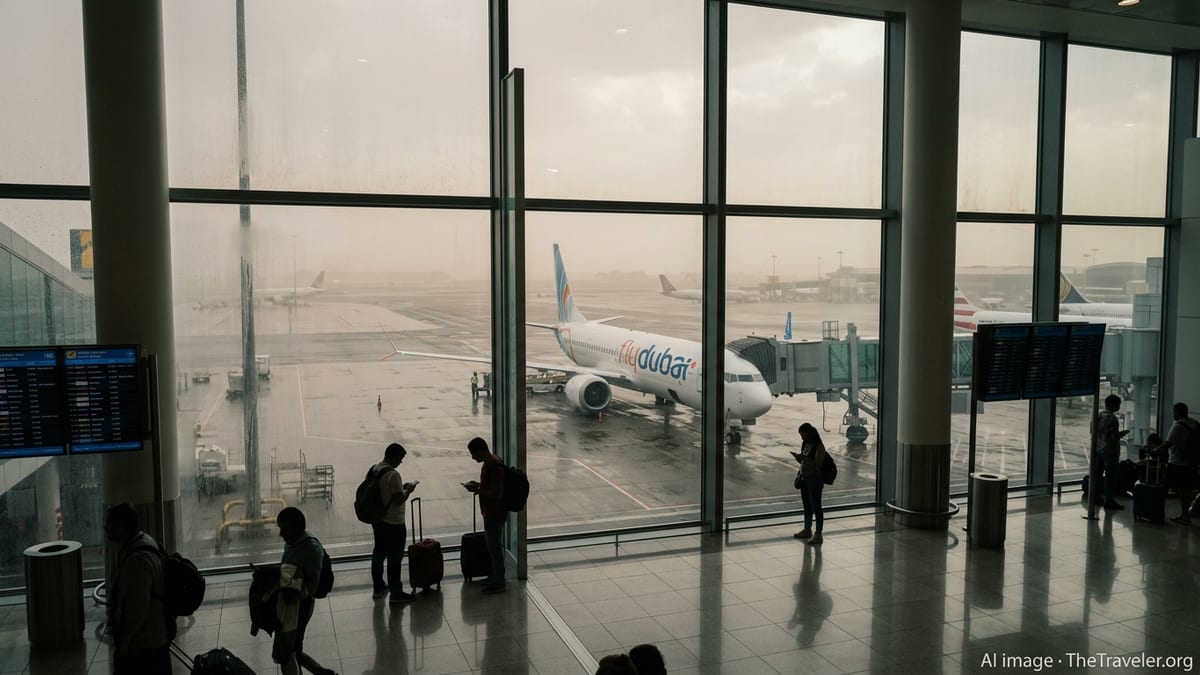
Unsettled Skies Add Strain to an Already Volatile Aviation Corridor
Recent industry advisories describe a period of “unstable weather” sweeping across the United Arab Emirates, with a mix of fog, dust, rain and rough seas affecting coastal cities such as Dubai and Abu Dhabi. Forecasters indicated that these conditions would recur around the turn of the year into early 2026, bringing reduced visibility, crosswinds and difficult approach conditions at some of the region’s busiest airports.
The Gulf’s aviation system is already under pressure from intermittent airspace restrictions and security-related disruptions, and the latest weather pattern is compounding those strains. Publicly available operational updates show that airlines have had to cut or consolidate rotations, hold aircraft in place and reroute flights via alternative hubs, sometimes with little advance notice for passengers.
For flydubai, which uses Dubai International as its primary base and serves Abu Dhabi and Muscat as important regional points, this combination of meteorological and geopolitical volatility has translated into cancellations and significant delays on selected routes. Travel-industry coverage indicates that flights linking Dubai with Omani and wider Gulf destinations have been particularly exposed whenever low cloud, strong winds or dust storms coincide with regional airspace constraints.
Analysts note that this is not the first time weather has sharply curtailed flydubai’s schedule. During the severe flooding that hit the UAE in April 2024, all flydubai departures from Dubai on a single day were cancelled, underscoring how quickly conditions can force a near-total standstill once visibility and airfield access are compromised.
Dubai and Abu Dhabi: Hub Connectivity Under Pressure
Dubai and Abu Dhabi depend heavily on reliable hub operations to sustain visitor flows, and even short-lived interruptions can ripple across the tourism economy. Reports from aviation consultancies and regional business media describe periods in late February and early March 2026 when departures from both cities were dramatically reduced, with some carriers temporarily suspending commercial operations while they reassessed airspace and insurance conditions.
During those windows, flydubai’s point-to-point model, which usually offers flexibility and frequency, became a vulnerability. Passengers reported on social platforms that flights into Abu Dhabi were diverted or held in holding patterns, with diversions to alternative airports such as Muscat mentioned when conditions or routing options deteriorated en route. In Dubai, travelers shared accounts of same-day cancellations, rolling delays and difficulty obtaining clear rebooking timelines as operations were continually adjusted.
Tourism and hospitality data compiled by trade publications indicate that Dubai’s luxury hotels have already felt the impact of these wider disruptions. Industry analysis shows that revenue per available room in the city fell sharply on some days in late February and early March compared with the previous year, a trend linked to reduced international arrivals and uncertainty around onward connections through Dubai’s airports.
Abu Dhabi, meanwhile, has seen high-profile events and leisure travel plans reconfigured as airlines trim frequencies and consolidate services. With the capital marketing itself as both a cultural and sports destination, any extended reduction in seat capacity via regional carriers such as flydubai raises questions about short-term visitor numbers and spending, even if core attractions and infrastructure remain fully operational.
Muscat’s Double Role: Diversion Hub and Disruption Hotspot
Muscat occupies a complex position in the current environment. On one hand, Oman’s capital has emerged as an important diversion and relief hub during periods when Gulf airspace is restricted and flights to or from the UAE are curtailed. Travel advisories note that Muscat International Airport has remained operational through recent regional disruptions, with Omani carriers adding temporary services to keep passengers moving while nearby hubs adjusted their schedules.
On the other hand, Muscat itself has not been immune to disruption. Industry coverage in early March reported a wave of cancellations at Muscat International across multiple carriers, including flydubai, as weather and airspace factors converged. One trade outlet highlighted that dozens of flights were cancelled or significantly delayed on a single day, prompting calls for travelers to monitor airline channels closely and avoid heading to the airport without confirmed rebookings.
For flydubai, Muscat serves as both a destination in its own right and, at times, an operational fallback for diverted flights unable to reach Dubai or Abu Dhabi. This dual role has made schedules especially fluid. Public information from aviation trackers and travel blogs shows that some passengers have been re-routed via Muscat or offered alternative dates when direct services were not viable, while others have experienced multi-day delays as capacity constraints limited the availability of replacement seats.
Tourism stakeholders in Oman are watching the situation carefully. While Muscat can benefit in the short term from additional transit traffic and emergency stopovers, sustained uncertainty around schedules may discourage some leisure travelers who were counting on smooth connections between the UAE and Oman’s coastal resorts or desert experiences.
Tourism Impact: From Hotel Bookings to Traveler Confidence
The immediate effect of flydubai’s weather-related disruptions is being felt by individual travelers in the form of missed holidays, delayed business trips and altered itineraries. However, the broader concern for the UAE and Oman lies in how repeated episodes of flight uncertainty influence booking patterns and confidence in the region as a whole.
Tourism market reports released in March 2026 indicate that the UAE entered the year from a position of strength, with hotel guest numbers and occupancy climbing through 2025. That momentum has been interrupted by the combination of unstable weather and airspace-related flight reductions. Analysts describe a “shock to reliability,” where the main issue is not infrastructure at the destination but the ability of airlines, including flydubai, to operate predictable schedules through a more complex sky.
Some international travelers are responding by rerouting through alternative hubs, rescheduling trips to later in the year, or shifting to destinations perceived as less exposed to sudden aviation disruptions. At the same time, travel advisors note a rise in last-minute decision-making, with tourists holding off on confirming long-haul journeys to Dubai or Abu Dhabi until they are confident that flights are running more normally.
In Oman, Muscat’s resilience as a functioning hub has improved its profile among some regional travelers, yet the cancellations affecting carriers at Seeb International Airport have also highlighted the limits of that advantage when weather and airspace uncertainties coincide. The net result, according to sector commentary, is a more cautious approach among tour operators selling combined UAE–Oman itineraries, at least in the near term.
What Travelers Should Watch Before Flying with flydubai
For passengers planning to use flydubai in the coming weeks, industry guidance emphasizes preparation and flexibility. Travel advisories recommend monitoring the airline’s official channels and flight-status tools closely in the 24 to 48 hours before departure, as schedules may be adjusted in response to evolving forecasts and airspace notices.
Travel blogs and consumer forums also stress the importance of understanding ticket conditions and insurance coverage. Many travelers affected by recent flydubai disruptions have shared experiences of applying for refunds or rebookings after receiving cancellation emails, and of documenting additional costs such as hotels, meals and local transport to support later compensation or claims.
Experts further suggest building additional buffer time into itineraries that rely on connections through Dubai, Abu Dhabi or Muscat, particularly when traveling to onward long-haul destinations. Where possible, passengers are advised to avoid tight layovers and to consider overnight stops or more generous connection windows during periods of forecast unstable weather.
Ultimately, while tourism authorities in the UAE and Oman continue to promote their destinations and events, the reliability of airlines such as flydubai will remain central to how quickly confidence returns. As the Gulf region navigates a season of unsettled skies and broader aviation constraints, travelers who stay informed, flexible and well insured are likely to be best placed to adapt to further changes.