

More news on this day
Dubai-based carrier flydubai is set to redefine travel between the United Arab Emirates and Southeast Asia, confirming that from 15 September 2026 it will operate double-daily flights between Dubai and Bangkok’s Don Mueang International Airport, lifting its total Thailand capacity to 28 weekly services and significantly deepening the UAE’s air links with the region.
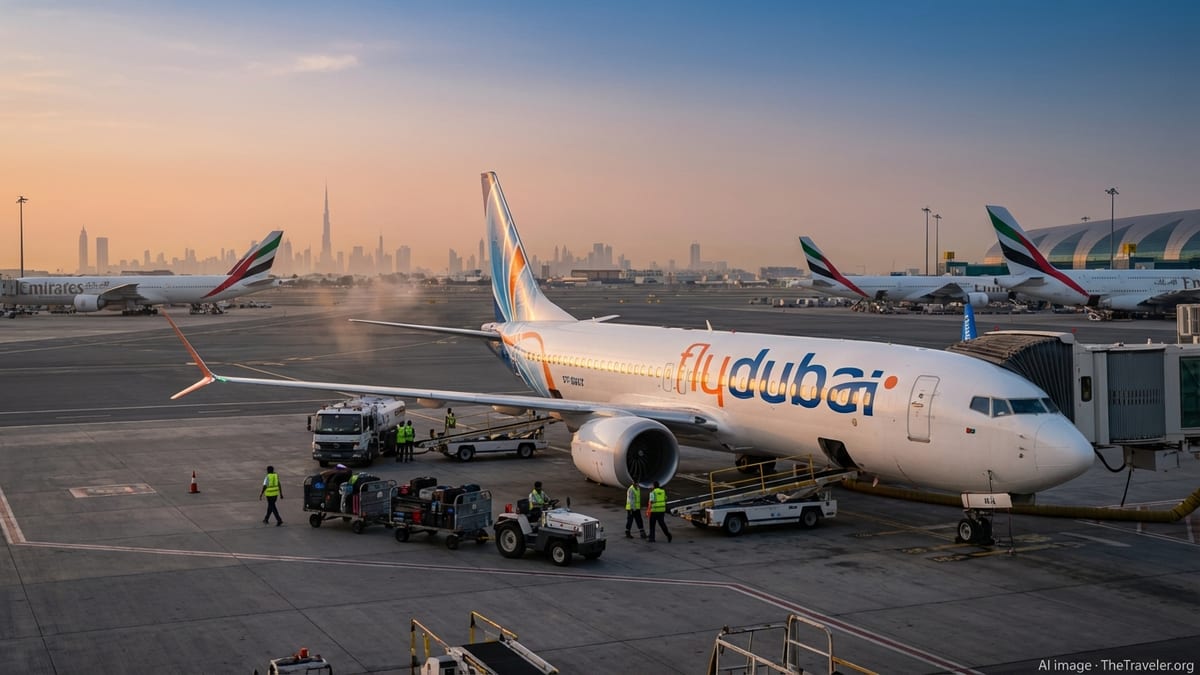
Details of Flydubai’s Double-Daily Bangkok Launch
Flydubai has filed its operational schedule for the new Dubai to Bangkok Don Mueang route starting 15 September 2026, with two daily rotations operated by Boeing 737 MAX 8 aircraft. The new services will run from Dubai International Airport’s Terminal 3, aligning the carrier more closely with its partner Emirates and simplifying transfers for passengers connecting across the broader Dubai hub.
Operational data published in mid-February shows four daily flights configured in the Dubai–Bangkok–Dubai pattern, translating into 14 weekly round trips on the new city pair. When added to flydubai’s existing Thailand services, this takes the airline’s total weekly schedule for the country to 28 frequencies, underlining Bangkok’s status as one of the carrier’s most important Southeast Asian gateways.
The flights are timed to capture both overnight and daytime traffic flows. One rotation departs Dubai shortly after midnight, arriving in Bangkok by late morning, while the second leaves late morning from Dubai to reach Don Mueang in the evening. The return services mirror this pattern, with a late-morning departure from Bangkok back to Dubai and a late-night departure designed to offer early-morning arrivals in the UAE, ideal for onward connections to Europe, the Middle East and Africa.
By selecting Don Mueang rather than Bangkok’s larger Suvarnabhumi hub, flydubai is also positioning itself in a market known for point-to-point and regional low-fare traffic, while still tapping demand from UAE-based travelers and long-haul passengers using Dubai as a one-stop hub for Southeast Asia.
Strategic Leap in UAE–Southeast Asia Connectivity
The expansion to double-daily Bangkok services represents more than just added capacity; it cements Dubai’s role as a primary bridge between the Gulf and Southeast Asia. The UAE has spent the past decade building itself into a global aviation crossroads, and added frequencies to high-demand markets like Bangkok are central to sustaining that competitive edge in the face of intensifying regional competition.
Southeast Asia remains one of the fastest-growing outbound regions for tourism and trade, and Bangkok in particular is a magnet for both leisure travelers and small and medium-sized enterprises. By offering more seat capacity and better schedule choice, flydubai is tapping robust demand from UAE residents, expatriates, and connecting passengers seeking affordable yet full-service options for reaching Thailand and beyond.
For the broader UAE aviation ecosystem, the move dovetails with large-scale investments in fleet expansion and airport infrastructure. Flydubai’s rapidly growing Boeing 737 MAX fleet and its forthcoming Airbus A321neo deliveries are designed to support precisely this type of route growth, while Dubai’s multi-billion-dollar airport development plans aim to accommodate significantly larger passenger volumes across the coming decade.
The additional Bangkok frequencies also help distribute traffic more evenly across the day at Dubai International, easing pressure on peak banks while still feeding key long-haul departures. This is especially important as the hub braces for record passenger levels and prepares for a future transition of more operations to Dubai’s second major airport.
Bangkok Don Mueang: A Second Thai Gateway with a Different Profile
Flydubai’s choice of Bangkok’s Don Mueang International Airport rather than the main Suvarnabhumi hub is a calculated strategic move. Don Mueang has developed into a thriving base for regional and low-cost carriers, handling large volumes of intra-Asian traffic and price-sensitive leisure travelers who are often comfortable using point-to-point services paired with self-managed connections.
By entering Don Mueang with a double-daily Dubai link, flydubai is effectively inserting a Gulf network carrier into a market segment typically dominated by Asian low-cost airlines. The 737 MAX 8’s range and economics are well suited to this profile, allowing competitive fares while still offering a business class cabin and an upgraded economy experience, which stands out against many no-frills competitors operating at the airport.
Don Mueang’s location in Bangkok’s northern suburbs makes it particularly attractive for domestic passengers connecting onward to secondary Thai cities and for regional travelers who are accustomed to its terminals and ground transport links. For UAE-based travelers, this opens up convenient access not only to central Bangkok but also to emerging Thai destinations served from Don Mueang by local carriers.
The airport’s growing role as a leisure and short-haul hub also aligns with flydubai’s focus on underserved and emerging markets. The airline has previously used its flexible narrowbody fleet to pioneer or deepen links to destinations that may not yet justify widebody operations, and Bangkok Don Mueang fits this template while offering the scale of a major Asian capital.
Codeshare Synergy with Emirates and the Dubai Hub Effect
One of the most significant aspects of the new double-daily Bangkok operation is its integration into the existing codeshare partnership between flydubai and Emirates. Operating from Dubai International’s Terminal 3 allows seamless transfers between the two carriers, enabling passengers to book itineraries that combine Emirates’ long-haul widebody services with flydubai’s point-to-point regional reach.
Under the partnership, travelers originating in Europe, North America, Africa or the Middle East with Emirates will be able to connect in Dubai onto the new flydubai Bangkok flights on a single ticket, with through check-in and coordinated baggage handling. This structure gives the Don Mueang service a global feed that extends far beyond the UAE’s local market, significantly boosting its commercial viability.
For Emirates, the arrangement strengthens its overall Southeast Asia proposition without requiring additional widebody capacity into Bangkok. The combination of multiple daily Emirates widebody services to Suvarnabhumi and flydubai’s narrowbody operation into Don Mueang provides travelers with more choice of airport, schedule and price point, while still keeping Dubai as the central transfer hub.
This division of roles reflects the evolving strategy of the two Dubai-based airlines. Emirates continues to concentrate on long-haul trunk routes and premium-heavy markets, while flydubai increasingly handles destinations and frequencies that are better served with smaller-gauge aircraft and a more flexible cost base. The new Bangkok flights are a textbook example of that complementary model at work.
Boost to Thailand’s Tourism and Regional Connectivity
Thailand’s tourism sector, long a cornerstone of the country’s economy, stands to benefit substantially from flydubai’s additional capacity. Double-daily Dubai flights broaden access for visitors from across the Middle East, Europe and Africa who prefer routing via the Gulf, and who often combine Thailand with multi-destination itineraries around Southeast Asia.
Bangkok serves as a critical gateway for onward journeys to Thai beach destinations such as Krabi and the islands, many of which already feature in flydubai’s own network or are served by partner and interline carriers. The increased inbound flow via Don Mueang will likely stimulate demand for accommodation, tours and hospitality services well beyond the capital, particularly among independent travelers and younger demographics who are drawn to Thailand’s value proposition.
The service also contributes to Thailand’s ambitions to attract higher-spending visitors from the Middle East, including family groups and medical tourists who appreciate the availability of direct or one-stop connections and who often travel in premium cabins. With business class offered on the 737 MAX 8, flydubai can cater to this segment while maintaining competitive fares in economy.
Beyond tourism, greater air access between Dubai and Bangkok is expected to support trade and investment ties, including sectors such as retail, food and beverage, wellness and creative industries. Small businesses in both countries will gain more flight options for attending trade fairs, sourcing trips and partnership meetings, further knitting together the UAE and Thai economies.
Flydubai’s Expanding Southeast Asia Footprint
The Bangkok expansion is the latest milestone in flydubai’s steadily growing Southeast Asia network. In recent years, the airline has inaugurated services to popular Malaysian destinations such as Penang and Langkawi, while strengthening its presence in Thailand with routes to resort cities including Krabi and, previously, Pattaya. Together, these routes illustrate the carrier’s focus on high-potential leisure markets that can be effectively served with narrowbody aircraft.
With Bangkok added as a second Thai gateway and upgraded to double-daily service, flydubai’s Southeast Asian portfolio looks increasingly like a coherent regional strategy rather than a collection of isolated routes. Each destination offers a distinct blend of leisure and business demand, yet all feed into the same Dubai hub structure and benefit from codeshare and interline traffic beyond the UAE.
The airline’s investment in enhanced onboard products, particularly in business class on selected Boeing 737 MAX aircraft, also plays a role in the region. Routes of five to seven hours, such as Dubai–Bangkok, sit at the upper end of narrowbody flying times, making lie-flat or near-flat business seats and improved inflight entertainment more attractive to travelers who might previously have opted for widebody competitors.
As flydubai receives additional aircraft and optimizes its schedule, observers expect further Southeast Asia adjustments, including potential capacity increases on existing routes and the introduction of new destinations in markets like Indonesia, Vietnam or the Philippines, where demand from the Gulf continues to climb.
Fleet Growth and Infrastructure Supporting the Move
The decision to mount a double-daily Bangkok operation is underpinned by flydubai’s rapid fleet growth. The carrier has been taking delivery of new Boeing 737 MAX jets, with more aircraft scheduled to arrive through 2025 and beyond, and has signaled its long-term expansion intentions through major additional narrowbody orders. These aircraft deliver improved fuel efficiency and range compared with previous-generation models, making longer medium-haul sectors such as Dubai–Bangkok more sustainable from a cost perspective.
The Bangkok flights will be operated with a configuration that balances density and comfort, giving flydubai the flexibility to target both volume leisure traffic and higher-yield business travelers. The commonality of the 737 fleet also simplifies crew training, maintenance and scheduling, enabling the airline to deploy capacity quickly as market opportunities emerge or evolve.
On the ground, Dubai’s continuing airport development provides the necessary infrastructure for such growth. Investments in terminal capacity, passenger processing technology and airfield improvements are aimed at reducing bottlenecks and preserving transfer reliability even as passenger numbers swell. That reliability is critical to attracting and retaining connecting traffic between Europe, the Middle East, Africa and Asia, where on-time connections can significantly influence travelers’ choice of hub.
Together, modern aircraft and upgraded airport facilities give flydubai and Dubai International the tools they need to support sustained route expansion. The double-daily Bangkok service is therefore both a product of past investment and a signal of confidence in continued traffic growth along the UAE–Southeast Asia corridor.
Implications for Travelers and the Regional Competitive Landscape
For travelers, the most immediate impact of flydubai’s new schedule is greater choice. Double-daily flights translate into more flexibility on departure and arrival times, especially valuable for business passengers fitting trips around meetings, as well as for leisure travelers who want to optimize daylight hours on arrival or coordinate with hotel check-in times.
The added capacity is likely to intensify competition on the Dubai–Bangkok route, where a mix of full-service and low-cost carriers already vie for passengers. While pricing outcomes will depend on broader market conditions, increased seat supply typically exerts downward pressure on average fares over time, particularly outside peak holiday periods. That dynamic could make Thailand more accessible to budget-conscious travelers from the Gulf and beyond.
At a network level, the service reinforces the growing role of Gulf hubs in connecting Europe, the Middle East and Africa with emerging cities across Asia. Other regional players have been expanding aggressively in Southeast Asia, but Dubai’s strategy of combining a long-haul widebody operator with a nimble narrowbody partner gives it a distinctive toolkit for matching capacity to demand on individual routes.
As of mid-2026, flydubai’s move into double-daily Bangkok flights can be seen as both a logical next step in that strategy and a statement of intent. By deepening its presence in one of the region’s most important markets and tying it closely to the wider Dubai connectivity web, the airline is helping to redefine how travelers think about journeys between the Gulf and Southeast Asia.