

More news on this day
Long one of the world’s most important crossroads for air travel, the Middle East is experiencing some of its most significant aviation disruption in decades, forcing travelers in 2026 to rethink how they route, book, and insure their journeys.
Get the latest news straight to your inbox!
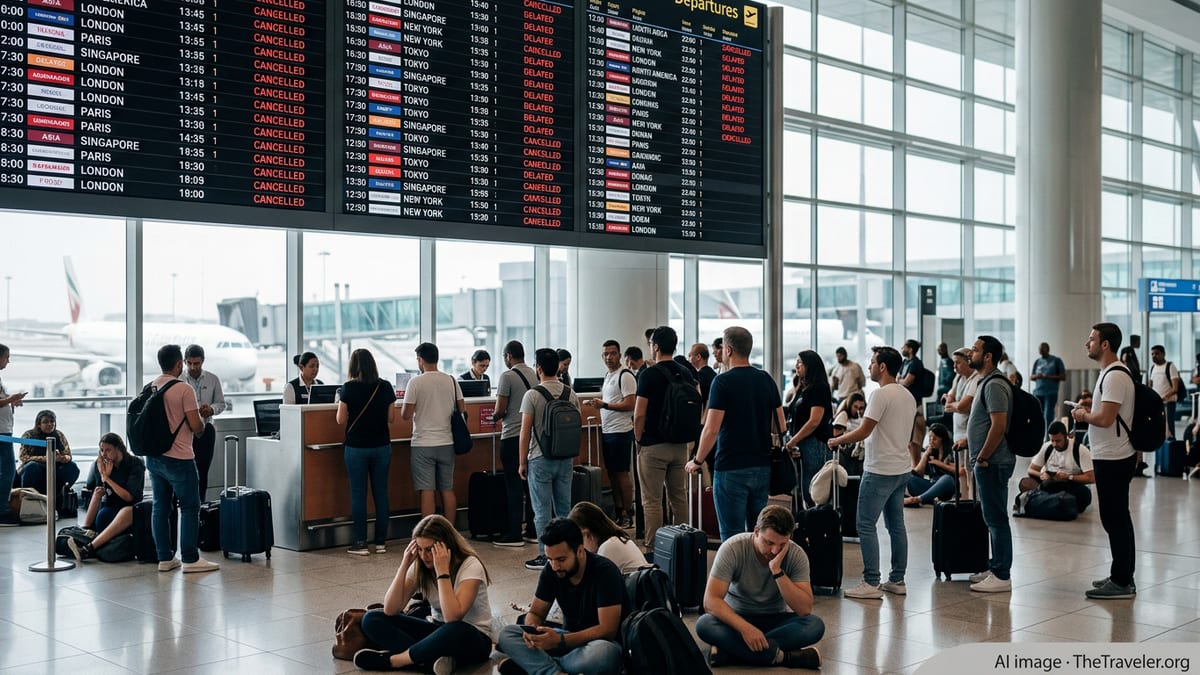
A Regionwide Shock to Airspace and Schedules
Since late February 2026, the escalation of conflict involving Iran, Israel, and several Gulf states has triggered rapid airspace closures across much of the Middle East. Publicly available flight data and industry reporting indicate that countries including Qatar, the United Arab Emirates, Bahrain, Kuwait, and parts of Saudi Arabia have at times shut their skies to civilian traffic, while Israel has periodically halted operations at Ben Gurion Airport.
Travel and aviation advisories compiled in early March describe tens of thousands of flight cancellations affecting major hubs such as Dubai International, Abu Dhabi, Doha Hamad International, Bahrain, Kuwait City, Muscat, Riyadh, and Tel Aviv. Some reports suggest that more than 13,000 flights were cancelled in the first days after airspace closures in late February, with additional cancellations and diversions rippling through global schedules into mid March.
The United States and several European governments have issued broad travel warnings for the region, and a recent worldwide caution from U.S. authorities specifically highlights elevated risks tied to the current military operations in and around Iran. While aviation regulators and airlines emphasize that commercial traffic is kept away from active conflict zones, the knock-on effect of restricted corridors has been severe for airline networks built around Gulf and Levant hubs.
These developments are not entirely new. Previous flare ups in 2024 and 2025 saw shorter closures and localized disruptions. What sets 2026 apart is the simultaneous impact on multiple Gulf hubs, combined with higher fuel prices and more cautious insurance and risk assessments, creating a more prolonged and global wave of changes for passengers who transit the Middle East.
Longer Routes, Tighter Capacity, and Higher Fares
As airspace over or near Iran, Iraq, and parts of the Gulf has become constrained, airlines have been diverting long haul flights along more southerly or northerly paths. Logistics advisories and aviation analyses describe reroutes via Turkey, the Caucasus, the Arabian Sea, or around the Horn of Africa, adding between two and five hours to some Asia Europe and Asia North America journeys that once passed efficiently through Gulf airspace.
These longer routes have measurable consequences. Industry estimates circulated in early March suggest that rerouting a single long haul flight can add 90 to 120 minutes of flying time in many cases, and significantly more on certain city pairs. Analysts note that this can increase fuel burn by 30 to 50 percent on the affected segments, sharply raising operating costs and in some cases reducing the payload an aircraft can carry, including both passengers and cargo.
At the same time, jet fuel prices have risen amid concerns about oil supply routes near the Strait of Hormuz and the wider Gulf. Travel and business media report that benchmark jet fuel prices reached multi year highs in early March, coinciding with the onset of the latest round of airspace closures. With global airline profit margins already thin, higher fuel bills combined with longer routes are expected to put upward pressure on fares for routes that typically rely on Middle East connections.
Capacity is also under strain. With major Gulf carriers temporarily suspending or sharply curtailing operations on key days, and a number of Asian and European airlines cancelling flights to regional destinations, seats that remain on alternative routings are filling quickly. This can leave travelers facing higher last minute prices, fewer award seat options, and reduced flexibility to change dates without incurring additional costs.
How Disruptions Affect Connections Through Gulf Hubs
For years, hubs such as Dubai, Doha, and Abu Dhabi have attracted passengers with short connection times and extensive onward networks linking Europe, Africa, Asia, and Oceania. In 2026, that hub model remains central to global aviation, but travelers are being reminded that it is also vulnerable to sudden operational shocks.
When a country closes its airspace, even temporarily, airlines may ground flights at the hub, divert inbound aircraft to alternative airports, or operate a reduced schedule using longer detours. Ground handling operations such as baggage transfer and cargo loading can be paused while security conditions are evaluated. Aviation and freight bulletins from early March describe periods in which these hubs were effectively idle, with cargo operations halted and passenger terminals filled with stranded travelers waiting for clearance for flights to resume.
The knock on effect is not limited to those starting or ending their journeys in the region. Travelers merely connecting via Gulf hubs may see tightly timed itineraries unravel as one delayed arrival leads to missed onward flights. Even once hubs reopen, airlines typically prioritize restoring a core schedule first, which means some secondary routes and off peak frequencies take longer to return.
Industry commentary notes, however, that Gulf carriers and airports have rebuilt operations relatively quickly after previous disruptions in 2025, often within days. Travelers routing through the region later in 2026 may therefore experience a patchwork pattern: periods of significant disruption when tensions spike, followed by phases of relative normality with revised routings and schedules that attempt to balance safety, efficiency, and commercial demand.
Practical Steps to Prepare Your 2026 Middle East Transit
For travelers who still plan to connect via the Middle East in 2026, preparation and flexibility are becoming as important as price and timing. Travel advisories and airline notices consistently urge passengers to monitor flight status frequently, particularly in the 48 hours before departure, and to ensure that contact details in airline bookings are up to date so schedule changes can be communicated quickly.
Booking strategies matter. Many travel experts currently recommend allowing longer minimum connection times when transiting Gulf hubs, especially on itineraries that mix airlines or require terminal changes. Choosing through tickets on a single carrier or alliance, rather than stitching together separate bookings, can improve your chances of automatic rebooking if one segment is delayed or cancelled.
Insurance and protections are another key consideration. Policies that include coverage for missed connections, extended delays, and unexpected hotel costs can provide a measure of financial protection if a sudden airspace closure strands you in a hub city. Travelers are also reviewing fare rules carefully, as some lower cost tickets allow limited flexibility in the face of major schedule changes, while others provide more generous options to reroute or postpone trips.
It is also advisable to prepare for practical contingencies at the airport. That can mean bringing essential medications and one change of clothes in hand luggage, downloading airline and airport apps for real time updates, and having access to funds in case a longer than expected layover requires an overnight stay. Travelers should keep in mind that hotel availability near major hubs can tighten quickly during disruption periods, and prices can rise as demand spikes.
Rethinking Routes and Risk in a Shifting Landscape
The instability of Middle East airspace in 2026 is prompting some travelers and corporate travel managers to reconsider whether to route via the region at all, especially for non essential trips scheduled in the coming months. Travel industry analysis suggests a noticeable shift of some Europe Asia traffic toward alternative hubs, including Istanbul and various European or Asian gateway airports, even when total journey time is slightly longer.
However, rerouting around the Middle East does not automatically remove all risk. Alternative corridors may themselves become congested, and weather or other operational issues can create separate challenges. In addition, bypassing the Gulf can reduce access to certain nonstop connections that have made journeys more comfortable and efficient in recent years.
For now, most observers expect the pattern of intermittent disruption to continue as long as regional tensions remain high. Airlines and regulators are likely to keep adjusting routings, schedules, and advisories in response to changing assessments of risk. Travelers planning to fly via the Middle East in 2026 face a more complex landscape than in the past, but with careful planning, flexible itineraries, and close attention to official guidance, many journeys can still proceed, albeit with more uncertainty than before.