

More news on this day
Southern Africa’s safari circuit is set to become markedly easier to navigate from April 2026, as FlyNamibia doubles its Windhoek–Victoria Falls services and strengthens links between Namibia, Zimbabwe and Botswana’s headline wildlife destinations.
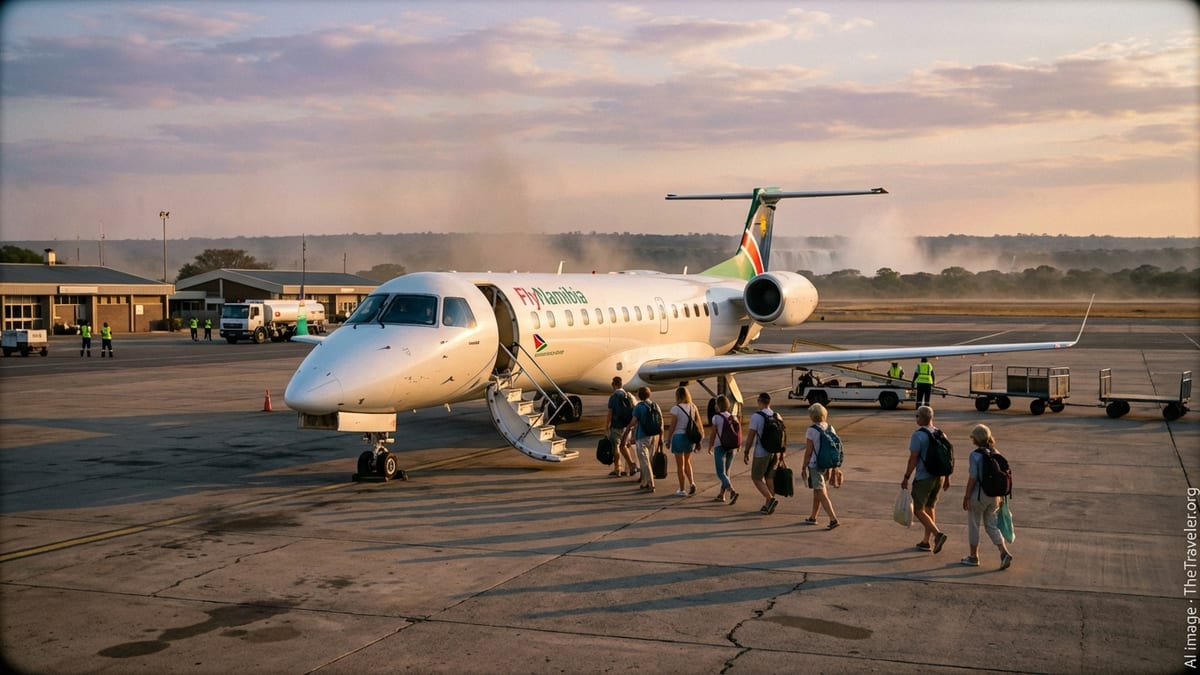
More Seats to the Smoke That Thunders
From April 2026, FlyNamibia will increase flights on its Windhoek–Victoria Falls route from three to six per week, sharply improving access to one of Africa’s most famous natural wonders. Operating from Namibia’s capital into the Zimbabwean side of the falls, the enhanced schedule is designed to give international and regional visitors far greater flexibility when building cross-border itineraries.
The route, first launched in partnership with Airlink in 2024, has steadily grown in popularity among tour operators and independent travelers looking to pair Namibia’s desert landscapes with the Zambezi River and surrounding reserves. The decision to double frequencies reflects sustained demand for shorter travel times and more direct connections between key safari hubs.
Additional flights are also expected to support growing trade and conference travel between the two countries. Tourism officials in both Namibia and Zimbabwe have been positioning the Victoria Falls corridor as a year-round destination that combines wildlife, adventure activities and regional events, making air capacity a crucial part of long-term growth plans.
FlyNamibia’s upgraded schedule will be timed to connect with long-haul arrivals into Windhoek, allowing visitors from Europe, North America and the Middle East to reach Victoria Falls with a single regional hop instead of complex routings through multiple hubs.
Effortless Multi-Destination Safari Journeys
The expanded Victoria Falls schedule is a cornerstone of a broader regional push to market Southern Africa as a single, easily navigable safari playground. By tightening the links between Windhoek, Victoria Falls and Botswana’s wildlife gateways, FlyNamibia is giving travelers the tools to craft seamless journeys across some of the continent’s most celebrated ecosystems.
Typical itineraries are expected to combine Namibia’s Sossusvlei dunes, Skeleton Coast or Etosha National Park with time at Victoria Falls and Botswana’s Okavango Delta or Chobe National Park. Previously, stitching these destinations together required a patchwork of charter flights or lengthy overland transfers; with more frequent scheduled services, the same trip can now be executed in fewer travel days and at more predictable cost.
Tour operators are already responding by designing round-trip circuits that begin and end in Windhoek, with guests flying to Victoria Falls, continuing on to Botswana, then looping back to Namibia. The ability to issue single or interline tickets across multiple flights also improves protection in the event of delays, making complex, multi-country safaris less risky for high-spend international visitors.
For the wider region, this model supports longer average stays and higher per-trip spending, both of which are priorities for tourism boards seeking to deepen the value of each visitor while managing environmental pressures on flagship parks and reserves.
Stronger Links to Maun, Katima Mulilo and the Kavango-Zambezi Region
Alongside the Victoria Falls boost, FlyNamibia is increasing frequencies on its Windhoek–Maun–Katima Mulilo route to four flights per week from April 2026, operating on Mondays, Wednesdays, Fridays and Sundays. This route connects Namibia’s capital directly with Botswana’s safari gateway of Maun and the far northeastern town of Katima Mulilo in the Zambezi Region.
Maun serves as the primary access point to the Okavango Delta, one of the world’s great wetland wildernesses, while Katima Mulilo sits within the Kavango-Zambezi Transfrontier Conservation Area, a five-country conservation initiative spanning Namibia, Angola, Botswana, Zambia and Zimbabwe. The increased schedule is expected to facilitate easier movement between lodges, houseboats and riverfront reserves straddling national borders.
By feeding passengers into Maun and Katima Mulilo, FlyNamibia is effectively stitching together a network of air bridges across the KAZA landscape. Travelers can fly from Windhoek into Victoria Falls, connect onward to Maun for delta safaris, then return via Katima Mulilo to explore Namibia’s riverine parks such as Bwabwata and Nkasa Rupara, all with minimal backtracking.
Industry observers say this kind of regional integration supports the long-term vision of KAZA: to enable wildlife to move freely across frontiers while communities, lodges and operators benefit from tourism revenues generated by multi-country itineraries rather than isolated, single-destination stays.
Windhoek’s Growing Role as a Regional Gateway
Windhoek’s Hosea Kutako International Airport has been steadily positioning itself as a secondary hub for Southern Africa, and FlyNamibia’s latest expansion underscores that ambition. With the national carrier Air Namibia no longer operating, private and regional airlines have stepped in to connect the country to Johannesburg, Cape Town, Harare and now increasingly to the Zambezi and Okavango tourism corridors.
Recent interline agreements signed by FlyNamibia with other regional carriers, including partners in Zimbabwe, mean that tickets can be sold through from Windhoek to Harare via Victoria Falls, as well as onward to other African capitals. This level of connectivity makes Namibia more accessible as both a starting point and a central node for itineraries spanning several countries.
For travelers, Windhoek offers a relatively calm, compact entry into the region compared with larger hubs. Its growing roster of international services, combined with an expanding web of short-haul routes, allows visitors to arrive, connect and be on safari within hours. Travel planners say this is particularly attractive for first-time visitors to Africa and for repeat guests seeking a fresh, less congested gateway.
Local tourism businesses, from guesthouses to ground handlers, also stand to gain from higher passenger throughput. Overnight stays in Windhoek before or after regional flights translate into additional revenue and opportunities to showcase the city’s food scene, craft markets and urban culture alongside its role as a logistical hub.
Boost for Communities, Conservation and Year-Round Tourism
Beyond convenience for visitors, the doubling of flights to Victoria Falls and the bolstering of services to Maun and Katima Mulilo carry significant implications for local economies and conservation initiatives. Increased, predictable air access tends to encourage investment in lodges, guides, transport services and community-based tourism projects, particularly in remote areas where alternative industries are limited.
More reliable connections can support employment in guiding, hospitality and ancillary services, especially for rural communities along the Zambezi and Okavango rivers. Many of these communities are partners in conservancies or co-managed parks where tourism revenue is directly linked to wildlife protection and habitat maintenance.
Year-round scheduling also helps smooth out the traditional peaks and troughs of safari tourism. With more flight options, visitors are better able to target shoulder seasons when wildlife viewing is still strong but crowding is lower, reducing pressure on ecosystems during the busiest months. Operators note that this can lead to more sustainable use of sensitive areas, helping to safeguard the very landscapes that draw travelers in the first place.
As FlyNamibia prepares to roll out its expanded regional network, tourism boards in Namibia, Zimbabwe and Botswana are expected to ramp up joint marketing campaigns positioning the trio as a unified, easily accessible safari super-region. For travelers, the message is clear: it has never been simpler to combine the dunes of the Namib, the spray of Victoria Falls and the floodplains of the Okavango Delta in a single, fluid journey.