

More news on this day
FlyNamibia will significantly expand its regional network from April 2026, doubling flights to Victoria Falls and increasing services to Maun and Katima Mulilo in a move aimed at cementing Namibia’s role as a gateway to Southern Africa’s safari heartlands.
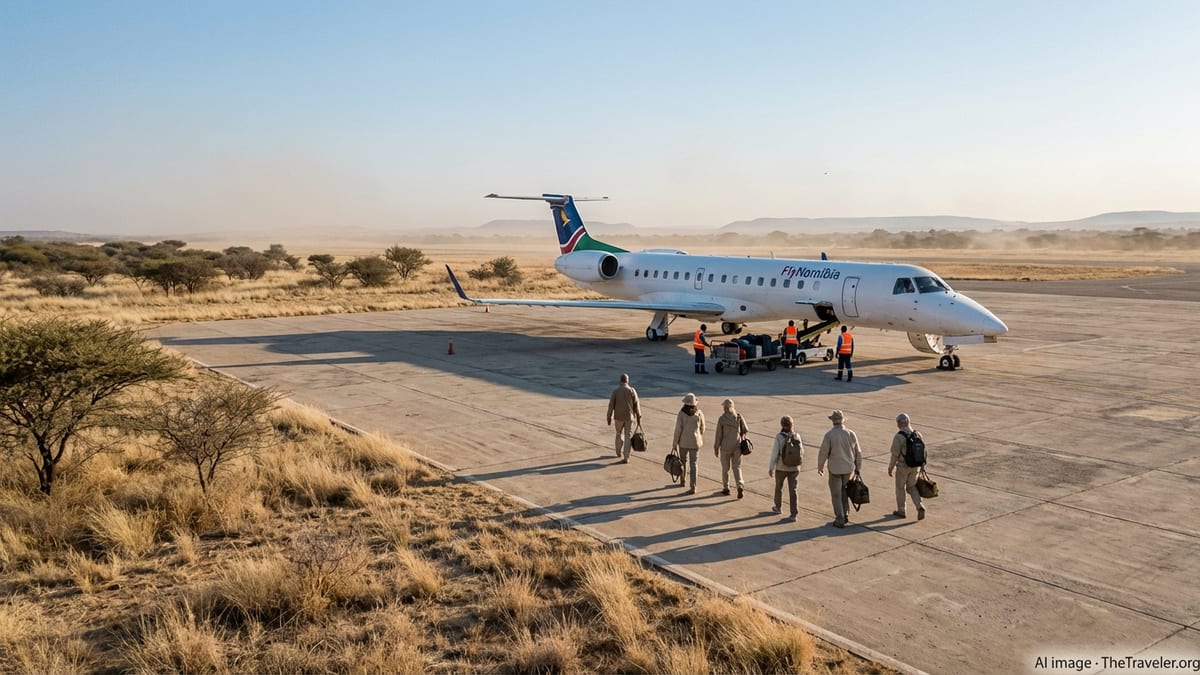
Network Expansion Targets Safari Corridor Growth
According to recent announcements, from April 2026 FlyNamibia will increase its Windhoek to Victoria Falls route from three to six weekly flights, while flights linking Windhoek with Maun and Katima Mulilo will rise to four per week. The enhanced schedule builds on the airline’s existing seasonal operations and reflects growing demand for seamless access to Botswana’s Okavango Delta, Zimbabwe’s Victoria Falls and Namibia’s Zambezi Region.
The airline’s Windhoek hub, served by both Eros Airport for domestic routes and Hosea Kutako International for regional services, has become an important springboard for multi-country itineraries. With the new frequencies, tour operators will be able to reduce layovers, offer tighter connections and design more efficient circular routes that link Namibia with neighbouring safari destinations.
Industry observers say the timing is deliberate. Long-haul carriers are adding or ramping up services into Namibia and the wider region in 2026, and FlyNamibia’s expanded regional footprint is positioned to capture a greater share of this inbound traffic and disperse visitors deeper into Southern Africa’s wilderness areas.
Boost for Namibia’s Tourism and Trade Ambitions
The increased frequencies are expected to deliver a tangible uplift for Namibia’s tourism economy, which has been rebuilding and diversifying since the collapse of former flag carrier Air Namibia in 2021. With more reliable links to high-profile safari and adventure destinations, Namibia strengthens its proposition as a central stop on Southern African travel circuits rather than a standalone long-haul destination.
Additional capacity into Maun and Victoria Falls is particularly significant for lodge operators, destination management companies and conservation tourism ventures that rely on high-spending visitors and predictable air access. More flight options typically translate into longer average stays, greater spend per trip and higher demand for local guides, transport providers and hospitality services.
FlyNamibia has also emphasised the role of cargo in the expansion. By using the added frequencies to move goods as well as passengers, the airline aims to support small and medium-sized businesses that depend on fast regional logistics, from fresh-produce exporters in the Zambezi Region to craft producers and safari suppliers serving camps across borders.
Stronger Links to Victoria Falls, Maun and the Zambezi Region
Victoria Falls, one of Africa’s best-known natural attractions, has long served as a key junction for regional travel, with onward links into Zimbabwe, Zambia and beyond. Doubling the Windhoek to Victoria Falls service will make it easier for travellers to combine Namibia’s deserts and coastlines with classic Zambezi River and waterfall experiences in a single itinerary.
In Botswana, Maun is widely regarded as the primary aviation gateway to the Okavango Delta. By lifting Windhoek to Maun and Katima Mulilo flights to four per week, FlyNamibia is tightening the connection between its domestic safari circuit and the Delta’s network of lodge airstrips and regional services. This enhanced connectivity dovetails with new scheduled flight circuits being introduced by specialist safari operators, many of which will rely on FlyNamibia’s links to feed guests into remote camps.
Katima Mulilo, on Namibia’s northeastern tip, functions as a strategic access point to the Zambezi Region and the broader Kavango-Zambezi Transfrontier Conservation Area. More frequent flights into the town help unlock lesser-known wilderness zones along the Zambezi and Chobe rivers, areas that tourism planners view as growth frontiers for low-impact, high-value safari development.
Strategic Partnerships and Regional Aviation Shifts
FlyNamibia’s regional build-out is taking place alongside a broader reshaping of Southern Africa’s aviation landscape. The airline already operates its scheduled services under the 4Z code through a franchise arrangement with South African carrier Airlink, and has aligned certain schedules with other regional operators to create smoother same-day connections.
In Zimbabwe, collaboration with carriers operating the Victoria Falls to Harare sector enhances the utility of FlyNamibia’s Windhoek to Victoria Falls link, effectively opening a convenient corridor between Namibia and the Zimbabwean capital. This is expected to benefit both leisure travellers adding city stays to safari trips and business passengers moving between the two markets.
With new long-haul routes to Windhoek due in 2026, and additional regional links from neighbouring countries into Namibia and Victoria Falls, FlyNamibia’s expanded timetable places it at the centre of an increasingly interconnected web of services. Aviation analysts note that this web is crucial for maintaining competitive fares and improving schedule resilience in a market still adjusting to the loss of a state-owned flag carrier.
Outlook: Consolidating Namibia’s Role as a Regional Hub
Looking ahead, the April 2026 expansion is seen as a step towards a more integrated Southern African air network in which medium-sized carriers and specialist operators share the task of feeding tourists and business travellers between international gateways and remote destinations. For Namibia, the strategy is aligned with national goals to grow tourism’s contribution to GDP, promote investment in rural areas and support conservation through nature-based tourism.
Travel trade stakeholders expect that the added capacity will encourage new itineraries that combine iconic Namibian sites such as Etosha National Park and the Namib Desert with Botswana’s wetlands and Zimbabwe’s wildlife areas. The result, they argue, will be a more compelling regional product for key source markets in Europe and North America, where travellers increasingly seek multi-country journeys with strong wildlife and sustainability credentials.
For FlyNamibia, the challenge will be to balance growth with reliability and to maintain load factors on routes that serve both seasonal tourism flows and the everyday mobility needs of local communities. If successful, the April 2026 network expansion could mark a pivotal moment in the airline’s evolution from a primarily domestic operator to a central player in Southern Africa’s safari and trade corridors.