

More news on this day
South African low-cost carrier FlySafair has announced a temporary fuel surcharge on its tickets from March 12 to May 12 2026, responding to a sudden spike in jet fuel prices that threatens to erode travel affordability and dampen the country’s fragile tourism recovery.
Get the latest news straight to your inbox!
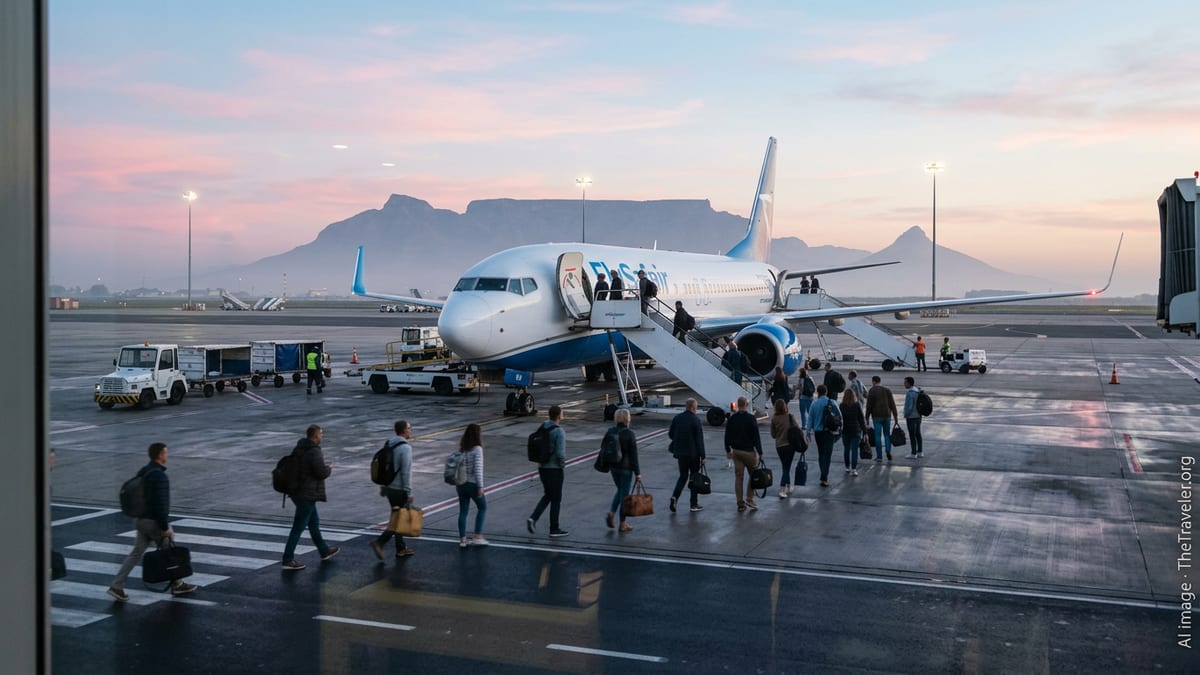
Sharp Jet Fuel Spike Forces Airline’s First Surcharge
FlySafair, South Africa’s largest domestic airline by passenger numbers, confirmed this week that it will apply a temporary “dynamic fuel surcharge” across its network after Jet A1 fuel prices at South African airports climbed by about 70 percent in just one week. Executives said the airline has been absorbing rising fuel costs since late February, when conflict in the Middle East began disrupting oil markets, but the latest surge has pushed operating costs to unsustainable levels.
The surcharge, which FlySafair has resisted throughout its 12 year history, will be itemised separately on tickets rather than baked into base fares. The airline said this approach is intended to keep pricing transparent, allowing customers to see exactly how much of their total ticket cost is being driven by the fuel shock.
Fuel typically accounts for around half of FlySafair’s direct operating expenses. At current price levels, the carrier estimates that each hour flown by its Boeing 737 800 fleet costs roughly an additional R35 000 in fuel. The temporary levy is designed to recoup only a portion of that increase while keeping the airline’s low cost positioning intact.
FlySafair has stressed that the measure is explicitly temporary and will be reviewed regularly. The surcharge currently applies to flights departing on or before May 12 2026, reflecting the company’s expectation that the current oil market disruption may prove short lived, even as analysts warn of continued volatility.
How the Temporary Surcharge Will Affect Travellers
For South African travellers, the new fee will not be applied retrospectively. Customers who booked and paid for their tickets before the effective date will not see any change in their total fare, protecting early planners from unanticipated cost hikes. The surcharge will, however, apply to new bookings and to changes made to existing reservations when the revised flight departs within the March 12 to May 12 window.
The fuel surcharge will vary by route length to mirror actual fuel consumption, meaning passengers on longer domestic sectors such as Johannesburg to Cape Town or Durban to Gqeberha are likely to shoulder higher additional costs than those on shorter hops. While FlySafair has not publicly confirmed exact rand figures per route, industry observers expect the charge to add anything from tens to a few hundred rand per ticket depending on distance and demand conditions.
Budget conscious leisure travellers, who form a large share of FlySafair’s customer base, may feel the pinch most acutely. Many South Africans rely on low cost domestic flights to visit relatives, access coastal holidays and connect to safari and wine regions. Even relatively small increases in ticket prices can prompt households to shorten trips, switch to road travel or postpone discretionary journeys altogether.
Business travellers are expected to absorb the increases more easily, especially on high frequency corporate routes between Johannesburg, Cape Town and Durban. However, travel buyers and corporate procurement managers will be watching closely to see whether the surcharge is indeed lifted in May or quietly extended if fuel prices remain elevated.
Tourism Recovery at Risk as Costs Creep Up
The timing of FlySafair’s move is particularly sensitive for South Africa’s tourism sector, which has been slowly rebuilding after the pandemic era collapse in international and domestic travel. Strong domestic demand and a weak rand have helped fill planes on popular leisure routes, supporting hotels, guesthouses and attractions from the Garden Route to Kruger National Park.
Higher airfares could cool that momentum. Domestic tourism has been a critical buffer for many destinations, with local travellers substituting international holidays for more affordable trips within South Africa. Industry stakeholders fear that if flight prices rise too sharply, households may cut back on travel altogether rather than simply shifting destinations.
Regional tourism flows may also be affected, as FlySafair expands its footprint beyond South Africa’s borders into neighbouring markets. Any broad based perception that flying in and out of South Africa is becoming more expensive risks undermining investment in new routes and tourism experiences that depend on reliable, competitively priced air access.
At the same time, analysts note that airlines are operating on thin margins after years of disruption and cannot indefinitely absorb external cost shocks without compromising safety, reliability or future growth. For destinations reliant on FlySafair’s capacity to keep seats in the market, a temporary surcharge may be a lesser evil than a scaled back schedule or sharply higher base fares.
Competitive Pressures and Policy Questions
FlySafair’s decision also puts a spotlight on its competitors. State owned South African Airways has publicly signalled that it will try to keep fares steady for now, although it has acknowledged that it is closely monitoring fuel markets and supply conditions. Other carriers in the region may be forced to follow FlySafair’s lead if oil prices remain high or climb further.
Globally, surcharges linked to fuel have long been a feature of airline pricing, but they remain controversial with passengers and consumer advocates. Critics argue that surcharges can be opaque, make comparison shopping harder and sometimes persist long after the fuel price spikes that originally justified them have abated. FlySafair’s commitment to a clearly labelled, time bound charge is in part an attempt to address those concerns.
The move also revives debates about how exposed South African aviation is to external shocks, from geopolitical conflicts to exchange rate swings. While airlines can hedge fuel costs to some extent, sudden supply disruptions and price jumps are difficult to fully insure against. Some industry voices are calling for more coordinated national strategies on fuel storage, procurement and taxation to cushion carriers and travellers from the sharpest volatility.
Tourism advocates, meanwhile, are urging policymakers to avoid any additional cost burdens on air travel while the country is still rebuilding visitor numbers. With travel affordability under pressure from both global and domestic forces, the balance between airline sustainability and accessible fares is likely to remain a central policy question in the months ahead.
What Travellers Can Expect in the Months Ahead
In the short term, passengers booking FlySafair flights through May 12 should expect to see the fuel surcharge broken out as a separate line item at checkout and on their tickets. Travel planners are advising customers to factor the extra cost into their budgets and to book early where possible, particularly for peak holiday and long weekend periods when inventory is already tight.
Should fuel prices retreat meaningfully, FlySafair has indicated that it will scale back or remove the surcharge, a pledge that will be closely watched by consumer groups and travel agents. Conversely, if oil markets remain unsettled, there is a risk that temporary measures become longer term features of ticket pricing, either in the form of continued surcharges or more permanent adjustments to base fares.
For now, the carrier’s move serves as a reminder of how swiftly global events can ripple through to the cost of a domestic flight. With the aviation sector once again navigating external shocks, both airlines and travellers face a period of uncertainty in which flexibility, transparency and clear communication will be critical to sustaining confidence in South Africa’s skies and its tourism driven economy.