

Food and grocery costs are a central consideration for anyone evaluating a move to Mexico. For many expatriates, Mexico’s food prices can significantly reduce overall living expenses compared with North America or Western Europe, but outcomes vary widely by city, purchasing habits and dietary expectations. Understanding current price levels, recent inflation trends and typical monthly grocery budgets is essential for realistic relocation planning.
Overview of Food Price Levels and Inflation
Mexico’s overall consumer inflation has remained broadly within the central bank’s target band in recent years, but food prices have been more volatile. Headline inflation hovered in the mid 3 to mid 4 percent range through 2024 and 2025, with food items in the basic basket at times outpacing general inflation. Analysts tracking the official basic food basket report cumulative increases of roughly 4 to 5 percent in some recent 12 month periods, slightly above headline price growth.
For relocating foreigners, this means grocery costs in 2026 are no longer at the ultra low levels seen a decade ago, but they remain competitive in global terms. International cost of living datasets place Mexico’s grocery index at roughly 40 to 45 on a scale where 100 corresponds to average grocery prices in major cities of the United States. In practical terms, a typical basket of staple foods purchased in a mid sized Mexican city will often be 30 to 50 percent cheaper than in a large US or Canadian city, though import heavy diets can erode this advantage.
Importantly, inflation pressures have not been uniform across all products. Fresh fruits and vegetables, eggs and some meats have recorded episodic spikes related to weather, transport costs or international commodity prices. Conversely, government attention to the cost of the canasta básica, along with competition among supermarket chains, has limited price growth for some everyday staples. Relocating households should anticipate modest but ongoing food price increases rather than dramatic short term shifts, and build a small buffer into grocery budgets accordingly.
Current Price Benchmarks for Key Food Items
To evaluate relocation feasibility, expats generally need concrete benchmarks rather than indices. Mid 2026 crowd sourced and retail price tracking data indicate the following typical price ranges in Mexican pesos (MXN) for commonly purchased items in large and mid sized cities:
At national level, commonly observed supermarket prices include approximately 25 to 35 MXN for a liter of regular milk, 45 to 70 MXN for a dozen eggs, and 45 to 70 MXN per kilogram for basic white rice. Chicken breast often ranges around 110 to 150 MXN per kilogram, while local cheese can fall in the 130 to 220 MXN per kilogram band depending on type and brand. Fresh white bread from supermarkets is usually around 30 to 50 MXN per 500 g loaf. Local apples or bananas often fluctuate between 30 and 60 MXN per kilogram, with tomatoes frequently in a similar broad range depending on season.
Imported or premium products are noticeably more expensive. Breakfast cereals from multinational brands, Greek yogurt, imported cheeses, almond or oat milks, and gluten free or organic items can be priced at or above levels seen in the United States when converted at current exchange rates. Wine and specialty international sauces and condiments (for example pesto, maple syrup or Asian branded sauces) typically carry a substantial import premium. Expats whose diets depend heavily on such items should adjust grocery cost expectations upward relative to local households.
The following table provides approximate urban supermarket price ranges in MXN for a selection of items, as a snapshot rather than a binding quote:
<table>
<tr><th>Item (supermarket)</th><th>Typical price range (MXN)</th></tr>
<tr><td>Milk, 1 liter</td><td>25 - 35</td></tr>
<tr><td>Eggs, 12 large</td><td>45 - 70</td></tr>
<tr><td>Chicken breast, 1 kg</td><td>110 - 150</td></tr>
<tr><td>Beef (mid range cuts), 1 kg</td><td>180 - 280</td></tr>
<tr><td>White rice, 1 kg</td><td>45 - 70</td></tr>
<tr><td>Bread loaf, 500 g</td><td>30 - 50</td></tr>
<tr><td>Local apples, 1 kg</td><td>35 - 60</td></tr>
<tr><td>Tomatoes, 1 kg</td><td>25 - 60</td></tr>
<tr><td>Domestic cheese, 1 kg</td><td>130 - 220</td></tr>
<tr><td>Bottled water, 1.5 L</td><td>12 - 25</td></tr>
</table>
Prices at discount supermarkets and wholesale clubs can be lower than the mid ranges above, especially for bulk purchases, while small convenience stores often charge 10 to 30 percent more per unit. For household budgeting, it is reasonable for expats in 2026 to assume that a representative weekly trolley of mixed staples and mid range products will cost significantly less than in major US cities, but not uniformly low compared with other emerging markets.
Grocery Channels: Supermarkets, Markets and Specialty Stores
Choice of shopping channel has a material impact on total food costs. Mexico has a layered retail ecosystem that includes large modern supermarkets, warehouse clubs, discount chains, municipal markets and informal street vendors. Each offers distinct price points and product quality profiles relevant to expatriates.
Modern supermarket chains and hypermarkets dominate in large urban areas and are typically the first reference point for new arrivals. These outlets offer standardized pricing, clear labeling, extensive packaged goods, cold chains for dairy and meat, and a broad range of local and imported products. Prices for packaged staples are often competitive due to national promotions, while imported items carry higher margins. For most expats, supermarkets become the baseline for estimating monthly grocery expenses.
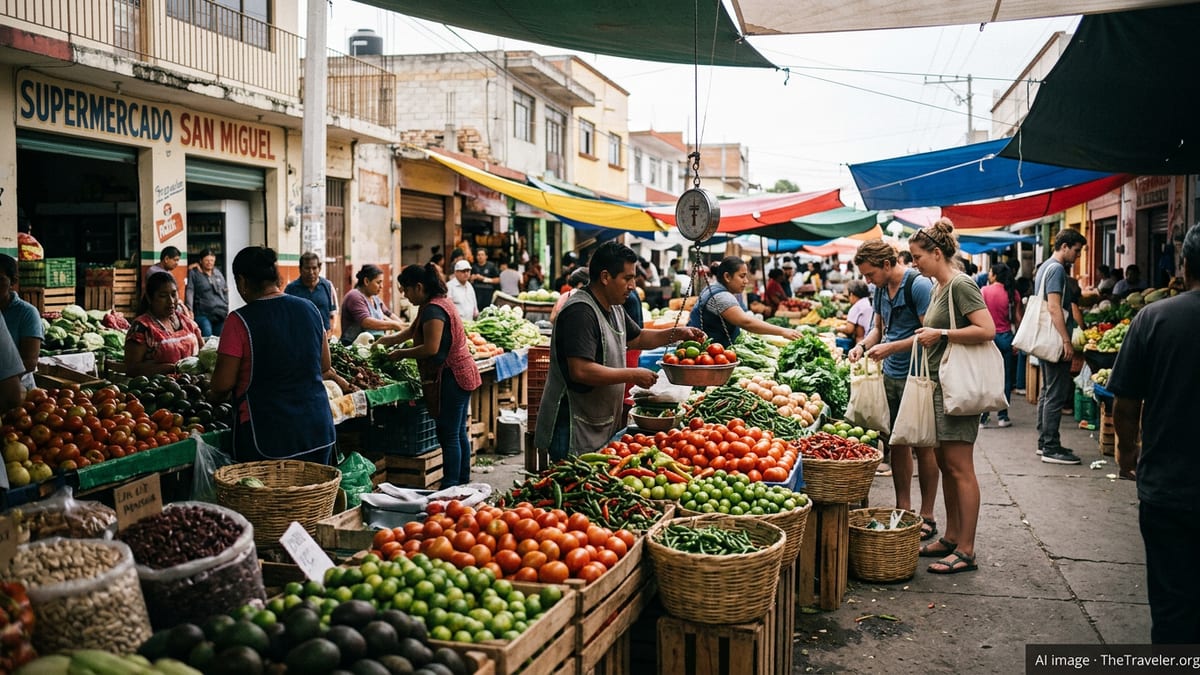
Traditional public markets and neighborhood fruterías and carnicerías frequently offer lower prices for fresh produce, meat and basic dry goods. Studies of Mexican retail patterns show that households relying more heavily on traditional markets can reduce their fresh food costs meaningfully, particularly for fruits, vegetables, eggs and some meats. However, price transparency and consistency can vary, and quality and hygiene standards must be assessed case by case. Many long term expatriates adopt a hybrid approach, purchasing packaged and specialty items in supermarkets while sourcing produce and some proteins from markets to optimize overall cost and freshness.
Specialty and gourmet stores cater to higher income customers and foreign tastes, particularly in Mexico City, Guadalajara, Monterrey and popular coastal cities. These outlets stock international brands, organic goods, plant based alternatives and niche dietary products. Average price levels in such stores can be substantially higher than mainstream supermarkets, often approaching or exceeding pricing in advanced economies. Relocating professionals with specific dietary needs may need to factor in a significant grocery budget premium if they depend heavily on these channels.
Regional and Urban Rural Variations
Food and grocery prices in Mexico vary meaningfully by region and by city size. Monitoring of the official basic food basket has highlighted that some metropolitan areas in the Bajío and southeast register higher basket costs than others, while certain border and interior cities are comparatively cheaper. Differences of 15 to 30 percent in the cost of an equivalent basic basket between the most and least expensive cities are not unusual.
In general, large metropolitan areas such as Mexico City, Monterrey and Guadalajara show higher supermarket prices for branded and imported goods, reflecting higher commercial rents and incomes. At the same time, competition among multiple chains can keep prices for staple private label items relatively contained. Tourist intensive coastal cities and gentrified neighborhoods within major cities tend to display premium pricing, particularly in smaller format stores, organic outlets and foreign oriented delis.
Mid sized interior cities and many rural areas exhibit lower average prices for locally produced items, especially fruits, vegetables and some meats, due to proximity to agricultural production and lower distribution costs. However, imported goods and niche products may be scarce or carry higher markups in such locations. For expats whose diets closely track local consumption patterns and who are comfortable shopping in public markets, interior cities can offer significant food cost savings compared with both large Mexican cities and home country benchmarks.
Border cities and towns present a mixed picture. Local staples can be affordably priced, but cross border trade and exposure to US demand can push up prices of some products, particularly those imported from the United States. Additionally, many cross border shoppers compare prices in both currencies and adjust purchasing patterns accordingly, which can influence local merchants’ pricing strategies over time.
Eating Out vs Cooking at Home
For many expatriates, a significant share of food expenditure is allocated to eating out rather than groceries. Restaurant prices in Mexico are generally low by international standards, but have also experienced gradual increases in recent years due to higher labor, rent and ingredient costs. The relative affordability of local eateries can influence how much of the overall food budget is devoted to groceries.
Recent price benchmarks suggest that an inexpensive sit down meal at a modest restaurant in a mid sized Mexican city typically costs around 120 to 180 MXN per person, excluding drinks. A mid range three course meal for two people at a restaurant commonly frequented by professionals is often in the 600 to 1,000 MXN range, depending on city and neighborhood. A basic combo meal at a multinational fast food chain tends to fall around 135 to 200 MXN. These figures mean that regular restaurant dining is accessible to many relocating professionals, although costs will escalate rapidly in premium or tourist heavy districts.
By contrast, preparing meals at home using supermarket staples usually reduces per meal costs substantially. For example, a home cooked chicken, rice and vegetable meal for two can often be assembled for well under 150 MXN in total when ingredients are purchased efficiently, compared with restaurant equivalents that might cost several times more. Over a month, a household that cooks most meals at home and limits restaurant visits to occasional outings can expect its per person food cost to be dominated by grocery bills rather than by dining out.
From a relocation budgeting perspective, it is useful to model separate monthly envelopes for groceries and for eating out. In practice, expatriates who rely heavily on restaurants for convenience may see their total food spending approach or exceed levels in their home countries, even if grocery staples remain cheaper. Those prioritizing home cooking and local ingredients are more likely to capture the full food cost advantage of living in Mexico.
Typical Monthly Grocery Budgets for Expats
Monthly grocery costs for expatriates in Mexico vary based on city, household size, cooking frequency and lifestyle. However, triangulating household expenditure surveys and current price data yields plausible ranges for 2026 that can support relocation modeling. The figures below exclude alcohol and extensive dining out, and assume a diet relying mainly on local products with some imported items.
A single adult who cooks most meals at home and shops primarily at mainstream supermarkets and local markets can often maintain a basic but varied diet on approximately 3,000 to 5,000 MXN per month in a mid priced city. This level generally involves limited imported goods and modest consumption of meat and dairy. A more comfort oriented single expat purchasing a higher proportion of branded products, more meat and some imported items might spend in the range of 5,000 to 8,000 MXN monthly on groceries.
A couple following similar patterns might expect a combined grocery bill in the region of 6,000 to 10,000 MXN per month for a cost conscious approach, and 8,000 to 14,000 MXN for a more premium diet in larger cities. For a family with two children, combined grocery spending bands of roughly 10,000 to 18,000 MXN per month are common estimates among foreign households, again with higher numbers associated with heavy reliance on imported products, special diets or shopping in upscale districts.
These ranges should be treated as indicative rather than prescriptive. Exchange rate fluctuations, regional price spreads and individual shopping habits can shift outcomes upward or downward. Prospective movers are advised to perform trial budget exercises using current local supermarket price lists for their target city and adjust for planned restaurant usage, alcohol consumption and special dietary needs.
Managing Food Costs: Strategies and Trade Offs
Relocating professionals retain considerable control over their ultimate food and grocery costs in Mexico. Several practical strategies are commonly adopted by cost conscious expatriates while maintaining acceptable quality and convenience. The main trade offs involve time, familiarity and dietary flexibility rather than pure price alone.
First, diversifying shopping channels tends to yield the greatest savings. Purchasing shelf stable items, cleaning products and dairy in large supermarkets or warehouse clubs, while sourcing fruits, vegetables and sometimes meats from traditional markets, can reduce the total monthly bill relative to a supermarket only approach. Over time, building familiarity with local market vendors, seasonal cycles and quality indicators enables more precise purchasing and less food waste.
Second, moderating imported and specialty product consumption helps keep budgets aligned with local income benchmarks. Replacing imported cheeses with domestic options, using local beans and grains in place of foreign packaged foods, and learning recipes based on widely available ingredients all contribute to sustaining lower per meal costs. Conversely, maintaining a diet heavily anchored in imported brands effectively shifts a portion of an expat’s food basket back to developed economy price levels.
Third, planning meals and buying in bulk where appropriate mitigates the impact of food inflation. Many Mexican households and expats alike purchase staples such as rice, beans, flour, oil and sugar in large formats, benefiting from lower unit prices and reducing the frequency of store visits during periods of rising prices. Simple menu planning aligned to weekly promotions and seasonal availability also tends to reduce overall spending, as does limiting impulse purchases in higher priced convenience stores.
The Takeaway
For expatriates, food and grocery costs in Mexico in 2026 are generally favorable compared with major cities in North America and Western Europe, but not uniformly low across all product categories or locations. Staple foods, fresh produce in season and locally produced meats and dairy are typically inexpensive in peso terms and still competitive after currency conversion. However, imported brands, specialty dietary products and meals in higher end restaurants can erode or eliminate the headline savings suggested by broad cost of living indices.
Regional disparities, city specific dynamics and shopping channel choices all play important roles in determining a relocating household’s actual food expenditure. A realistic assessment should therefore move beyond generic country averages and instead consider the target city, anticipated neighborhood, preferred diet, and willingness to adapt to local shopping and cooking practices. With informed planning, many expat households are able to secure high quality diets at substantially lower absolute cost than in their home countries, but this outcome is not automatic and depends on conscious choices.
FAQ
Q1. How much should a single expat budget monthly for groceries in Mexico?
A cost conscious single expat who cooks at home and focuses on local products can often budget around 3,000 to 5,000 MXN per month, while a more premium diet with frequent branded and imported items tends to fall closer to 5,000 to 8,000 MXN.
Q2. Are groceries significantly cheaper in Mexico than in the United States?
Basic staples and many fresh foods are usually 30 to 50 percent cheaper than in large US cities, but imported brands, specialty goods and upscale restaurant meals can approach or match US price levels.
Q3. Which Mexican cities have the highest food and grocery costs for expats?
Major metropolitan areas and tourist intensive cities tend to exhibit higher grocery and restaurant prices, particularly in central and high income neighborhoods and in specialty stores catering to foreign tastes.
Q4. Is it cheaper to shop at public markets than at supermarkets in Mexico?
Public markets often offer lower prices for fruits, vegetables and some meats, especially when buying seasonal products, while supermarkets can be competitive for packaged goods and private label staples.
Q5. How much does eating out add to a typical expat food budget in Mexico?
Inexpensive local restaurants are affordable, but regular dining at mid range or higher end venues can rapidly match or exceed home country spending, so heavy reliance on restaurants requires a larger food budget.
Q6. Are imported and specialty foods expensive in Mexico?
Yes, imported cheeses, cereals, plant based milks, gluten free products and international sauces often carry substantial markups, and frequent purchase of such items can significantly increase total grocery costs.
Q7. How volatile are food prices in Mexico from year to year?
Overall inflation has recently been moderate, but some food categories such as eggs, fresh vegetables and certain meats can experience noticeable short term price spikes linked to weather or supply conditions.
Q8. Can a family of four live comfortably on a modest grocery budget?
A family of two adults and two children that primarily consumes local products and cooks most meals at home may be able to maintain a varied diet on roughly 10,000 to 18,000 MXN per month, depending on city and habits.
Q9. Do warehouse clubs offer meaningful savings on food for expats?
Warehouse clubs can reduce the unit cost of staples and some packaged foods, especially for larger households, but annual membership fees and the temptation to overbuy should be considered when evaluating net savings.
Q10. What is the best way for expats to estimate their personal food costs before moving?
The most reliable method is to check current online price lists for supermarkets in the target city, map those prices to a realistic weekly meal plan, and then adjust for intended restaurant use and any reliance on imported products.