

Food and grocery costs in Thailand are a central consideration for foreign residents evaluating relocation. Thailand can offer comparatively low day-to-day food spending, particularly for those who adapt to local products and markets. However, prices vary significantly between metropolitan and provincial areas, between local and international brands, and between wet markets and modern supermarkets. Understanding these differences is critical for accurate budget planning and for aligning expectations with the realities of living in Thailand in 2026.
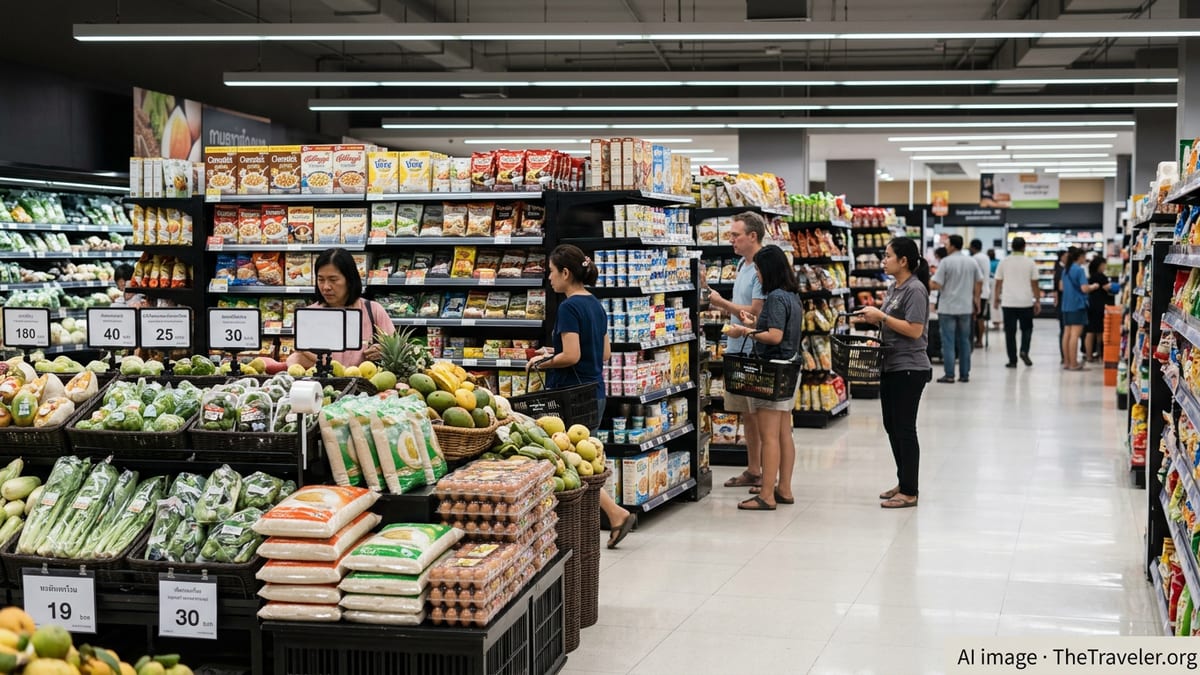
Overview of Food and Grocery Cost Structure in Thailand
Food spending in Thailand represents a substantial share of household budgets, and this pattern extends to many foreign residents. National statistics indicate that food and non-alcoholic beverages commonly account for roughly one quarter to one third of total household expenditure, with some variation by income level and region. For newcomers benchmarking costs, this provides a useful starting point for estimating the share of income that may be allocated to food once other relocation costs such as housing are determined.
Average Thai households reportedly spend in the range of 7,000 to 9,000 Thai baht per month on food consumed at home, with higher figures in Bangkok and lower figures in rural provinces. This includes staple items, fresh produce, basic animal protein, and packaged foods. Foreign residents who maintain a mixed diet of Thai and international products typically spend more than this domestic benchmark, while those who rely heavily on imported or specialty items can see grocery bills increase by 50 to 150 percent compared with local-oriented consumption.
For orientation, the Thai baht has recently traded at around 31 to 32 baht per US dollar in early March 2026, although this rate fluctuates. Converting Thai prices into foreign currencies should always use up-to-date rates and factor in transaction fees or card foreign exchange costs. From a relocation planning perspective, scenarios should be modeled in local currency first, then translated into home currency for comparability.
It is important to distinguish between food eaten at home and meals purchased outside the home. Thailand has a strong eating-out culture, with low to moderate prices at street stalls and simple eateries, but this article focuses primarily on groceries and household food purchases. Eating out is referenced only where it directly influences grocery budgeting decisions for foreign residents.
Local versus Imported Products
The most important driver of grocery costs for foreign residents in Thailand is the balance between local and imported products. Locally produced items such as rice, many vegetables, tropical fruits, eggs, poultry, pork, and basic seasonings are generally inexpensive in baht terms. By contrast, imported cheese, butter, cold cuts, breakfast cereals, premium coffee, and international snack brands are often priced at or above levels seen in Western Europe or North America after import duties, logistics, and retailer margins are factored in.
As a broad indicative range, local staples can cost a fraction of comparable imported items. A kilogram of Thai jasmine rice, for example, is often priced in the tens of baht, while imported specialty grains or organic Western-branded rice mixes can cost several times more per kilogram. Local fresh milk is moderately priced, whereas imported organic or lactose-free milk products may carry substantial markups. Similarly, local yogurt in Thai brands tends to be economical, while European or Australian yogurt brands sit in the premium price segment.
Foreign residents who are flexible about brand and origin and willing to switch to Thai or regional alternatives can manage grocery costs relatively efficiently. Those who wish to replicate a full Western diet using imported products from Europe, North America, or Australia should anticipate a grocery budget that is closer to, or even above, their home-country spending for food at home, particularly in large urban centers. Budget planning should explicitly map out which dietary elements are non-negotiable and evaluate facing price differentials product by product.
Special dietary requirements such as gluten-free, vegan specialty foods, or particular health supplements can further increase reliance on imported goods and drive up spending. These products are increasingly available in major Thai cities but often at niche pricing. Foreign residents with these needs should expect to allocate an additional premium above mainstream grocery budgets and to concentrate their purchases at large supermarkets or health food chains rather than at local markets.
Urban, Regional, and Neighborhood Price Differences
Food and grocery prices in Thailand vary by geography and even by neighborhood within the same city. Bangkok and its surrounding metropolitan area usually present the highest price levels, reflecting higher rents, logistics costs, and a concentration of international retailers catering to higher-income locals and foreigners. Secondary cities such as Chiang Mai, Pattaya, Phuket Town, and Khon Kaen tend to show slightly lower prices for local goods, but heavily touristed districts within these cities can still command premium pricing for imported items and convenience-oriented outlets.
In Bangkok, foreign residents typically have access to a wide range of supermarket formats from hypermarkets to high-end international grocery stores. These outlets stock extensive imported selections and often charge higher prices per unit than suburban hypermarkets or discount chains. In provincial towns, choice may be more limited, especially for specialized foreign goods, but local staples are generally less expensive. The trade-off for foreign residents is between product range and unit cost, with metropolitan areas favoring variety at a price premium.
Even within a single city, price segmentation is visible. Convenience stores located in central business districts and tourist areas may charge more for identical items than large-format stores in residential zones. Traditional wet markets commonly offer lower prices for fresh produce and animal protein than supermarkets, especially when buying in season and in moderate quantities. Establishing a shopping routine that combines larger, less frequent trips to hypermarkets with regular visits to neighborhood markets can significantly reduce overall food expenditure.
Transportation and time constraints also affect effective food costs. Foreign residents without private vehicles may rely on ride-hailing or taxis for large supermarket runs, adding transport costs to grocery spending. Those living near fresh markets can instead make frequent small purchases on foot, which can both lower direct costs and reduce waste from overbuying perishable goods.
Shopping Channels: Markets, Supermarkets, and Delivery
Thailand offers a layered food retail ecosystem that directly influences grocery costs for foreign residents. Traditional wet markets and fresh markets remain central for fresh produce, meat, fish, and herbs. Prices at these markets are typically the most competitive, particularly for in-season vegetables and fruits, and for cuts of meat commonly used in Thai cooking. Many foreign residents learn to navigate these markets to secure lower prices and fresher products, though language and bargaining norms may require a period of adjustment.
Modern supermarkets and hypermarkets are the primary channels for packaged foods, household goods, dairy products, and imported items. Prices in these outlets are usually posted and fixed, which provides transparency but not the negotiation room of traditional markets. Promotions and loyalty programs can yield significant savings on specific items, but base prices for imported goods remain relatively high. For cost-conscious foreign residents, using supermarkets primarily for non-perishable and specialty items, while sourcing most fresh food from markets, tends to provide a favorable balance between convenience and cost.
Convenience stores are ubiquitous in urban Thailand and play a prominent role in day-to-day food consumption. Items such as ready-to-drink coffee, snacks, instant noodles, and basic refrigerated foods are available at extended hours. However, per-unit prices in convenience stores are often higher than in supermarkets or markets, and reliance on these outlets as a main grocery source can materially increase monthly food spending. For foreign residents, convenience stores are best viewed as supplementary or emergency sources rather than primary grocery channels.
Online grocery delivery has expanded rapidly, especially in Bangkok and major cities. Several platforms offer same-day or next-day delivery from supermarkets, specialty grocers, and even wet markets. Delivery fees, service charges, and higher pricing for some delivery-eligible items can add a premium relative to in-person shopping, but this may be offset by saved time and transportation costs. Foreign residents should compare itemized costs between in-store and online baskets before adopting delivery as a routine solution, particularly when working within a fixed budget.
Typical Monthly Grocery Budgets for Foreign Residents
Monthly grocery budgets for foreign residents in Thailand vary widely according to city, household size, dietary preferences, and shopping behavior. However, it is possible to outline indicative bands, expressed in Thai baht, for planning purposes. These figures refer primarily to food consumed at home and standard household groceries, excluding alcohol and dining out.
At the lower end, a single person who primarily consumes Thai food, cooks at home using local ingredients, shops at fresh markets, and uses supermarkets sparingly for staples may be able to manage on approximately 4,000 to 7,000 baht per month for groceries. This scenario assumes minimal use of imported goods and a willingness to adapt to local brands and product sizes. It is more realistic in provincial towns and outer suburbs than in central Bangkok.
A mid-range single foreign resident in Bangkok or a major city who combines local staples with some imported foods, regularly uses supermarkets, and occasionally buys convenience products is more likely to spend in the region of 8,000 to 12,000 baht per month on groceries. Couples or small families with similar habits might reasonably project 12,000 to 25,000 baht per month, depending on the ages of children, dietary needs, and the extent of home cooking versus reliance on ready-made items.
At the higher end, foreign households seeking to maintain a predominantly Western diet, purchasing a large proportion of imported dairy, meat, bakery products, and packaged foods, may see monthly grocery bills that exceed 25,000 baht and can reach or surpass 40,000 baht, especially in Bangkok and resort areas. These budgets are common among families with multiple children, extensive dietary restrictions, or a preference for premium organic and specialty items. For relocation feasibility assessments, it is prudent to model both a local-adapted and a high-import scenario to understand the full range of possible outcomes.
Price Examples for Key Food Categories
While exact prices fluctuate by region, retailer, and season, examining relative price levels across food categories helps foreign residents understand where savings or cost pressures are likely. Local rice, noodles, and other carbohydrate staples are among the least expensive items on a per-calorie basis. Eggs and chicken are generally affordable, while pork is moderately priced and beef tends to be more expensive relative to local incomes. Fish and seafood range from economical to premium depending on species and source, with small river fish and farmed varieties generally cheaper than imported or high-demand seafood.
Vegetables grown domestically and in-season fruit are typically low-cost, especially when purchased in markets. Imported apples, berries, and stone fruits are significantly more expensive and can quickly increase overall grocery spending if consumed in large quantities. Local tropical fruits provide a more cost-effective source of vitamins and variety. Foreign residents who are flexible about fruit types and willing to adjust to seasonal availability can capture substantial savings compared with a fruit basket modeled on a European or North American diet.
Dairy products and cheese are key budget line items for many foreign residents. Local milk, yogurt, and basic cheese alternatives are moderately priced, but European-style cheeses, butter from Western brands, and specialty dairy products are heavily marked up. This category is often one of the main reasons that foreign-oriented grocery baskets cost more than Thai household averages. Coffee and tea show a similar split: local ground coffee and instant coffee are relatively affordable, while imported specialty beans and branded capsules carry a noticeable premium.
Packaged foods such as breakfast cereals, granola bars, and international snack foods are usually priced at or above Western levels when imported. Thai snack brands are more economical but may not match the specific preferences of foreign residents. Those willing to substitute local biscuits, chips, and sweets can moderate costs, while those who insist on familiar imported brands should account for a higher monthly grocery budget.
Inflation, Exchange Rates, and Recent Price Trends
Food prices in Thailand have trended upward over the past decade, reflecting both global commodity dynamics and domestic factors such as labor, fuel, and logistics costs. Research into urban food pricing has indicated that the cost of a typical Thai prepared dish has more than doubled over roughly a thirteen-year period, illustrating the cumulative effect of inflation on basic food expenditures. For foreign residents, this means that older anecdotal accounts of extremely low food prices can be misleading when applied to 2026 conditions.
Headline inflation in Thailand has generally been moderate in recent years, but food and beverage sub-indices often move differently from the overall consumer price index. Food price spikes can occur due to weather events affecting harvests, global grain and oilseed markets, or currency movements. These episodes may temporarily push up the cost of staples such as rice, cooking oil, and meat, as well as imported products that become more expensive when the baht weakens against major currencies.
Exchange rate dynamics play a central role for foreign residents budgeting in foreign currencies. With the Thai baht trading around the low 30s per US dollar in early March 2026, foreign residents whose income is denominated in stronger currencies may find local grocery prices relatively attractive in converted terms. However, currency movements can quickly alter this relationship. A depreciation of the baht makes imports more expensive in baht terms but can make Thailand cheaper in foreign currency terms, while an appreciation of the baht has the opposite effect.
Relocating individuals and HR mobility teams should therefore assess food and grocery budgets using multiple exchange rate scenarios and incorporate reasonable assumptions about annual food price inflation. Building a buffer of at least 10 to 20 percent above initial estimates can help accommodate unexpected price changes over the first years of residence, especially for households with inflexible dietary patterns or high reliance on imported goods.
The Takeaway
Food and grocery costs in Thailand for foreign residents are best understood as a spectrum rather than a fixed number. At one end, residents who embrace local ingredients, shop frequently at fresh markets, and limit imported goods can achieve relatively low monthly grocery bills by international standards. At the other end, households committed to a largely Western diet, shopping primarily in high-end supermarkets and relying heavily on imported products, should expect grocery spending that approaches or surpasses home-country levels.
Geographical location, shopping habits, and dietary choices interact to determine actual outcomes. Bangkok and major tourist centers offer the most product variety but with higher prices for foreign goods, while smaller cities and provincial towns provide cheaper local staples but reduced access to specialized imports. Online delivery adds convenience at a cost, and frequent reliance on convenience stores can materially inflate monthly bills.
For relocation planning, using Thai baht as the base budgeting currency, modeling multiple scenarios of local versus imported consumption, and applying conservative assumptions on inflation and exchange rate movements will yield more reliable forecasts. Employers and individuals evaluating assignments or long-term moves to Thailand should incorporate these nuances into cost-of-living assessments and allowance structures, treating food and grocery costs as a flexible but significant component of the overall relocation equation.
FAQ
Q1. How much should a single foreign resident budget monthly for groceries in Thailand?
A single foreign resident who mainly buys local products and cooks at home may spend roughly 4,000 to 7,000 baht per month, while those combining local and imported goods in major cities more commonly fall in the 8,000 to 12,000 baht range.
Q2. Are groceries cheaper in Thailand than in Western Europe or North America?
Local Thai staples and fresh produce are generally cheaper in baht terms than in many Western countries, but imported products, specialty items, and Western brands can be similar in price or more expensive, particularly in Bangkok.
Q3. Which shopping channels offer the lowest grocery prices in Thailand?
Traditional wet markets and fresh markets typically provide the lowest prices for produce, meat, and fish, while hypermarkets and discount supermarkets are cost-effective for packaged items. Convenience stores and premium international supermarkets are usually the most expensive options.
Q4. How much more expensive are imported foods compared with local Thai brands?
Imported foods can range from modestly more expensive to several times the price of local equivalents, depending on the category. Items such as cheese, butter, breakfast cereals, and specialty snacks often carry the largest markups compared with Thai brands.
Q5. Do grocery costs differ significantly between Bangkok and other Thai cities?
Yes. Bangkok and major tourist hubs usually have higher prices for many items, especially imported goods, due to higher operating costs and strong demand. Provincial towns and smaller cities often offer lower prices for local staples but a more limited range of foreign products.
Q6. How do food inflation and exchange rates affect foreign residents’ grocery budgets?
Food inflation increases local prices over time, while exchange rate movements change how those prices translate into foreign currencies. A weaker baht can make groceries cheaper in foreign currency terms, whereas a stronger baht makes them relatively more expensive for foreign residents paid in other currencies.
Q7. Is it realistic for foreign residents to rely mainly on fresh markets for groceries?
Many foreign residents successfully use fresh markets for most produce, meat, and fish, supplementing with supermarket purchases for packaged and specialty items. This approach is realistic for those comfortable with local shopping practices and willing to adapt to available cuts and seasonal produce.
Q8. How do special diets such as vegetarian, vegan, or gluten-free affect grocery costs?
Basic vegetarian diets based on local vegetables, rice, and legumes can be economical, but specialized vegan or gluten-free processed foods are often imported and more expensive. Foreign residents with strict dietary requirements should expect higher grocery budgets and may need to rely on large supermarkets or specialty stores.
Q9. Are online grocery delivery services cost-effective in Thailand?
Online delivery can be cost-effective when factoring in saved time and transport costs, but item prices, delivery fees, and service charges may exceed in-store costs. It is typically most economical when used selectively for bulk or heavy items rather than as the sole shopping method.
Q10. How should employers factor Thai grocery costs into relocation allowances?
Employers should consider typical local food spending, the assignee’s likely reliance on imported products, city-specific price levels, and potential exchange rate and inflation changes. Providing a cost-of-living allowance based on a mid- to high-range grocery budget scenario can help ensure that foreign residents maintain an appropriate standard of living without financial stress related to food.