

Few factory tours in the United States feel as alive and relevant as the Ford Rouge Factory Tour in Dearborn, Michigan. This is not a preserved relic of industrial history. It is a working home of the Ford F-150, one of America’s best-selling trucks, paired with a thoughtfully curated visitor experience that explains how a modern vehicle comes to life. From an elevated look at the assembly line to an 80-foot-high observation deck overlooking a vast living roof, the tour is designed to appeal to car enthusiasts, design lovers, families, and anyone curious about how big ideas turn into something that rolls off the line and onto the road.
Understanding the Ford Rouge Factory Tour Experience
The Ford Rouge Factory Tour is based inside the massive River Rouge industrial complex in Dearborn, a short drive west of downtown Detroit. Today, the heart of the visitor experience centers on the Dearborn Truck Plant, where many Ford F-150 trucks are assembled. The tour is not a scripted walk with a guide at the front of the group. Instead, it is a mostly self-guided, multi-part visit that allows you to move at your own pace through films, exhibits, observation points, and a walking route above the working assembly line.
The Henry Ford, the larger institution that operates the tour, describes it as a five or six-part experience, depending on the season. Elements typically include the Legacy Theater, Manufacturing Innovation Theater, an 80-foot-high Observation Deck, an elevated walkway inside the Dearborn Truck Plant, the Legacy Gallery, and in warmer months an Outdoor Living Lab focused on environmental innovation. Typical operating hours are roughly 9:30 a.m. to 5 p.m. on most days, with the last bus departures mid-afternoon, though exact times can vary slightly by season and day of the week. Tickets are sold through The Henry Ford, and buses usually depart from the Henry Ford Museum of American Innovation in Dearborn.
Visitors should expect a roughly two to three hour experience door to door. You begin at the museum campus, board a dedicated tour bus, and then ride through active industrial areas to the Rouge complex itself. Once at the visitor center, you pass through theaters and exhibits in any order permitted that day, then follow clear signs toward the observation deck and the plant walkway. Many travelers pair the Rouge tour with a half day at the adjacent museum, turning it into a full day focused on American innovation and automotive history.
Because this is a working factory, there are days when the assembly line may slow or pause for retooling, holidays, or maintenance. When the line is not running, the walkway and exhibits generally remain open, and video displays explain each stage of production. Travelers who have visited both during full production and during slower periods often note that the overall experience remains compelling, though those who are passionate about machinery and industrial motion may want to check ahead for any scheduled shutdowns when planning their dates.
The Dearborn Truck Plant: Watching F-150s Come to Life
The signature moment of the Ford Rouge Factory Tour for many visitors is the in-plant experience at the Dearborn Truck Plant. After passing through orientation exhibits, you reach an elevated glass-walled walkway that curves above portions of the final assembly line. Below you, workers fit wiring harnesses, dashboards, doors, seats, and beds to unfinished F-150 bodies that glide past on carriers. Overhead conveyors move painted body shells across the ceiling, while automated guided vehicles and parts bins feed each station below.
What you see in detail can change from day to day. On one visit, you might watch a row of SuperCrew cab F-150s in metallic blue and white receive their interiors. On another, you might see a batch of F-150s destined for fleet customers in more utilitarian colors. Some travelers report spotting high-performance models like the F-150 Raptor in various stages of assembly, though there is never a guarantee of which trims will be on the line during any specific tour. The important point is that you are looking at real work, at real speed, with real trucks that will be shipped to dealers shortly after they leave the line.
Practical details matter while you are up on the walkway. Photography is not allowed in the factory portions of the tour for security and safety reasons, so it is worth taking a few minutes simply to stand still and observe. If you are visiting with children, this is a good place to pause and point out how each worker focuses on a narrow set of tasks while the larger process flows around them. On a busy day, it can be striking to see just how many people are involved in turning stamped metal and components into a finished vehicle. A full-size pickup takes roughly hours rather than days to move from body to final checks, a pace that surprises many first-time visitors.
The sound environment is also a core part of the experience. You will hear tools whirring, air systems cycling, forklifts beeping as they reverse, and the murmur of workers communicating. Ear protection is generally not needed from the vantage point of the walkway, but the noise reminds you that this is a serious industrial space. Markings on the floor below indicate safe walkways and staging areas, giving a visual sense of how safety, logistics, and engineering have to work together in real time.
The Observation Deck and the Rouge Living Roof
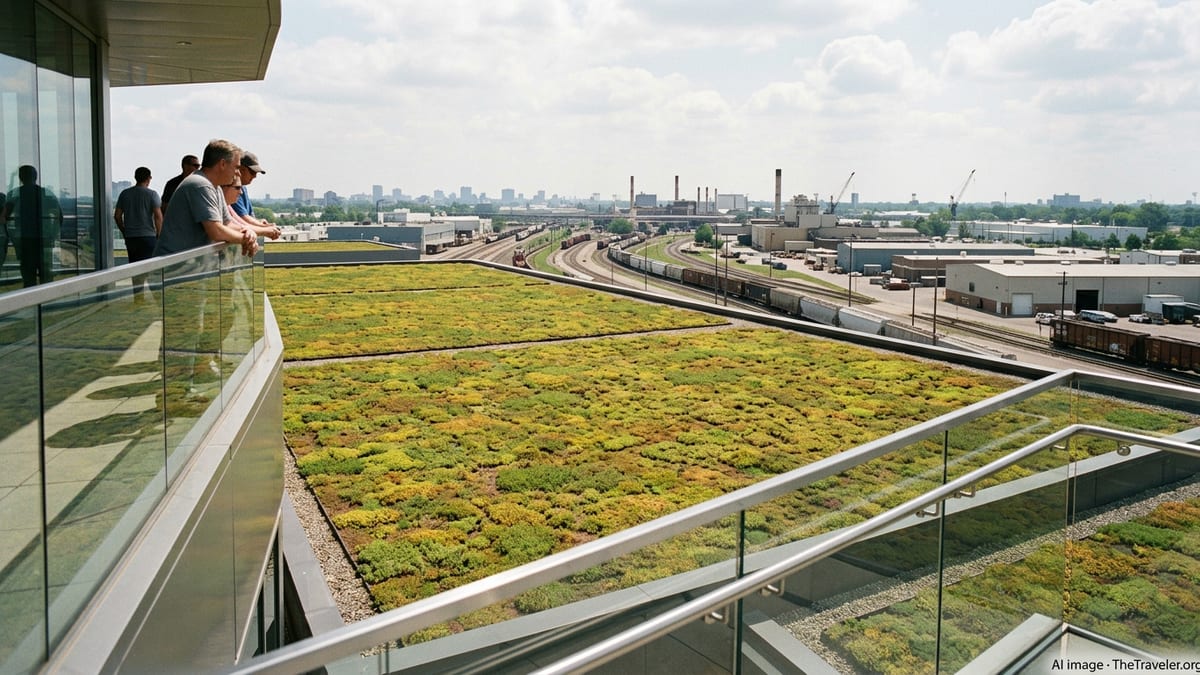
Before or after you walk the plant, you ride an elevator up to the Observation Deck, one of the most distinctive features of the Rouge tour. From roughly eight stories above ground level, you can look out across the sprawling Dearborn Truck Plant and the wider Rouge complex. The most striking feature is the huge living roof atop the assembly building, often described as one of the largest of its kind in the world. The roof is covered with a low, green carpet of sedum plants and other hardy species that change color with the seasons, from bright green in spring to more muted tones in late summer and fall.
Interpretive panels along the deck explain how the living roof and surrounding stormwater systems help manage runoff, filter air, and moderate building temperatures. Instead of stormwater running straight off a traditional roof and into the Rouge River, much of it is absorbed and slowed down through layers of soil and vegetation. The roofing design is often held up as a case study in how heavy industry can integrate environmental thinking into large facilities. While you are not walking on the living roof itself, the vantage point from the deck allows you to see skylights, ventilation systems, and adjacent wetlands-style features that work together.
The Observation Deck is also where you get a sense of scale. Looking out, you can see rail lines, truck yards, conveyors, cranes, and multiple buildings, a reminder that this complex once served as a nearly self-contained industrial city. For context, interpretive displays highlight the Rouge’s early twentieth century role as a flagship of vertically integrated manufacturing, where raw materials like iron ore and coal arrived and finished vehicles left by rail and ship. Today the complex has evolved, but the scale remains impressive, and the bird’s-eye view gives travelers a very different understanding than you can get from street level.
On clear days, the deck is an excellent photo opportunity for the broader plant and the green roof, since photography is permitted in this portion of the tour. Travelers who visit in late afternoon often note particularly warm light on the roof and the surrounding structures. In winter, snow sometimes outlines the roof’s patterns and accentuates the geometry of the complex. If you are pairing the Rouge tour with other Detroit-area sights, this view can help you mentally place Dearborn in relation to the rest of the metro area’s industrial and residential neighborhoods.
Immersive Theaters and Interactive Exhibits
Before you reach the plant itself, the Ford Rouge Factory Tour typically begins with theater experiences designed to contextualize what you are about to see. In the Legacy Theater, you watch a short film that traces the history of the Rouge complex and the Ford brand. Archival footage, narration, and historic photographs explain how the Rouge was conceived as a pioneering industrial system, how it shaped labor history, and how it weathered economic booms and busts. Rather than dwelling only on nostalgia, the presentation tends to emphasize change, reinvention, and the challenges of keeping a century-old site relevant to twenty-first century manufacturing.
The Manufacturing Innovation Theater is more of a multi-sensory show. Visitors are surrounded by screens, dynamic lighting, and carefully choreographed sound that walk you through the process of turning design sketches into a finished truck. Special effects such as projection mapping, bursts of light, and synchronized audio cues simulate stamping presses, welding robots, paint shops, and crash tests. Some travelers compare it to an amusement park-style pre-show, designed to both inform and build anticipation before you step into the real plant environment.
Once you move into the exhibit areas, you may find interactive stations and physical displays that allow you to dive into specific aspects of vehicle design and manufacturing. Examples might include cutaway views of truck frames and cab structures, samples of different lightweight materials, or mockups that demonstrate how robots and human workers share tasks. Recent years have seen increased emphasis on topics like fuel efficiency, emissions standards, and electrification, reflecting broader industry trends. Exhibits are written in plain language and are meant to be approachable for visitors without an engineering background, while still providing enough detail to satisfy enthusiasts.
Families traveling with children often appreciate that the exhibits offer things to touch, watch, and manipulate, rather than being exclusively text-heavy. For instance, a child who may be restless during a film often re-engages when turning a wheel to see how suspension components move or pressing buttons to trigger animations about safety systems. Staff members and volunteers are usually present in exhibit areas to answer questions about both historic and current production practices.
The Legacy Gallery and Seasonal Outdoor Living Lab
Near the end of your route, you reach the Legacy Gallery, a space that connects the working truck plant to Ford’s broader history. Here, you typically find a rotating selection of significant Ford vehicles that have some connection to the Rouge complex. Past displays have included classic Ford pickups that trace the evolution from basic work trucks to today’s more refined models, as well as historically important vehicles tied to milestones in design or manufacturing. The gallery often includes at least one truck that visitors can sit inside for photo opportunities, such as an F-150 Raptor or another well-known variant.
Large graphic panels in the gallery provide timelines, milestones, and archival images that help situate the F-150 in a longer story about American transportation and work. Instead of treating the modern truck plant as an isolated operation, the Legacy Gallery reminds visitors that today’s assembly line stands on the shoulders of decades of experimentation, labor struggles, design shifts, and technological leaps. Car enthusiasts may recognize engine codes, body styles, or historical marketing imagery that marked different eras of Ford’s history.
During the warmer months, usually from mid-spring through mid-fall, the tour may also include access to an Outdoor Living Lab or similar environmental demonstration area on the grounds near the plant. Here, interpretive displays and landscaping illustrate how green roofs, native plantings, and stormwater systems work together with the surrounding industrial infrastructure. Travelers interested in sustainability often find this outdoor segment particularly striking. You might walk along paths bordered by native grasses and shrubs, see signage about pollinator-friendly plantings, or observe how bioswales collect and filter stormwater before it enters local waterways.
Even if the Outdoor Living Lab is not accessible due to season or weather, the themes it represents run throughout the tour. The integration of a large living roof, improved water management, and habitat considerations into an active truck plant is frequently highlighted in both the Observation Deck messaging and the interior exhibits. For visitors who associate heavy industry only with smokestacks and gray concrete, this more nuanced portrayal of a working site trying to reduce environmental impact can be an eye-opening contrast.
Planning Your Visit: Tickets, Timing, and Practical Tips
Planning ahead can make the difference between a rushed walk-through and a relaxed, in-depth experience. Tickets for the Ford Rouge Factory Tour are sold through The Henry Ford. As of early 2026, adult ticket prices for the Rouge tour alone typically sit in a moderate range, with discounted rates for children, seniors, and members of The Henry Ford. Combination tickets that bundle the Rouge tour with entry to the Henry Ford Museum of American Innovation or Greenfield Village are often a good value if you have a full day or more in Dearborn. Because specific time slots can sell out on busier days, particularly around summer holidays, school breaks, and major events in Detroit, it is wise to purchase tickets several days in advance when possible.
Tours normally operate most days of the week, often Monday through Saturday, with first departures in the morning and last buses in the mid-afternoon. The factory portion of the tour is subject to the plant’s production schedule. When the Dearborn Truck Plant is idled for retooling, model changeovers, or extended holiday shutdowns, you may not see live assembly activity even though the visitor experience remains open. If watching the line in motion is a top priority for you, consider checking the tour’s official visitor information or contacting The Henry Ford before finalizing travel dates, especially around late model-year transitions when retooling is more common.
On the day of your visit, plan to arrive at The Henry Ford campus at least 30 minutes before your scheduled Rouge departure time to allow for parking, ticket pickup, and a short walk to the bus boarding area. Parking at the museum is generally plentiful in large surface lots, and daily rates are typical of major attractions in the Detroit area. From the museum, dedicated Rouge tour buses transport you through parts of Dearborn’s industrial district to the plant. The ride typically takes around 15 to 20 minutes each way, depending on traffic and any brief narrated segments highlighting local landmarks along the route.
Inside the Rouge visitor center and plant, food options are limited to vending machines and small snack offerings. There is no full cafeteria comparable to what you might find in a large museum. Many travelers choose to eat either before or after the tour at the Henry Ford Museum’s food court, at nearby fast-casual chains along Michigan Avenue and the Southfield Freeway, or at independent Detroit-area restaurants. Restrooms are available both at the museum and at the Rouge visitor center, but seating inside the factory portion is limited, so visitors who prefer to rest frequently may want to plan short breaks between segments.
Accessibility, Families, and Visitor Comfort
The Ford Rouge Factory Tour is designed to be accessible to a wide range of visitors. Buses used to shuttle guests between The Henry Ford and the Rouge are generally equipped with features to accommodate guests with mobility challenges, and the visitor center, observation deck, and elevated plant walkways are served by elevators. Ramps and wide corridors make it possible for wheelchair users and those with strollers to follow the standard route without having to navigate stairs. As with any large facility, it is helpful to inform staff of specific needs upon arrival so they can suggest the best boarding and viewing options.
Visitors with sensory sensitivities should be aware that the tour includes loud environments, bright lights, and crowded areas, particularly in the theaters and along the plant walkway during peak times. Some families choose to bring noise-dampening headphones for younger children who may be unsettled by industrial sounds. The pace of the self-guided format does allow you to step out of a film early, wait for the next elevator, or spend more time in quieter exhibit zones if necessary.
For families, the Rouge tour can pair well with a visit to the Henry Ford Museum’s hands-on exhibits, which offer additional outlets for kids’ energy and curiosity. Many parents report that school-age children who are interested in cars, trucks, or building things respond particularly well to the Rouge visit. Younger children in strollers can still enjoy the visual spectacle of moving conveyors and colorful trucks, though the narrative content of the films may go over their heads. There are no ride-style attractions, so expectations should be set toward learning and observation rather than thrill-seeking.
Dress comfortably and practically. Closed-toe shoes are recommended, as you will be walking and standing on industrial-style floors, and some surfaces may be slightly slick in wet weather. Temperatures inside the plant are generally controlled but can feel warmer in summer. Layers are helpful in cooler months for the brief outdoor portions between bus, entrance, and observation deck. Bags are permitted, but anything large or cumbersome may become tiring to carry for two to three hours, since there are limited locker options in the Rouge portion of the experience.
The Takeaway
The Ford Rouge Factory Tour stands out among industrial attractions because it balances real, present-day manufacturing with clear storytelling and thoughtful design. You are not simply looking into a display case or walking through a preserved workshop. Instead, you are watching some of the most popular trucks in the United States move through a complex system of human labor, automation, environmental engineering, and logistics.
Between the Dearborn Truck Plant’s elevated walkway, the sweeping views from the observation deck, the multisensory theaters, and the historically rich Legacy Gallery, the tour offers multiple angles on the same core story. It is about how an idea moves from sketch to steel, how a century-old complex adapts to new technology and environmental expectations, and how everyday vehicles are the product of countless unseen decisions and movements. For travelers to Detroit and Dearborn, especially those with even a passing interest in cars or industry, it is a rare opportunity to step inside a living piece of American manufacturing.
Whether you pair the Rouge tour with a full day at The Henry Ford or drop in for a focused look at the F-150’s birthplace, the experience rewards curiosity and unhurried attention. Plan ahead for tickets and timing, prepare for some walking and sensory stimulation, and arrive ready to look closely. In doing so, you will leave with not only a new appreciation for pickup trucks, but also a deeper understanding of how large-scale industry shapes landscapes, jobs, and innovation in the twenty-first century.
FAQ
Q1. How long does the Ford Rouge Factory Tour typically take?
Most visitors spend about two to three hours on the Ford Rouge Factory Tour, including the round-trip bus ride from the Henry Ford Museum, time in the theaters, the observation deck, the plant walkway, and the Legacy Gallery.
Q2. Do I need a separate ticket for the Ford Rouge Factory Tour?
Yes. The Rouge tour requires its own timed ticket, although combination tickets that also include the Henry Ford Museum of American Innovation or Greenfield Village are often available and can be good value if you plan a full day in Dearborn.
Q3. Can I see the F-150 assembly line running every day?
Not always. The Dearborn Truck Plant is a working factory, so the line may be slowed or idled for retooling, maintenance, holidays, or model changeovers. The tour and exhibits usually remain open, but live assembly is not guaranteed on any specific date.
Q4. Are photos and videos allowed during the tour?
Photography is generally allowed in the visitor center, theaters, observation deck, and Legacy Gallery, but it is not permitted inside the active areas of the Dearborn Truck Plant. Signs and staff make these boundaries clear during your visit.
Q5. Is the Ford Rouge Factory Tour suitable for children?
Yes. Many families bring school-age children who enjoy seeing real trucks on the line and interactive exhibits. Younger children can ride in strollers, but parents should be prepared for loud sounds, busy spaces, and a focus on observation rather than rides or playgrounds.
Q6. What should I wear and bring to the Rouge tour?
Wear comfortable clothing and closed-toe shoes, since you will spend significant time walking and standing. A light layer is useful for changing indoor and outdoor temperatures, and a small bag for water and essentials is usually sufficient, as storage options on-site are limited.
Q7. Is the tour accessible for visitors with mobility challenges?
Yes. The buses, visitor center, observation deck, and elevated plant walkways are designed with accessibility in mind, including elevators and ramps. Visitors using wheelchairs or with other mobility needs should mention this to staff so they can assist with boarding and viewing options.
Q8. Are there food and drink options at the Rouge facility?
Food options at the Rouge site itself are limited to vending machines and small snack offerings. Most travelers plan to eat before or after the tour at the Henry Ford Museum’s food court or at restaurants in the surrounding Dearborn and Detroit area.
Q9. When is the best time of year to visit?
The tour operates year-round, but spring through fall often offers the most comfortable weather and the best views of the living roof and outdoor environmental areas. Winter visits can still be rewarding, though you should plan for colder conditions when moving between bus, entrances, and observation deck.
Q10. Can I visit the Rouge Factory Tour without going to the Henry Ford Museum?
Yes. You can purchase a ticket for the Ford Rouge Factory Tour by itself, and many visitors do exactly that. However, combining the tour with the museum or Greenfield Village provides a broader context for the history and innovation stories introduced at the Rouge.