

More news on this day
In Seattle’s Denny Triangle, a retired United Airlines Boeing 747-400 is being transformed from long-haul workhorse into a gravity-defying landmark, its fuselage now dramatically wedged between two glassy residential towers.
Get the latest news straight to your inbox!
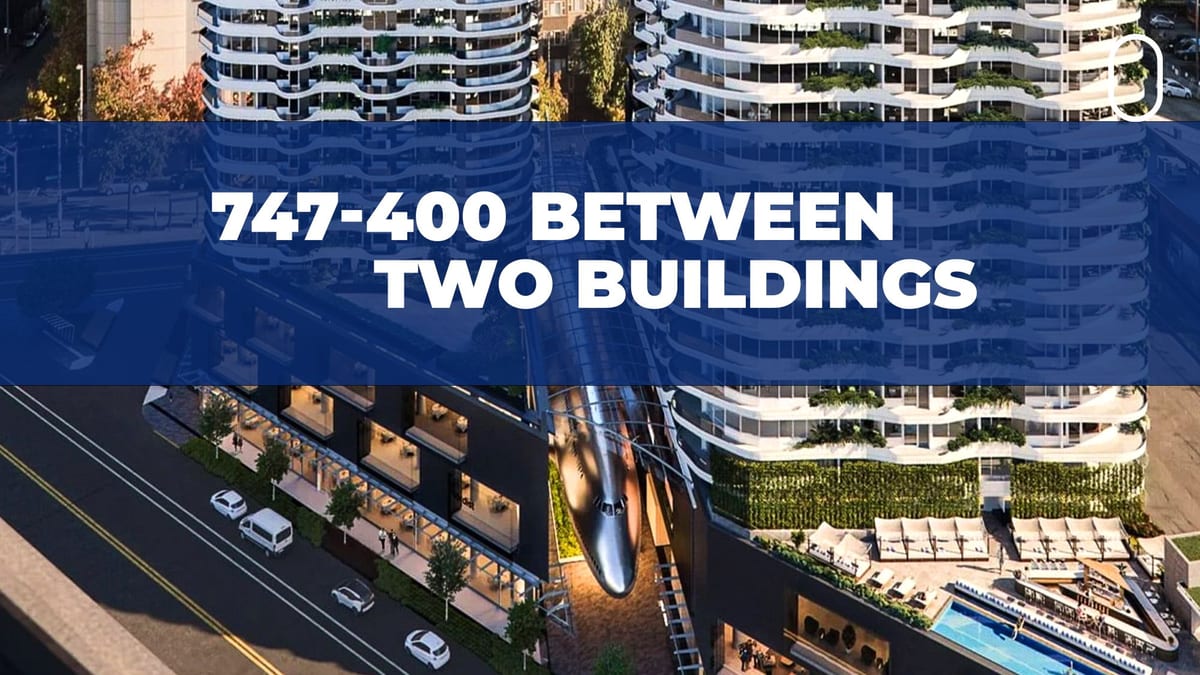
Image by Simple Flying
A Jumbo Jet Reimagined Above Stewart Street
The former United Airlines Boeing 747-400, identified in aviation circles as N178UA, is finding an unlikely second life suspended several stories above Stewart Street. The wide-body fuselage is being installed between the twin towers of the long-delayed 1200 Stewart development, now branded WB1200, near the intersection of Stewart Street and Denny Way in central Seattle. Recent construction images and local reports show the aircraft’s aluminum shell reconstructed around a steel support frame that links the two high-rises.
Project descriptions published by the developer explain that the aircraft will function as a centerpiece within a multi-level galleria at the base of the towers, rather than as an operational space for aviation-related uses. The stripped fuselage spans the gap between the buildings, creating a tunnel-like volume that appears to hover over a pedestrian passage and retail podium. From street level, the effect is that of a jumbo jet seemingly parked in midair amid downtown’s dense skyline.
The installation places a highly visible aviation relic at the doorstep of two 48-story residential towers, in a neighborhood already dominated by the headquarters and offices of major technology companies. For visitors arriving along the nearby Interstate 5 corridor, the silver tube of the former long-haul airliner is set to become an unmistakable visual marker on Seattle’s increasingly vertical cityscape.
From United Workhorse to Urban Sculpture
Publicly available aviation records and enthusiast coverage indicate that N178UA spent much of its working life flying for United Airlines, part of the carrier’s once-iconic fleet of Boeing 747-400 aircraft. The type was a mainstay of transoceanic travel for decades, linking major hubs across North America, Europe, and Asia before being gradually retired as airlines shifted toward more fuel-efficient twin-engine jets.
The 747-400’s retirement from frontline passenger service in the United States created a surplus of large airframes, many of which were scrapped or parted out. In this case, the aircraft’s fuselage was acquired and transported for adaptive reuse in Seattle. Earlier design material for the 1200 Stewart project described the vision of exposing the jet’s raw aluminum skin and internal ribbing, presenting the structure of the aircraft as a work of art rather than restoring its original airline identity.
By suspending the fuselage between two towers, the developers and collaborating designers are effectively turning the aircraft into a monumental urban sculpture. Instead of passengers and cargo, the jet now carries only its own history, evoking a time when the 747 symbolized both technological confidence and the global reach of commercial air travel.
Honoring Seattle’s Aviation Heritage
The decision to anchor the new towers with a vintage Boeing 747 is closely tied to Seattle’s deep aviation roots. The region is home to Boeing’s historic production facilities, the Museum of Flight, and decades of aerospace innovation that helped shape both the local economy and the city’s global identity. Project descriptions and architectural features circulated since the scheme was unveiled emphasize the installation as an homage to that legacy.
Design narratives describe the fuselage as a physical bridge between Seattle’s industrial past and its present role as a technology and services hub. The aircraft’s presence in the galleria is intended to acknowledge the city’s manufacturing heritage at a moment when its skyline is increasingly defined by residential and office towers inhabited by software engineers and corporate staff.
For travelers and aviation enthusiasts, the installation adds another stop to Seattle’s portfolio of flight-related attractions, joining the Museum of Flight and the nearby Boeing Everett Factory tours. Unlike those traditional museum-style experiences, however, the 747 at WB1200 is embedded directly in the urban fabric, encountered not through ticketed exhibits but while walking to a grocery store, apartment lobby, or neighborhood café.
Tourism Magnet and Talking Point
As the fuselage has come together between the towers over recent weeks, local social media posts and national lifestyle coverage have framed the project as both a curiosity and a potential tourism draw. A retired intercontinental airliner hovering between skyscrapers offers an instantly shareable image that aligns with contemporary trends in destination marketing, where unusual architecture and large-scale art installations often double as city branding.
Observers note that once the project is fully opened, visitors will likely be able to experience the jet from multiple vantage points: looking up from street level, viewing it laterally from nearby sidewalks and intersections, and glimpsing it from within the galleria or adjacent indoor spaces. For photographers and aviation fans, the play of reflections on the aircraft’s metal skin against the glass façades of the towers is expected to become a frequently captured scene.
At the same time, online discussion reflects a range of reactions, from excitement about the bold reuse of an iconic aircraft to unease with the visual of a plane placed between tall buildings. Some commentaries frame the installation as a poignant symbol of how the city’s industrial era has given way to a landscape dominated by high-rise housing and technology offices, with the 747 now literally framed by that new reality.
Engineering Feat in a Tight Urban Site
Beyond its visual impact, the project represents a significant engineering challenge. Descriptions from project documents and construction updates indicate that the aircraft was disassembled, transported in large sections, and then reassembled around a purpose-built structural frame anchored into the two towers on either side. The suspended fuselage does not carry structural loads for the buildings themselves; instead, it functions as an architectural object supported by concealed steel elements.
The tight urban site, flanked by busy streets and surrounded by existing high-rises, required careful sequencing of work. Crews have been seen maneuvering large fuselage segments into position, then attaching and restoring the distinctive curvature of the 747’s upper deck and main body. The work has unfolded alongside ongoing façade and interior fit-out for the residential towers, extending a project timeline that has already stretched across several years.
When complete, the 747 installation is expected to form a sheltered passageway below, linking retail spaces and lobby areas at the base of the two towers. While detailed public access plans have not yet been widely published, the presence of the aircraft in a mixed-use podium suggests that residents, office workers, and visitors will encounter the jet as part of everyday circulation through the complex, rather than as a distant object viewed only from outside.