

More news on this day
Hundreds of travelers were stranded or forced to abandon trips on Monday as 79 flight delays and 196 cancellations at Fort Lauderdale–Hollywood International Airport cascaded across JetBlue, Spirit and Delta networks, snarling operations in Miami, Orlando and dozens of other U.S. cities already reeling from a powerful winter storm in the Northeast.
Storm-Battered Networks Buckle as Florida Becomes a Pressure Point
The latest wave of disruption hit on February 23 as a fast-deepening nor’easter pushed blizzard conditions across major Northeastern hubs. While the center of the storm was hundreds of miles away, South Florida’s airports quickly became collateral damage, with Fort Lauderdale emerging as a key pressure point in the strained U.S. aviation system.
According to live tallies from flight-tracking services, Fort Lauderdale–Hollywood International Airport recorded roughly 79 delayed departures and arrivals alongside 196 outright cancellations in a single day, a staggering figure for a gateway that typically prides itself on rapid aircraft turns and high-frequency service to leisure markets. The knock-on impact was immediate, as aircraft and crews failed to arrive from storm-hit New York, Boston and Philadelphia, forcing last-minute schedule cuts in Florida.
By mid-morning, Fort Lauderdale’s troubles were mirrored at Miami International Airport, where more than a hundred flights were also canceled, and at Orlando International Airport, which saw waves of cancellations and delays as the day progressed. The result was a patchwork of disruptions stretching from Florida to the Mid-Atlantic and New England, as airlines tried to recover from one of the most logistically challenging winter days of the season.
Nationwide, more than 5,000 flights within, into or out of the United States were canceled on Monday, underscoring how a single severe weather system can radiate outward from a regional problem into a national breakdown in connectivity. For many travelers passing through Fort Lauderdale, that broader picture translated into hours of uncertainty, crowded terminals and abruptly changed plans.
JetBlue, Spirit and Delta Bear the Brunt at Fort Lauderdale
At the center of the disruption were three carriers with major stakes in the Florida market: JetBlue Airways, Spirit Airlines and Delta Air Lines. Each has built substantial schedules at Fort Lauderdale, with routes that are tightly intertwined with Northeastern hubs now directly in the storm’s path.
JetBlue, which maintains a strong presence in both South Florida and New York, had already cut hundreds of flights over the weekend as the storm approached the East Coast. By Monday, its Fort Lauderdale operations were further constrained as aircraft that would normally cycle between JFK, LaGuardia, Newark or Boston and Florida remained grounded. Multiple JetBlue flights to and from Northeastern cities were canceled outright, and others left hours late as crews and planes trickled into position.
Spirit, headquartered in Miramar, just west of Fort Lauderdale, found itself in a similarly difficult position. The ultra-low-cost carrier relies heavily on high utilization of its fleet, meaning that disruptions in one part of the network quickly spill over elsewhere. With a large share of its traffic touching Florida and major northern markets, even a modest number of cancellations at its key outstations translated into a much larger wave of schedule adjustments at Fort Lauderdale, where scores of passengers were left seeking rebooking options.
Delta, which uses Fort Lauderdale as a key spoke feeding its hubs in Atlanta, New York and Detroit, was also hit as operations in the Northeast faltered. Several flights linking Fort Lauderdale with storm-affected cities were either delayed or canceled as the airline adjusted its schedule to match airport closures, runway deicing constraints and ground-stop programs further north.
Miami and Orlando Join the Disruption as Weather Grips the Northeast
While Fort Lauderdale found itself in the spotlight because of the concentration of delays and cancellations, the disruption extended across South and Central Florida. Miami International Airport, one of the nation’s busiest international gateways, logged more than 100 cancellations as airlines trimmed schedules on routes to New York, Boston and other cities facing blizzard conditions.
Orlando International Airport, a critical hub for both domestic leisure travel and international tourism, was likewise pulled into the vortex. Live data showed hundreds of Florida-related cancellations spread across the state’s biggest airports, with Orlando becoming a flashpoint for disrupted flights to and from Northeastern cities whose runways and taxiways were buried under heavy snow.
The cascading effect illustrates how closely linked Florida’s airport system is to the wider U.S. network. Even though the state itself saw cold temperatures and gusty winds rather than heavy snow, its role as a major destination and connection point for travelers escaping winter weather elsewhere left it highly exposed to ripple effects from the storm.
Travel analysts noted that the pattern of disruption, with Florida airports absorbing a high volume of cancellations originating elsewhere, is typical during large-scale weather events. Carriers often choose to protect aircraft and crew positioning at core hubs, even if that means cutting service to warmer-weather destinations that remain physically open but are reliant on inbound flights from storm-struck regions.
Passengers Face Long Lines, Confusion and Limited Alternatives
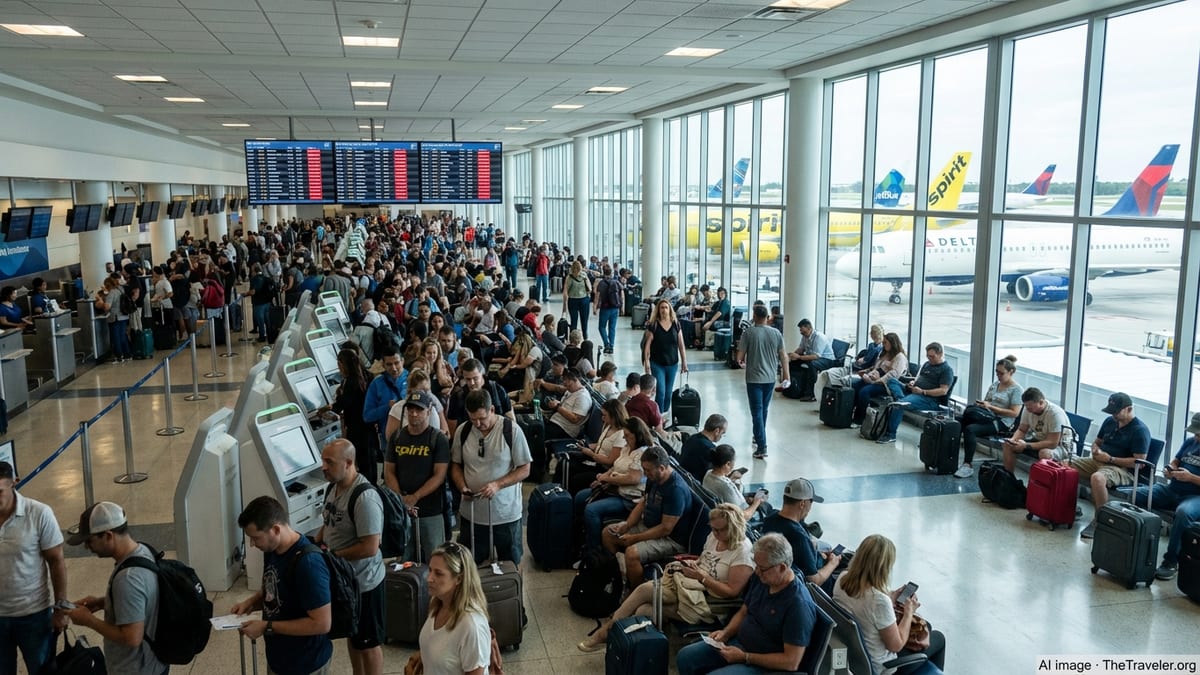
Inside Fort Lauderdale’s terminals, the statistics translated into a familiar but still jarring scene: long check-in queues, crowded gate areas, and passengers hunched over phones as they tried to refresh airline apps for new departure times. Many woke up early to find text alerts informing them that their flights had been canceled, but with scarce seats left on remaining departures.
Families heading home from cruises out of Port Everglades and vacationers returning from South Florida beach holidays were among those caught up in the disruption. Some faced the prospect of multi-day delays before they could secure seats to storm-battered Northeastern cities, while others scrambled to piece together alternate routings through less-affected hubs in the Midwest or Southeast.
Airport staff and airline agents spent the morning and afternoon rebooking travelers, fielding questions about refund policies and explaining why flights were canceled from a sunny Florida airport due to snow hundreds of miles away. With gate agents overwhelmed, many passengers turned to online channels and call centers that were themselves struggling under a surge of demand.
Hotels near the airport saw a spike in last-minute bookings from travelers forced to stay an extra night or more in Broward County. Ride-share pickup zones were busy throughout the day as disappointed passengers chose to abandon their trips or drive to other airports in search of better options, often only to find that Orlando, Miami and Tampa were grappling with similar problems.
Weather, Nor’easter and the Wider National Picture
The underlying driver of Monday’s disruption was a powerful nor’easter barreling into the U.S. Northeast, bringing heavy, wind-driven snow and prompting travel bans, school closures and widespread power outages. Meteorologists described the system as one of the most impactful winter storms of the season, with conditions that made safe flying and airport ground operations extremely difficult.
New York City regions, including major airports like JFK, LaGuardia and Newark, bore the brunt of the storm, with runway visibility reduced by blowing snow and strong crosswinds. Deicing operations slowed departures, while inbound traffic was cut back sharply as air traffic controllers implemented flow restrictions. Boston and Philadelphia faced similar challenges, magnifying the magnitude of cancellations among carriers for whom those airports act as key connecting points.
Flight-tracking platforms reported more than 5,000 cancellations across the United States by early afternoon, with the numbers still rising as airlines proactively scrubbed later departures. JetBlue and other Northeast-focused carriers were among the hardest hit, but virtually every major airline reported material disruptions as aircraft and crews ended up badly out of position.
For Florida, the storm’s wider impact came in the form of severed links to these Northeastern hubs. Once the backbone of the route network into cities like New York and Boston was compromised by weather, airports such as Fort Lauderdale, Miami and Orlando lost the inbound and outbound capacity they depend on, producing a second wave of cancellations that would not have been necessary based on local weather alone.
Operational Recovery: Waivers, Rebooking and Network Rebalancing
In response to the unfolding chaos, airlines moved quickly to activate weather waivers that allow affected customers to change travel dates without penalty. JetBlue, Spirit and Delta all encouraged passengers scheduled to fly through impacted airports to check their flight status early and consider rebooking for later in the week, when conditions are expected to improve and operations can gradually normalize.
Carriers also began the painstaking work of rebalancing their networks. That includes repositioning aircraft stranded at outstations, calling in reserve crews where available and consolidating lightly booked flights into single departures to free up capacity elsewhere. At Fort Lauderdale, this meant that some flights that did operate on Monday were unusually full, as airlines squeezed in as many displaced passengers as they could.
Industry experts caution that even after the snow stops falling, the residual effects of a storm of this scale can linger for days. Aircraft require inspections and maintenance after long ground holds, crews must be rotated to remain within duty-time limits, and airports must clear backlogs of deiced and plowed runways. As a result, travelers using Fort Lauderdale and other Florida airports in the coming days may still encounter sporadic delays and occasional cancellations even under clear skies.
For now, both airport authorities and airlines are urging flexibility. Passengers with non-urgent travel are advised to consider postponing trips, while those who must fly should build in extra time for security, check-in and potential rebooking, particularly if their journeys connect through airports in the path of the storm.
Economic and Tourism Impacts Across Florida
The wave of cancellations at Fort Lauderdale, combined with similar patterns in Miami and Orlando, is likely to carry a tangible economic cost for Florida’s tourism-dependent communities. Fewer arrivals mean fewer hotel check-ins, restaurant visits and theme-park entries, especially during what is typically a busy winter getaway period for Northeastern travelers seeking warmer weather.
Local tourism officials have long warned that repeated disruptions tied to severe winter weather elsewhere in the country can dampen demand by eroding traveler confidence. While most visitors understand that storms are an unavoidable part of winter, the prospect of being stranded far from home or losing valuable vacation days stuck in an airport can push some to delay or reconsider trips altogether.
On the other hand, extended stays caused by cancellations can provide a short-term boost for some businesses, as stranded passengers book extra nights in hotels, dine out and seek ways to make the most of unexpected time in the region. Car rental companies and ground transportation providers often see elevated demand when travelers are forced to pivot from flying to driving.
For airlines, the financial implications of a day marked by nearly 200 cancellations at a single airport are substantial. Lost revenue from tickets is compounded by the cost of crew overtime, aircraft repositioning, deicing at northern airports and passenger care, including hotel and meal vouchers in some cases. Carriers will be parsing the data in the coming weeks to assess how this event fits into a broader pattern of weather-related volatility affecting their winter operations.
What Travelers Can Do Next Time Severe Disruption Hits
For passengers who found themselves caught off guard by Monday’s chaos at Fort Lauderdale, the experience serves as a stark reminder of how vulnerable air travel can be to weather events far from the departure gate. Travel advisers say there are practical steps passengers can take to improve their odds of avoiding the worst impacts during the next major storm.
Booking nonstop flights, particularly on early-morning departures before weather delays accumulate, can reduce exposure to cascading disruptions. Choosing routings that avoid multiple connections through storm-prone hubs in winter can also help. Travelers are further encouraged to download their airline’s mobile app, enable push notifications, and check flight status frequently in the days leading up to departure when a storm is in the forecast.
Flexible tickets or itineraries that permit fee-free changes, whether through airline policies or via travel insurance with robust weather coverage, can provide an important safety valve. When possible, shifting a trip by a day or two, as many carriers are now allowing during this storm, can mean the difference between a straightforward journey and a multi-day ordeal.
For now, as operations slowly stabilize, the hundreds of passengers affected by 79 delays and 196 cancellations at Fort Lauderdale are likely to focus less on long-term strategy and more on simply getting where they need to go. But as nor’easters and severe winter systems continue to test the resilience of the U.S. aviation network, their experiences on this turbulent day in February will inform how both travelers and airlines prepare for the next major weather shock.