

More news on this day
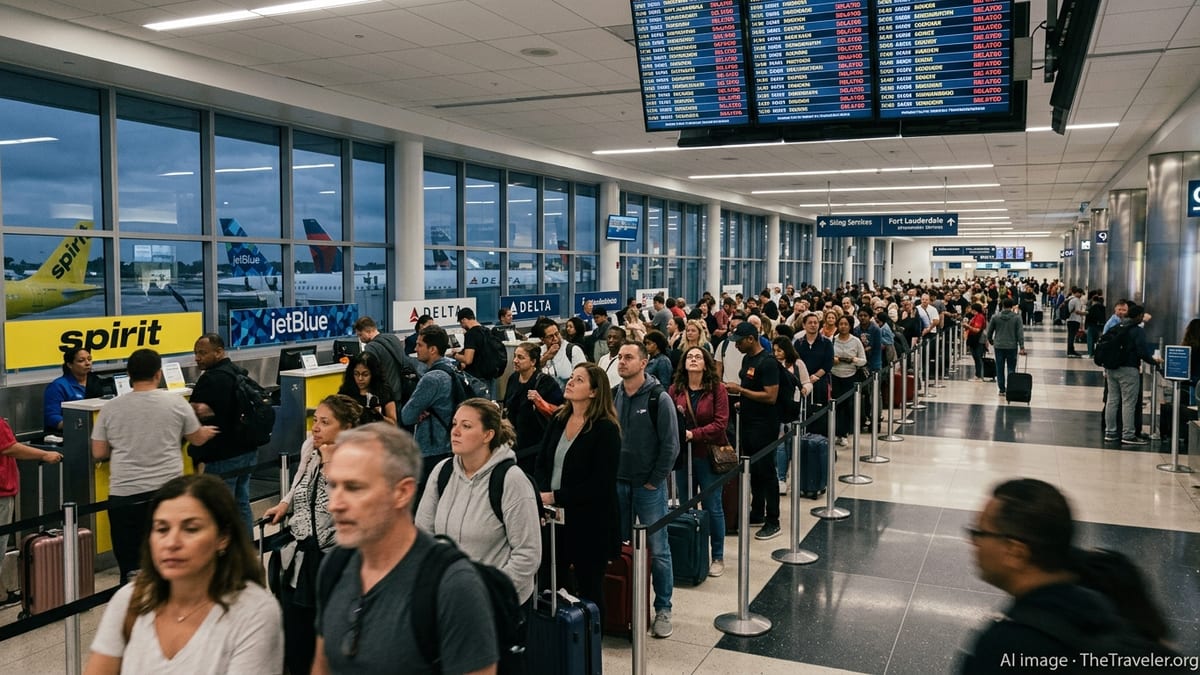
Travelers passing through Fort Lauderdale-Hollywood International Airport on March 19 faced widespread disruption, as publicly available flight-tracking data showed 211 delays and five cancellations affecting Spirit, JetBlue, and Delta services and rippling across Miami, Orlando, New York, and other major U.S. cities.
Get the latest news straight to your inbox!
Knock-on Delays Across South Florida and Beyond
The disruption at Fort Lauderdale came at a time of already strained airline operations in the United States, with recent winter weather systems and high travel demand impacting schedules across multiple hubs. Fort Lauderdale’s role as a major base for Spirit and an important station for JetBlue and Delta meant that irregular operations quickly spread beyond South Florida.
Published coverage and live tracking data indicated that delayed departures and arrivals at Fort Lauderdale fed into further late operations at Miami International Airport and Orlando International Airport, as aircraft, crew and passengers missed planned connection windows. As a result, travelers bound for or originating in those airports experienced rolling knock-on delays even when local weather conditions were not severe.
Major long-haul and transcontinental routes were also affected. Flights linking Fort Lauderdale and other Florida airports with New York-area airports, including John F. Kennedy International, LaGuardia, and Newark, saw schedule disruptions that added to congestion along one of the country’s busiest corridors. Similar patterns were reported on services to other large hubs, including Atlanta and Detroit, where late-arriving aircraft contributed to extended turnaround times.
Although only a handful of cancellations were recorded compared to the larger number of delays, the relatively small number of outright cancellations still displaced hundreds of passengers, particularly on heavily booked flights tied to school holidays and late-winter travel.
Spirit, JetBlue, and Delta Operations Under Pressure
Spirit, Fort Lauderdale’s largest carrier by passenger volume, was particularly visible in the day’s disruptions. Recent public financial disclosures and coverage have documented the airline’s efforts to streamline its network and focus on core markets such as Fort Lauderdale and Orlando, even as it copes with tighter resources and a lean operating model. When delays stack up, that model can leave limited flexibility to reposition aircraft and crews quickly.
JetBlue, which has been increasing its presence in South Florida and remains a major operator on routes between Florida and the Northeast, also appeared among the airlines with multiple delayed departures and arrivals. Historical consumer reports and prior months’ delay statistics have shown that congestion along the East Coast and weather-sensitive hubs such as Boston and New York often translate into uneven on-time performance for the carrier’s Florida flights.
Delta, while operating a smaller schedule at Fort Lauderdale compared with its large hubs in Atlanta, New York and Detroit, nonetheless experienced delays that reverberated through its national network. Publicly available data and traveler accounts in recent days have highlighted how even modest disruption at a secondary station can intensify pressure on mainline and regional operations when severe weather, crew rotations and aircraft availability are all in play.
Industry performance data released in recent months also indicate that the three airlines have faced differing but persistent operational challenges. Budget carriers with dense schedules and limited spare aircraft are especially vulnerable to cascading delays, while legacy airlines managing multiple hubs can see isolated issues spread rapidly when storm systems or ground delays hit key connecting points.
Weather Systems and Network Complexity Drive Cascading Impact
The timing of Fort Lauderdale’s disruptions coincided with a powerful mid-March storm system that affected wide swaths of the United States, including major airline hubs in the Midwest and along the East Coast. Meteorological analyses describe that system as a large extratropical cyclone that produced heavy snow, strong winds, and severe weather over several days, affecting airport operations from the Upper Midwest to the Mid-Atlantic.
While Fort Lauderdale itself did not endure the most severe winter conditions, the broader storm’s impact on cities such as Detroit, Minneapolis and New York created a chain reaction. Aircraft and crews scheduled to operate into or out of Fort Lauderdale from storm-affected regions frequently arrived late or were forced into extended ground holds, which in turn delayed onward flights to other Florida airports and major U.S. destinations.
Aviation analysts regularly point to this kind of network complexity as a key factor in modern travel disruption. Even when an airport like Fort Lauderdale reports manageable local conditions, its dependence on aircraft rotations through weather-sensitive hubs means that disruptions elsewhere can generate local backlogs, long gate holds, and prolonged time on the tarmac for passengers.
Recent federal consumer reports on flight performance underscore how quickly such conditions can escalate into tarmac delays of several hours when gate space is constrained and arrival flows outpace departures. These dynamics appeared again in the latest round of disruptions, as aircraft arriving behind schedule competed for limited resources and turnaround staff.
Passenger Experience at Fort Lauderdale and Connected Airports
Travelers navigating Fort Lauderdale during the disruption period encountered crowded check-in halls, extended security queues and busy gate areas, according to traveler reports shared publicly on social platforms and forums. Passengers on Spirit and JetBlue in particular described long lines at airline counters as they sought rebooking options, meal vouchers, or revised itineraries to reach Orlando, Miami, New York, and beyond.
At Orlando International Airport, which also serves as a key leisure gateway, travelers recounted heavy evening crowds and large standby lists on multiple departures, reflecting the broader strain on capacity as airlines attempted to accommodate passengers from delayed and canceled flights. Miami International Airport experienced its own share of delayed inbound and outbound services, further illustrating how tightly coupled South Florida’s air travel ecosystem has become.
New York-area airports reported busy terminals and shifting departure times on flights to and from Florida, as late-arriving aircraft and ongoing weather-related constraints complicated recovery efforts. Publicly available flight-status boards showed waves of delays clustered around peak travel periods, particularly on routes operated by carriers with large Florida footprints.
Across these airports, traveler accounts highlighted the practical challenges of such disruption: missed onward connections, difficulty securing same-day rebooking, and uncertainty around baggage handling and overnight accommodation. For many passengers, even flights that ultimately departed still involved hours of unplanned waiting.
What Travelers Can Do When Schedules Unravel
The latest disruption at Fort Lauderdale offers a case study in how quickly airline operations can be affected by a combination of weather, network complexity and resource constraints. Travel advisories and consumer guidance published by airlines and federal agencies consistently recommend that passengers build additional buffer time into itineraries that depend on tight connections, especially during late winter when storm systems are more common.
Publicly available advice also suggests that travelers monitor flight status frequently through airline apps or airport information displays, as schedules may change multiple times in a single day. In irregular operations, some carriers open temporary change-fee waivers or flexible rebooking windows, which can provide alternative options to reroute through less congested airports.
For routes linking Fort Lauderdale with Orlando, Miami, New York and other major U.S. cities, travel planners often recommend early-morning departures, which tend to be less affected by the accumulated delays of a long operating day. Choosing slightly longer connection times, and avoiding the last flight of the evening where possible, can also reduce the risk of becoming stranded overnight if delays mount.
As airlines refine their schedules for the coming months and as Spirit, JetBlue, and Delta adjust their networks and fleet plans, operational reliability at Fort Lauderdale and connected airports will remain closely watched by passengers and industry observers alike.