

More news on this day
The long‑anticipated Four Seasons I has formally entered service, marking a high‑profile arrival in the ultra‑luxury yachting market and setting the stage for a lavish first Mediterranean season that blends superyacht intimacy with cruise‑ship scale.
Get the latest news straight to your inbox!
A New Flagship for Ultra-Luxury Yachting
Recent delivery of Four Seasons I from Italian shipbuilder Fincantieri to Marc‑Henry Cruise Holdings, joint owner and operator of Four Seasons Yachts, signals a decisive move by the hotel group into high‑end sea travel. Publicly available information describes the 207‑meter vessel as an “ultra‑luxury hospitality ship,” designed to feel more like a private superyacht than a traditional cruise liner.
The ship carries just 95 suites across roughly 33,000 gross tons, a ratio that places it firmly at the exclusive end of the market. Each accommodation is conceived as a residential‑style retreat with expansive outdoor terraces, floor‑to‑ceiling views and a focus on quiet, private space rather than crowd‑pleasing spectacle.
Industry coverage indicates that Four Seasons I represents an investment in the hundreds of millions of dollars, with designers and yacht specialists brought in to merge the brand’s hotel aesthetic with maritime engineering. The project is positioned as the first in a planned fleet, with a second vessel already under contract for a mid‑decade delivery.
The handover comes after sea trials and technical testing in Ancona, on Italy’s Adriatic coast, where Fincantieri has assembled some of the cruise sector’s most high‑profile newbuilds. With the ship now delivered and christened, attention is turning to what the inaugural Mediterranean voyages will look like in practice.
From Caribbean Debut to Mediterranean Showcase
According to published itineraries, Four Seasons I is scheduled to debut commercially in early 2026 with Caribbean sailings before repositioning to Europe for the spring and summer season. Travel trade reports describe a sequence of routes that pair marquee ports with harder‑to‑reach anchorages more typically served by small yachts.
The Mediterranean program, slated to begin after the Atlantic crossing, includes longer “Grand Mediterranean” journeys alongside shorter, more focused itineraries. Sample routings highlighted in booking materials feature calls in Spain’s coastal cities, the south of France, the Italian and Sicilian coasts and the islands of Malta, as well as Greek and Turkish ports further east.
Early schedules emphasize seven to twelve‑night voyages, a length that mirrors upscale cruise norms but with a distinctly yacht‑like twist. Overnight stays in select ports, late evening departures and flexible tender access to smaller harbors are marketed as differentiators from larger ships constrained to major cruise terminals.
Industry analysts note that pricing reflects the ultra‑luxury positioning, with entry‑level suites on peak Mediterranean departures running into the mid‑five‑figure range for two guests. That places Four Seasons I in direct competition with established boutique cruise names and a growing set of hotel‑backed yacht concepts.
Designing a “Superyacht for Many”
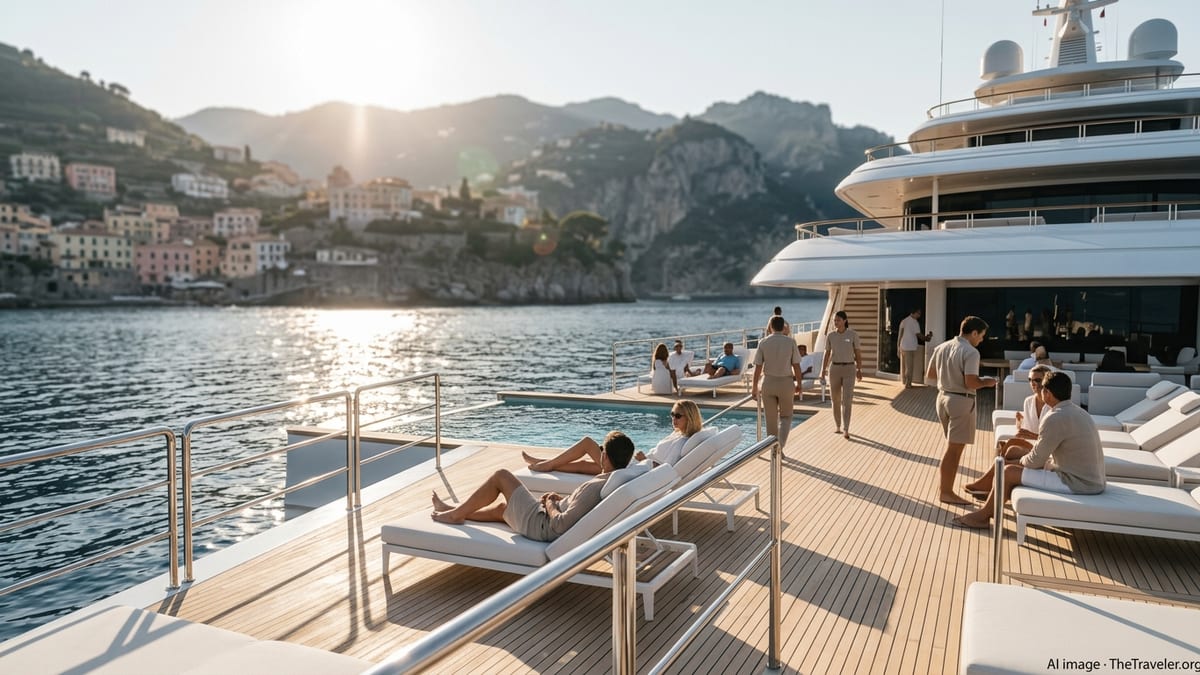
Design details released by Four Seasons Yachts present Four Seasons I as a “superyacht for many,” borrowing the scale of a small cruise ship but the language of private yachting. Exterior lines are low and streamlined, with a pronounced aft terrace cascading down to the sea and multiple decks of open teak.
On board, 95 suites are configured to interconnect in numerous ways, allowing families or groups to combine units into larger residential footprints. Reports highlight the so‑called Funnel Suite, a four‑level, almost 10,000‑square‑foot residence stacked into the superstructure, intended as a floating penthouse for the brand’s top clientele.
Interior schemes are described as warm and mid‑century influenced, with pale woods, textured fabrics and a muted palette rather than the glossy, high‑contrast finishes seen on some contemporary ships. Publicly available visuals show oversized windows, generous ceiling heights and a focus on blending indoor lounges with shaded outdoor verandas.
Across the vessel, multiple pools, a marina‑style watersports platform, a spa and wellness complex and several restaurants are designed to serve a guest count of only a few hundred at most. The result, according to travel industry coverage, is an experience calibrated for space and quiet as much as for spectacle.
“Navis Sapiens” and the Rise of the Smart Yacht
Beyond its visible luxuries, Four Seasons I is also being promoted as a technological showcase. Fincantieri and affiliated partners have introduced what is described as a “Navis Sapiens” concept, an umbrella term for integrated digital systems that monitor and optimize the ship’s operations in real time.
Public materials indicate that these systems draw on data analytics and advanced automation to manage energy efficiency, navigation support and hotel services behind the scenes. The aim is to reduce fuel consumption, enhance comfort and streamline crew workflows without overtly advertising the technology to guests.
In guest‑facing spaces, technology appears largely in subtle ways: suite tablets controlling lighting and climate, discreet connectivity networks and digital platforms that support personalized service. The approach aligns with Four Seasons’ land‑based properties, where high‑touch service is often underpinned by quietly deployed digital tools.
Analysts suggest that the “smart yacht” positioning also serves a strategic purpose. By embedding advanced monitoring and optimization systems from the outset, Four Seasons I can more easily adapt to evolving environmental regulations and efficiency expectations in the coming decade.
A Competitive Mediterranean Just Got More Exclusive
The arrival of Four Seasons I in the Mediterranean coincides with a broader shift in the region’s cruise mix. Over the past several years, major operators have steadily added small‑ship and expedition‑style capacity alongside traditional mega‑liners, while hotel brands from Ritz‑Carlton to Aman have announced or launched yacht concepts of their own.
Travel industry commentary indicates that Four Seasons’ move is particularly closely watched because of the company’s existing base of loyal hotel guests, many of whom already spend heavily on villas, private residences and branded jet journeys. The Mediterranean, with its dense cluster of marquee coastal destinations, presents a natural testing ground for extending that loyalty to the sea.
For local ports and destinations, the arrival of another ultra‑luxury operator could bring a modest increase in high‑spend visitors rather than a surge in overall passenger counts. Vessel size and itineraries suggest that Four Seasons I will prioritize smaller guest volumes, boutique excursions and premium dining on shore.
As the ship begins its first season and early sailings unfold, the performance of Four Seasons I is expected to serve as a bellwether for whether ultra‑luxury, hotel‑backed yachting can sustain long‑term momentum in an increasingly crowded Mediterranean market.