

More news on this day
Four Seasons Hotels and Resorts has formally launched Four Seasons I, its first ultra-luxury yacht, marking the hospitality group’s entry into high-end cruise tourism with design-forward itineraries across the Mediterranean and Caribbean for the 2026 inaugural season.
Get the latest news straight to your inbox!
A New Flagship for Ultra-Luxury Yacht Tourism
The debut of Four Seasons I positions Four Seasons Yachts at the top end of the cruise market, targeting travelers who typically charter private yachts or stay in villa-style resorts. Publicly available information describes the 222-guest vessel as offering significantly more space per passenger than conventional cruise ships, with just 95 suites and a near one-to-one guest-to-staff ratio.
The yacht, built by Italian shipbuilder Fincantieri, was floated out in Ancona ahead of delivery in late 2025, before entering service in 2026. Industry coverage notes that the project forms part of a broader multi-ship program, with a second Four Seasons yacht already under contract, underscoring the company’s long-term commitment to sea-based hospitality.
Four Seasons I has been positioned as a “category of one” product, sitting between traditional small-ship cruising and ultra-exclusive yacht charter. The brand is leaning on its hotel heritage, promising service, spa, wellness and culinary standards familiar from its land-based properties but adapted to a maritime setting.
The launch follows a series of timeline adjustments, including a shift from an initially signaled 2025 start to a 2026 inaugural year. Despite those changes, recent itineraries and promotional materials indicate that the yacht is now moving from development to operational reality, with full-season deployment across the Caribbean and Mediterranean.
Caribbean Launch: Turquoise Waters and Boutique Ports
Four Seasons I opens its inaugural season in the Caribbean, with early voyages concentrated between January and March 2026. The westbound repositioning from Europe introduces the yacht to turquoise waters and smaller island harbors, many of which are typically accessible only to private vessels and small ships.
Sample itineraries highlighted in brochures and trade coverage include weeklong journeys through the Lesser Antilles, pairing marquee destinations with quieter anchorages. St. Barts and St. Kitts appear alongside more low-key islands and yacht-style bay stops, with a focus on extended time at anchor instead of rapid port-hopping.
The holiday and festive period for 2026 to early 2027 is planned around the Bahamas and wider Caribbean region, with sailings designed for guests looking to replace traditional land-based festive escapes with time at sea. Publicly available information emphasizes flexible embarkation and disembarkation points, a hallmark of private yachting that Four Seasons is trying to bring into the cruise environment.
Shore experiences in the Caribbean are being framed around access rather than volume, with smaller-group landings, beach clubs and private-style marina operations. The yacht’s transverse marina and generous stern platform are intended to serve as hubs for water sports and tender operations, allowing guests to move seamlessly between ship, shore and sea.
Mediterranean Grand Voyages and Yachting Classics
After its initial months in the Caribbean, Four Seasons I is scheduled to transition to the Mediterranean for the spring and summer of 2026. Grand Mediterranean voyages outlined in booking materials trace routes through Croatia, Montenegro, Italy, Spain, Portugal and Türkiye, mixing marquee coastal cities with yacht-friendly islands and coves.
Reports on the itinerary design indicate a strong emphasis on so-called “yacht-only” harbors and off-the-radar stops, where the vessel’s size and shallow draft provide an advantage over larger cruise ships. Ports such as Valletta, Dubrovnik and the Amalfi and Dalmatian coasts are expected to feature prominently, paired with lesser-known anchorages for late departures or overnight stays.
Seasonal routing reflects the pattern of traditional private yachting, following the sun from Caribbean winter to Mediterranean summer. Some itineraries are structured as longer repositioning journeys between regions, while others focus on tightly curated one-week segments that can be combined back-to-back for extended voyages.
The Mediterranean program is being marketed not only on destination appeal but also on the promise of fewer crowds at key sites, with schedules calibrated around shoulder hours and overnight port calls. This approach is aimed at affluent travelers seeking familiar European highlights delivered with more privacy and space.
Onboard Design, Space and Culinary Ambitions
Central to the positioning of Four Seasons I is its hardware. The yacht’s 95 suites have been designed with large terraces, generous glazing and residential-style layouts. The most high-profile accommodation, the multi-level Funnel Suite, has attracted attention for its wraparound glass and expansive outdoor space, framed in coverage as a floating penthouse for travelers accustomed to large-scale villas.
Across the accommodation categories, publicly available specifications highlight terrace decks starting from around 100 square feet and increasing significantly in higher-tier suites. The design brief focuses on maximizing outward views and ensuring that even entry-level suites feel more like city hotel suites than conventional cruise cabins.
Aboard Four Seasons I, dining is a major pillar of the experience. The yacht will host 11 restaurant and bar concepts, including a mix of Mediterranean-inspired venues, Asian influences and classic grill and bar settings. Travel and lifestyle reports describe a rotating “chef-in-residence” program featuring talent from existing Four Seasons restaurants, including Michelin-recognized properties, to reinforce the brand’s culinary credentials at sea.
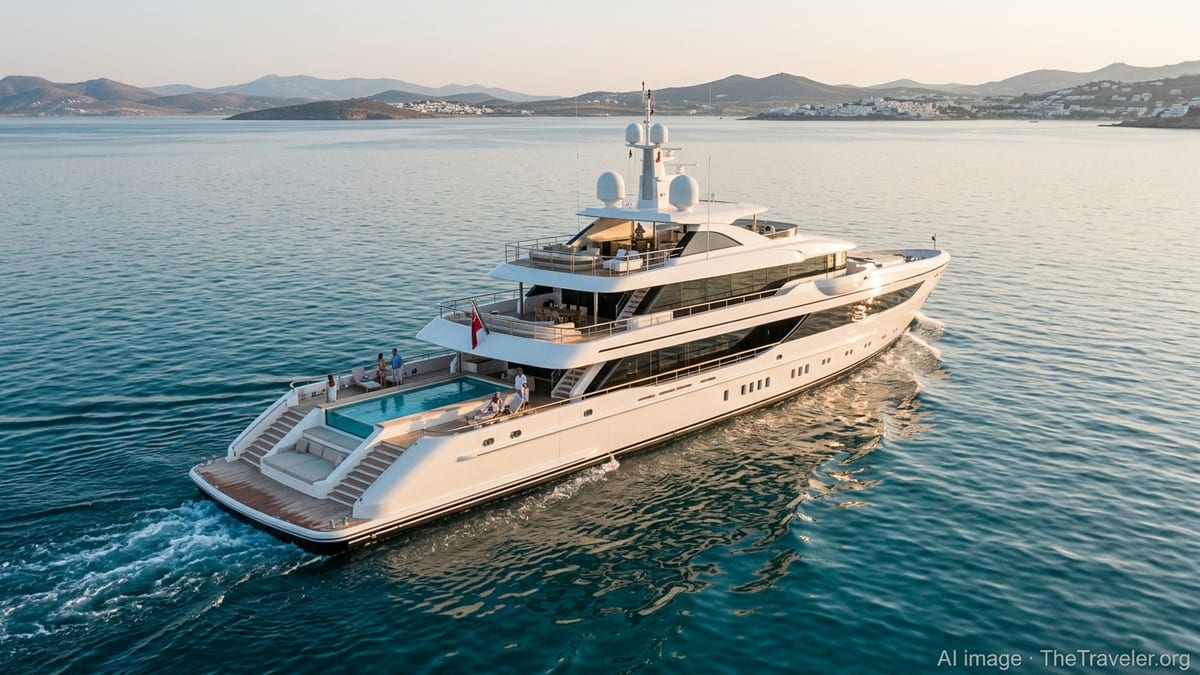
Public information also points to a comprehensive spa and wellness offering, with indoor and outdoor treatment spaces, a dedicated wellness deck and programming that draws on Four Seasons’ resort portfolio. A large stern pool, nearly 19 meters long, is being positioned as a visual centerpiece, with stepped terraces and loungers echoing the feel of a beach club built into the yacht’s aft section.
Market Impact and the Race for High-End Small Ships
The arrival of Four Seasons I comes at a time of rapid expansion in the luxury small-ship and yacht-style cruise segment. Newbuilds from hotel brands and cruise operators are targeting travelers willing to pay premium fares for smaller passenger counts, larger suites and more bespoke routes, particularly in the Mediterranean and Caribbean.
Analysts following the sector suggest that Four Seasons’ move into yachting could intensify competition at the very top of the market, where ticket prices are already considerably above mainstream cruising. Early pricing examples circulating in industry forums and promotional materials place entry-level Caribbean itineraries in the high-end bracket, aligned more closely with private yacht charter costs than traditional cruise fares.
By leveraging an established hotel brand, Four Seasons Yachts is seeking to convert loyal guests who are comfortable with the company’s resort rates and service expectations, but who previously may have avoided cruising. The yacht’s itineraries and onboard programming are designed to align with this audience, prioritizing privacy, space and personalized service over large-scale entertainment.
With future vessels already in the pipeline, Four Seasons I is being watched closely as a test case for whether a hotel-led approach can successfully redefine luxury cruising. If early Caribbean and Mediterranean seasons perform in line with expectations, more capacity in similar yacht-style formats is likely to follow, further blurring the line between cruise ship, private yacht and floating resort.