

More news on this day
Manchester Airport’s upgraded Terminal 2 is tightening its position in the global shift to digital borders, as France formally joins Italy, Portugal, Spain, Singapore and a widening group of countries whose travellers are increasingly processed through biometric technology rather than traditional passport checks.
Get the latest news straight to your inbox!
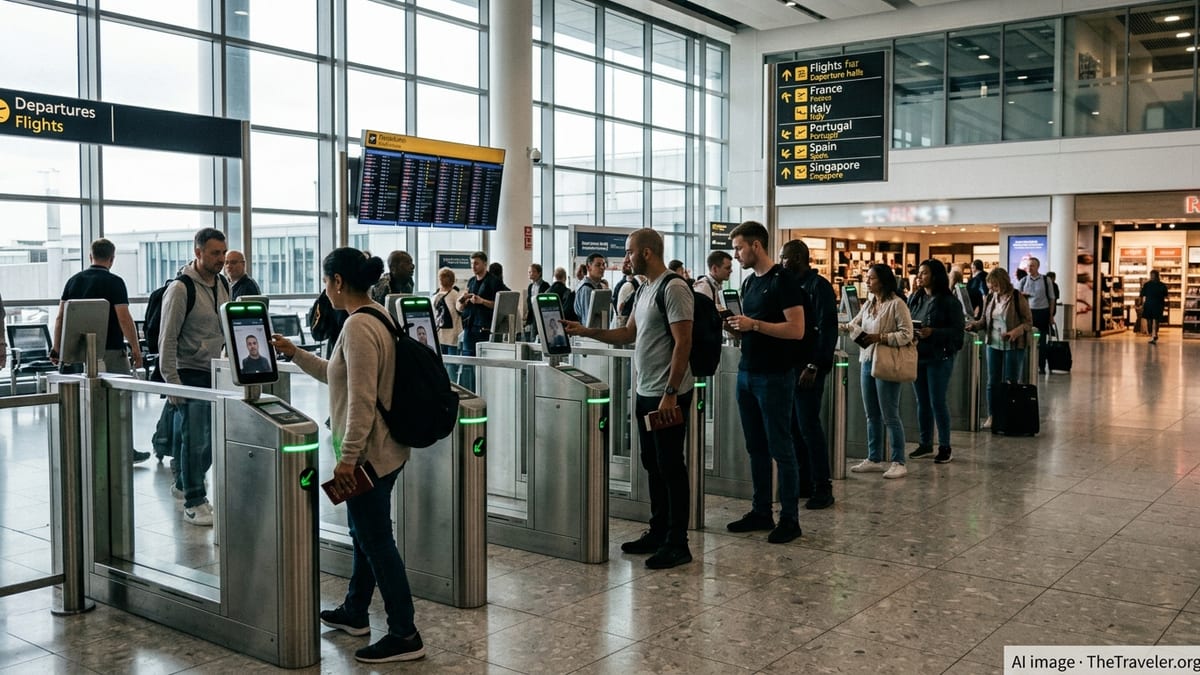
A Modernised Terminal 2 Becomes a Biometric Testbed
Manchester Airport’s Terminal 2 is emerging as a flagship for the United Kingdom’s biometric ambitions, combining a recently completed physical expansion with new layers of digital identity checks. Publicly available information on the airport’s guidance for passengers shows that facial recognition is now embedded at multiple points, from boarding pass e-gates to arrival channels, particularly for routes within the UK and Common Travel Area.
The terminal’s redevelopment has been unfolding over several years as part of a multi‑billion‑pound transformation programme, with the new security hall and additional pier opening in phases. Reports indicate that Terminal 2 now concentrates many of the airport’s newest technologies, including advanced CT scanners that allow passengers to keep liquids and electronics in their bags, complementing the biometric infrastructure at border and boarding points.
Recent coverage of a national trial of “contactless” border controls at Manchester highlights how the airport is being used to test passport‑free, face‑only processing for eligible travellers. These systems build on the UK’s existing ePassport gates, which already use facial recognition to compare a live image with the biometric chip in a traveller’s passport and run checks against security databases.
For travellers, the result is a terminal that increasingly relies on digital identity rather than manual document checks, positioning Manchester as one of the UK’s leading testbeds for the future of border control and passenger handling.
France Joins a Growing Club of Biometric‑Enabled Destinations
The latest shift that brings France into focus is rooted in Europe’s broader move toward biometric border control and the forthcoming Entry/Exit System across the Schengen area. According to recent industry and travel trade coverage, France, Italy, Portugal and Spain are among the European countries rolling out fingerprint and facial‑scan based systems that will gradually replace traditional passport stamping for many third‑country visitors.
These changes align France with earlier adopters such as Italy, Portugal and Spain, which have already installed automated gates and biometric kiosks at key airports. Reports describe how these systems capture travellers’ facial images and, in many cases, fingerprints, storing them digitally to record entries and exits and reduce reliance on manual inspection.
In parallel, Singapore is pressing ahead with its own contactless border programme at Changi Airport, where iris and facial biometrics are being expanded for automated immigration clearance. The inclusion of Singapore in the same conversation as major European hubs underlines that Manchester’s biometric ecosystem is now intertwined with a wide network of airports and borders investing in similar technologies.
For UK‑based passengers flying from Manchester Terminal 2 to France, Italy, Portugal, Spain, Singapore and other participating states, this means a journey increasingly characterised by biometric checks at both ends, from departure security and boarding to arrival immigration.
Efficiency, Security and Scalability for UK Travel
Advocates of the rollout at Manchester Airport present the combined effect of biometric technologies as a way to deliver faster processing while tightening security. Information published by the airport notes that facial recognition is used to verify that the person scanning a boarding pass is the same individual who checked in, helping to reduce identity fraud and boarding errors. At the border, ePassport gates and contactless trials are designed to maintain rigorous checks while cutting queuing times.
Across Europe, travel industry analysis has highlighted that biometric systems aim to offer similar dual benefits. Automated gates using facial recognition and fingerprints are framed as tools to improve throughput during peak travel periods while generating richer, structured data for border agencies. France’s move to fully digital entry and exit records, alongside countries such as Italy, Portugal and Spain, is being portrayed as a cornerstone of this strategy.
From an operational perspective, Manchester’s upgraded Terminal 2 offers the physical capacity to scale these systems. Additional security lanes, modernised check‑in zones and reconfigured arrival flows create space for more biometric kiosks, cameras and self‑service points as adoption increases. Industry reports suggest that as volumes grow, ports and airports that have invested in both infrastructure and biometrics will be better able to manage surges in passenger numbers.
For airlines operating from Terminal 2, which include carriers serving France, Italy, Portugal, Spain and Singapore, the integration of biometrics can also support more predictable turnaround times. Faster boarding through automated verification reduces the risk of last‑minute delays at the gate and helps keep tight schedules on track.
Passenger Experience: Smoother Journeys, New Frictions
The promise of a smoother journey is central to the narrative around Manchester’s biometric expansion. Airport guidance emphasises that travellers who meet eligibility criteria for eGates or contactless trials may experience significantly shorter queues compared with traditional manual lanes. Combining this with CT scanners at security, which lessen the need to unpack liquids and electronics, Terminal 2 is being positioned as a more streamlined, modern departure and arrival experience.
However, European media and travel associations have also highlighted growing pains in other countries implementing similar systems. Reports from Spain, Portugal, France and Italy describe periods of congestion as airports adjust to new biometric border checks, particularly during peak summer seasons. Longer processing times while travellers familiarise themselves with kiosks, as well as technical interruptions, have been cited as sources of disruption.
These experiences are influencing expectations around the UK’s own trajectory. With Manchester acting as a high‑profile test location for contactless border controls, industry commentary suggests that careful planning, clear information for passengers and robust contingency measures will be essential to prevent similar queues as biometric use widens.
For now, passengers travelling through Terminal 2 are being encouraged, through publicly available guidance, to allow familiar margins for security and border formalities even as the technology promises faster processing. The transition from traditional checks to fully biometric, largely paperless journeys is still in motion rather than complete.
What This Means for Future UK and European Travel
The convergence of Manchester’s biometric terminal and the expansion of digital borders in France, Italy, Portugal, Spain, Singapore and beyond signals a structural change in how international travel will work over the next few years. Travel analysts increasingly frame biometrics not as an optional add‑on but as the backbone of future border management and passenger handling.
For UK travellers, the practical effect is likely to be a more consistent experience across multiple airports. A journey that begins at Manchester Terminal 2 could soon involve similar self‑service gates, cameras and kiosks on arrival in Paris, Lisbon, Barcelona, Rome or Singapore, reducing the contrast between departure and destination processes.
At the same time, privacy and data protection remain in the spotlight. As more countries, including France and its European neighbours, embed fingerprint and facial recognition systems, regulators and watchdogs are scrutinising how long biometric data is stored, who can access it and how it is secured. Public debate in Europe and the UK is expected to intensify as large‑scale biometric databases become central to border operations.
Against this backdrop, Manchester Airport’s Terminal 2 offers a live case study in how a major UK hub can integrate biometric technology into a modernised terminal while remaining plugged into a fast‑evolving international ecosystem. With France now joining Italy, Portugal, Spain, Singapore and many others in embracing advanced biometric border controls, the contours of a new, digitally driven travel landscape are becoming increasingly clear for passengers using the airport.