

More news on this day
Global tourism is entering 2026 with renewed momentum, and France is emerging alongside Mexico, Spain, Italy and the United States as one of the key engines of growth, supported by aggressive capacity expansion from Air France, Iberia, American Airlines and Marriott.
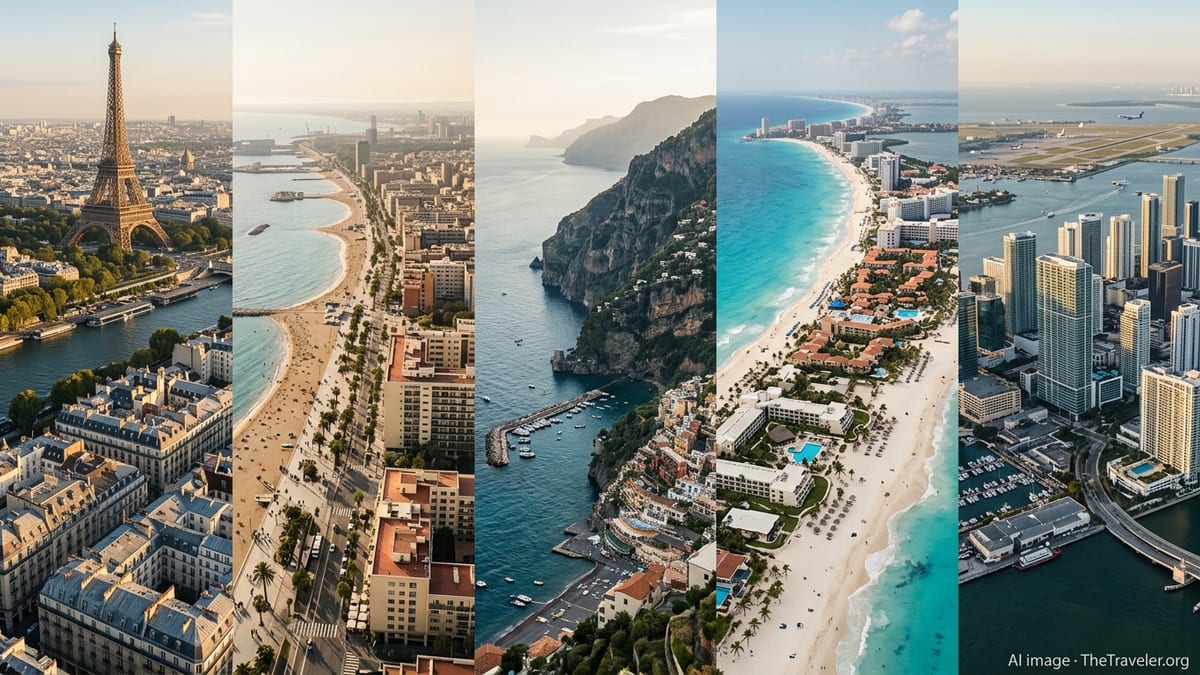
Historic Leaders Regain Their Grip on Global Tourism
After a record-setting 2025 for many destinations, early 2026 data and forecasts indicate that France, Mexico, Spain, Italy and the United States are consolidating their status as the world’s heavyweight tourism markets. UN Tourism’s latest outlook projects international arrivals worldwide to grow a further 3 to 4 percent in 2026 compared with 2025, a trend that is expected to be led by established destinations with deep air connectivity and mature hospitality infrastructure.
Recent European statistics show that Spain, Italy and France collectively account for the majority of nights spent in tourist accommodation across the European Union, underlining their structural importance to the region’s visitor economy. In 2025, Spain and Italy reported record or near-record levels of overnight stays, and published coverage indicates that France is on a similar trajectory, buoyed by sustained demand for Paris, the Riviera and regional cultural tourism.
Mexico, meanwhile, continues to benefit from strong North American demand and its position as Latin America’s leading international destination. Publicly available information highlights that Mexico retained a top global ranking in international arrivals through the recovery period, while the United States remains the world’s largest single travel economy despite recent softness in some long-haul inbound segments.
Air France and Iberia Add Capacity Ahead of Mega-Events
On the aviation side, European flag carriers are using 2026 as a year to lock in market share on transatlantic and intra-European routes. Air France, operating within the Air France-KLM group, is ramping up long-haul capacity into key North American gateways, including participation in New York’s New Terminal One project at JFK, where the carrier will be part of a cluster of global airlines slated to operate from the new complex from 2026. Industry reports describe the terminal as a next-generation hub intended to streamline connections and improve the passenger experience on routes linking Europe and the United States.
Air France is also positioning itself for greater network resilience with a renewed long-haul fleet strategy. Publicly available fleet plans point to sustained investment in fuel-efficient widebody aircraft over the medium term, a move that is expected to reduce operating costs per seat and support more competitive pricing at a time of robust leisure demand but heightened sensitivity to fares.
Iberia is similarly expanding its reach as Spain leans into its role as one of the world’s most visited countries. Updated schedules for Madrid-Barajas show a steady increase in seasonal and year-round services, including resumed and newly announced routes into the Americas and key European cities in 2025 and 2026. The Spanish flag carrier’s focus on strengthening Madrid as a transatlantic hub is designed to capture flows between Europe, the United States and Latin America, further reinforcing Spain’s tourism performance.
American Airlines Targets High-Demand Sun and City Routes
In the United States, American Airlines is aligning its 2026 capacity plan with clear pockets of demand to and from the leading tourism economies. Industry analyses of schedule filings suggest that American is concentrating growth on high-yield leisure and blended business-leisure routes linking major U.S. hubs with Mexico’s resort destinations, Spain’s coastal and island airports, and key gateways in France and Italy.
Publicly available booking and search data for 2025 and early 2026 indicate that U.S. travelers continue to favor transatlantic city breaks and Mediterranean holidays, even as domestic demand remains resilient. American’s expansive joint ventures with European partners are giving it additional flexibility to adjust capacity, share inventory and optimize aircraft deployment across the North Atlantic market, reinforcing connectivity between the United States and the European tourism powerhouses of France, Spain and Italy.
At the same time, constraints in some segments of inbound travel to the United States, including slower recovery in certain long-haul markets, are encouraging U.S. carriers to put greater emphasis on outbound leisure. As a result, additional seats from U.S. gateways into Mexico, Europe and beyond in 2026 are likely to support continued growth in visitor numbers for partner destinations.
Marriott’s Development Pipeline Maps the New Tourism Geography
Hotel capacity is tracking the same pattern as airlines, with Marriott International’s development pipeline offering a clear snapshot of where investors expect sustained tourism demand through 2026 and beyond. Sector construction reports for the Americas show Marriott leading the regional pipeline, with hundreds of projects and tens of thousands of rooms under development across the United States and Mexico, including resort properties on both coasts and in major inland leisure markets.
In Europe, Marriott is accelerating its growth in France, Spain and Italy, particularly in urban lifestyle brands and upscale resorts. Recent announcements for vacation ownership and resort offerings near Paris and on Spain’s Mediterranean coast, as well as new projects in Italian cultural and coastal destinations, point to a deliberate strategy to diversify beyond traditional city-centre business hotels and capture higher-spend leisure travelers.
Industry observers note that global hotel groups are using 2026’s favorable demand outlook to push ahead with projects that were delayed or rephased during the pandemic years. For major tourism economies such as France, Spain, Italy, Mexico and the United States, this means a wave of new openings and renovations that should increase room inventory, refresh aging stock and support higher average daily rates where demand outpaces supply.
Major Events and Shifting Demand Patterns Shape 2026
Looking ahead, a series of global sporting and cultural events is set to further concentrate visitor flows in the leading tourism economies. UN Tourism’s latest forecast highlights the Milano Cortina 2026 Winter Olympics in Italy and the 2026 FIFA World Cup, which will be hosted across Canada, Mexico and the United States, as key drivers of international travel. These events are expected to boost air traffic, hotel occupancy and tourism spending across host cities and surrounding regions before, during and after the competitions.
At the same time, traveler behavior is evolving. Search and booking trends for 2026 show rising interest in secondary cities, regional cultural hubs and nature destinations in countries such as France, Spain and Italy, where rail and regional air links make it easier for international visitors to move beyond established gateways. This shift is encouraging airlines and hotel groups to invest not only in global hubs and resort corridors, but also in mid-sized markets that can help spread tourism benefits more evenly.
With international arrivals and spending on an upward trajectory, the combined influence of France, Mexico, Spain, Italy and the United States is likely to remain decisive for the global tourism economy through 2026. The expansion strategies of carriers such as Air France, Iberia and American Airlines, alongside Marriott’s substantial development pipeline, suggest that the industry is betting heavily on continued demand, even as it navigates economic uncertainty and evolving traveler expectations.