

More news on this day
France is stepping up investment in a new generation of high-speed rail hubs, positioning its network as a central gateway for faster, lower‑carbon tourism across Europe as major infrastructure projects converge around Paris and the country’s south and east.
Get the latest news straight to your inbox!
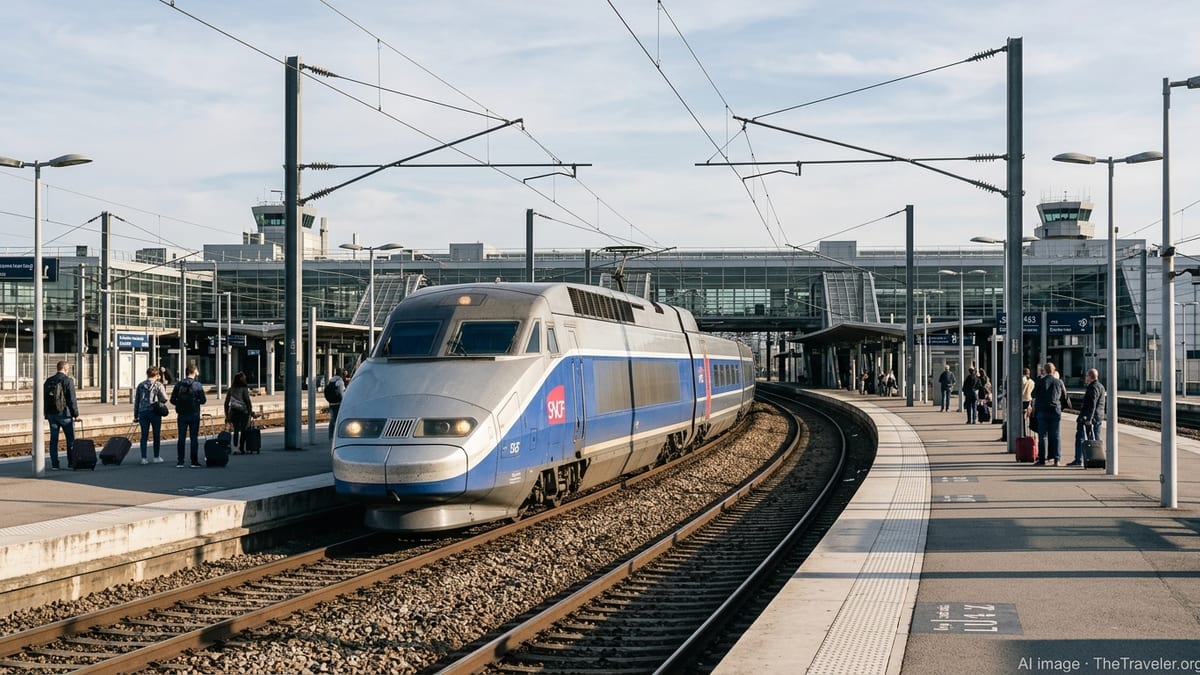
Paris Consolidates Its Role as Europe’s High-Speed Nerve Center
Recent planning and investment decisions are reinforcing Paris as a pivotal node in Europe’s rail map, with new and upgraded links designed to funnel more international travelers through the French capital. Publicly available information indicates that projects such as the Roissy–Picardie link and the CDG Express airport rail line are being configured to converge around the existing Charles de Gaulle TGV station, in effect creating a more powerful high‑speed hub that connects air passengers directly into the continent‑wide network.
The Roissy–Picardie link, now under construction with opening planned for 2026, will plug northern towns in Picardy and the greater Hauts‑de‑France region straight into the airport and national high‑speed grid. The line is expected to shift tens of thousands of airport journeys from road to rail each year, easing congestion while improving access for both residents and visitors heading toward Paris and other French destinations.
In parallel, the CDG Express project, slated to run dedicated trains between Paris Gare de l’Est and Charles de Gaulle Airport using a mix of existing and new tracks, is moving ahead after several delays. Although it is not a full high‑speed service, the line is designed to interface precisely with the high‑speed platforms at the airport station, making it easier for international arrivals to connect onward to cities such as Lille, Lyon, Strasbourg, Brussels and Amsterdam.
Travel analysts note that these layered upgrades reinforce a broader strategy: to treat the capital’s main stations and the airport TGV stop as a single, multimodal hub. As high‑speed operators expand timetables to London, the Low Countries, Germany and Spain, Paris is positioned to capture a larger share of city‑break and multi‑country itineraries built entirely around rail.
Southern High-Speed Corridor Becomes a Cross-Border Tourism Spine
Farther south, France is investing in a missing link that is set to transform long‑distance tourism flows between the Iberian Peninsula and the rest of Europe. The planned Montpellier–Perpignan high‑speed line, highlighted in recent European rail funding documents, is described as the only gap in the high‑speed corridor stretching from Seville to Amsterdam. Once this section is completed, high‑speed trains will be able to run more seamlessly along the Mediterranean coast between Spain and France.
The project builds on earlier upgrades, including the bypass high‑speed line around Nîmes and Montpellier, which already allows some international services to skirt congested urban sections and cut journey times. The new Montpellier–Perpignan segment is being developed in phases, supported by national funding and European grants, with updated governance and financing milestones reported in 2025 to pave the way for tenders.
For tourism, the implications are significant. A continuous high‑speed axis along the western Mediterranean would shorten trips between Barcelona, the French Riviera, Provence and major northern hubs. Operators expect it to support more weekend and short‑break travel, as itineraries linking beach destinations, heritage cities and wine regions become realistically achievable by rail within a few hours.
Regional tourism bodies on both sides of the border have already begun promoting rail‑based routes that combine Spanish and French highlights. Travel coverage points to growing demand for journeys that pair Catalan coastal resorts with Occitanie vineyards or alternate between Barcelona’s modernist architecture and the Roman sites of Nîmes and Arles, using a mix of high‑speed and local trains.
Lyon–Turin Link Anchors a New Alpine and Central European Hub
In the Alps, the Lyon–Turin high‑speed rail project is emerging as another cornerstone of France’s hub‑driven strategy. At its heart is the Mont d’Ambin Base Tunnel, a major cross‑border work on the Mediterranean Corridor of the European Union’s core transport network. Once operational, this tunnel will form the central section of a high‑capacity axis running from southwestern France across northern Italy and onward toward Central and Eastern Europe.
Project documentation describes the cross‑border section between France and Italy as a future gateway for both passenger and freight trains, with the aim of diverting traffic from busy Alpine road corridors. For international travelers, the new link is expected to unlock faster services between Lyon, Turin and Milan, providing an additional high‑speed route that can be combined with existing lines to Paris, Marseille and Spain.
European transport plans go further, integrating the Lyon–Turin line into a longer Lyon–Budapest rail axis. While that wider vision will take years to fully materialize, tourism stakeholders see potential in new multi‑country circuits that could one day stitch together France, Italy, Slovenia, Austria and Hungary into rail‑connected cultural routes, ski holidays and city‑hopping itineraries.
In the shorter term, the focus is on preparing the French access lines and stations to function as another hub, complementing Paris. Lyon Part‑Dieu already ranks among the busiest stations in France, and regional investment plans in Auvergne‑Rhône‑Alpes call for billions of euros in rail upgrades aimed at making the city the backbone of Alpine and wine‑route tourism.
New Trains and Operators Target International Leisure Demand
Infrastructure is only part of France’s high‑speed tourism play. Rolling stock and service patterns are evolving quickly as national and private operators gear up for more cross‑border passengers. In late 2025 and early 2026, Alstom disclosed orders from SNCF Voyageurs and Eurostar for additional Avelia Horizon trainsets, with a combined contract now covering around 160 very high‑speed trains configured for routes within France and across several European countries.
According to manufacturer and operator disclosures, these next‑generation trainsets are being designed for multi‑system operation, allowing them to run under different national electrification and signaling standards. This flexibility is central to plans by Eurostar and other brands in the same group to ramp up frequencies between Paris, London, Amsterdam and Munich and to introduce new services linking London to cities such as Frankfurt, Cologne and Geneva over the coming years.
Competition is also reshaping the landscape. Travel industry coverage highlights the growing presence of Trenitalia France on the Paris–Lyon–Marseille axis, as well as Renfe’s expansion into cross‑border routes that now connect multiple Spanish and French cities at high speed. Other newcomers, including privately backed operators targeting western France, are exploring open‑access routes out of Paris, attracted by sustained demand and high load factors on existing services.
For leisure travelers, the result is a broader choice of timetables and price points, with more direct trains linking tourism hotspots. Market observers note that increased competition has already begun to bring down fares on some key routes, making rail a more attractive alternative to low‑cost airlines, particularly for weekend and short‑notice bookings.
Tourism Industry Pivots Toward Rail-Based Itineraries
As the high‑speed network densifies around French hubs, tourism organizations and travel companies are adjusting their strategies. Regional tourism boards in areas such as Occitanie, Auvergne‑Rhône‑Alpes and the Grand Est are foregrounding rail connectivity in their marketing, emphasizing the ease of combining several destinations on a single ticket or pass.
Recent travel features spotlight new overnight and high‑speed connections that knit together France with Germany, the Low Countries and Spain, often via Paris or Lyon. One notable development is the introduction of a direct high‑speed link between Paris and Berlin, launched in late 2024 and now forming part of an emerging rail corridor that ties together multiple capital cities and cultural regions.
Industry commentators argue that such services change how visitors plan European trips. Instead of flying into one hub and relying on short‑haul flights, more travelers are piecing together loops that cross several borders by train, taking advantage of central stations located within walking distance of historic quarters, museums and riverfronts.
France’s latest investments in hub‑focused high‑speed infrastructure, rolling stock and cross‑border services suggest that this trend is likely to strengthen through the end of the decade. If timelines hold, the combination of a more integrated Paris airport‑rail complex, a completed southern corridor toward Spain and a new Alpine gateway to Italy would cement the country’s role as the main interchange for tourists exploring Europe at high speed.