

More news on this day
Europe’s rail revival is accelerating as France joins Germany, Italy, the Netherlands, Denmark and other countries in backing a new wave of high-speed and night trains that could dramatically cut demand for short-haul budget flights by 2026.
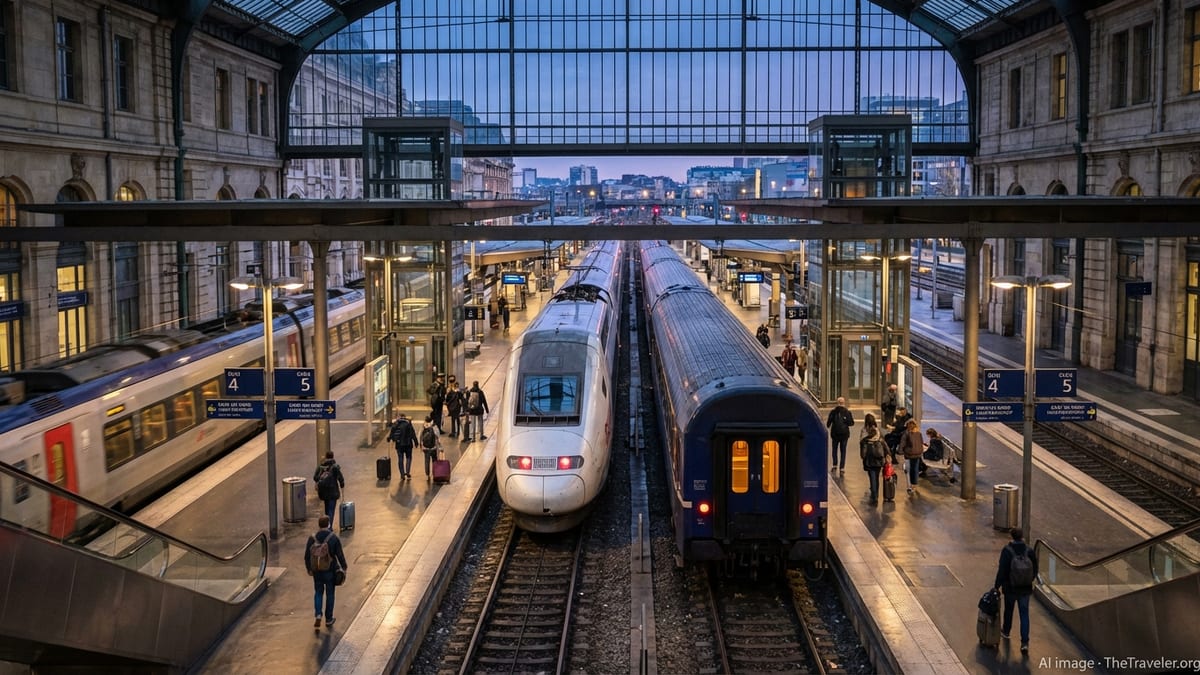
A Continental Push to Shift Travelers From Air to Rail
Across Europe, governments, rail operators and the European Union are converging on a shared goal: to move passengers from planes to trains on busy short-haul routes. From Paris to Berlin and Brussels to Barcelona, a new generation of high-speed and overnight services is being framed as a climate-friendly alternative to budget airlines that have long dominated cross-border travel.
The European Commission has set out a vision of a dense, interoperable high-speed rail grid by 2040, with faster cross-border links and simplified ticketing intended to make rail a default option for journeys under 1,000 kilometers. While that target remains distant, the practical building blocks are arriving sooner, with a series of new long-distance and night-train routes slated for launch between now and the end of 2026.
France’s role is pivotal. After years of debate over the cost of operating sleeper services, the country is back at the heart of Europe’s night-train map thanks to new cross-border ventures that rely less on state subsidies and more on open-access operators. Together with expanded services from Germany, Italy, the Netherlands and Denmark, these trains are expected to reshape how Europeans move between major cities, particularly on routes where low-cost airlines have thrived.
Industry analysts say the emerging network will not eliminate budget flights, but it is likely to erode their market share on trunk routes by 2026, especially among leisure travelers and climate-conscious passengers willing to trade airport queues for overnight cabins or direct city-center links.
France Rejoins the Night-Train Map After Funding Shock
France’s renewed prominence in the rail renaissance comes after a turbulent period for sleeper services. In late 2025, Austrian operator ÖBB confirmed it would terminate its Nightjet night trains linking Paris with Vienna and Berlin from mid-December 2025, following the French government’s decision to withdraw subsidies from 2026. The cuts prompted an outcry from passengers and campaigners, who argued that night trains were being sacrificed just as Europe’s climate ambitions were intensifying.
Yet the political setback has opened the door for new players. Dutch-Belgian cooperative European Sleeper announced that it would step into the gap and restore a Paris to Berlin overnight link from March 2026, operating as an open-access service rather than a state-subsidised one. The new train will run three nights per week, routing Paris–Brussels–Berlin and tying directly into the cooperative’s existing Brussels–Berlin and Brussels–Prague operations.
By choosing a route via Brussels rather than Strasbourg, European Sleeper is explicitly targeting travelers from France, Belgium, the Netherlands and the UK, who can connect from London using the existing cross-Channel high-speed service. The operator plans to use refurbished 1990s-built sleeping cars that offer a mix of seats, couchettes and sleeper cabins, with capacity for several hundred passengers on each departure.
French officials, while cautious about direct subsidy commitments, have welcomed the move as proof that night trains can be run on a more commercial footing. It also allows France to remain a key hub in the emerging north–south and east–west sleeper network, even as it tightens its public spending.
New High-Speed and Night Routes Linking Germany, Denmark and Beyond
While France is regaining ground on the sleeper front, its partners to the north are pressing ahead with both night and daytime routes that will strengthen the case for leaving the plane on the ground. Germany, Denmark and Switzerland are jointly backing a new overnight link from Basel to Copenhagen and Malmö, scheduled to launch in April 2026. Operated by Swiss Federal Railways in partnership with German private operator RDC, the train will connect major German hubs such as Frankfurt, Mannheim and Hamburg before crossing into Denmark and southern Sweden.
Further north, Danish and German operators are preparing a faster daytime connection between Prague and Copenhagen via Berlin, due to start in May 2026. The service is expected to cut journey times between Copenhagen and Berlin to around seven hours, with about eleven hours needed between Copenhagen and Prague. The route is being marketed as a genuine alternative to flying for leisure and business travelers, especially once the on-board amenities, including family-friendly spaces such as a children’s cinema, are in place.
Within Germany itself, Deutsche Bahn is working with France’s SNCF on a new high-speed Paris–Munich link planned for late 2026. While one daily TGV connection already runs between the two cities, the upgraded service is intended to be both faster and more frequent, taking advantage of improved infrastructure and closer cooperation between the two national operators. Industry observers see the project as a concrete example of how national high-speed networks can be stitched together into something approaching a pan-European grid.
These projects, taken together, extend the reach of rail across northern and central Europe, vastly improving options for travelers moving between France, Germany, the Netherlands, Denmark, the Czech Republic and the Nordic countries. When combined with France’s own TGV network and its growing roster of revived night trains, they are expected to chip away at the dominance of budget carriers on busy city pairs.
Italy, the Netherlands and Belgium Fuel a Cross-Border Sleeper Revival
To the south, Italy is emerging as a key beneficiary of the sleeper revival. European Sleeper plans to inaugurate a Brussels and Amsterdam to Milan night train in June 2026, routing via Switzerland and linking the Low Countries directly to Italy’s commercial heart. The service is designed to tap into strong demand between northern Europe and the Alps, offering an overnight alternative to short-haul flights feeding into Milan’s busy airports.
Italian operator Trenitalia, meanwhile, has been expanding its own high-speed Frecciarossa services beyond national borders, strengthening links with France and Spain over the past few years. By 2026, observers expect that coordination between high-speed daytime links and an expanding mesh of sleeper services will give travelers more integrated rail-based itineraries that combine overnight legs with fast daytime hops.
The Netherlands and Belgium play an outsized role in the new landscape as origin points for many of the cross-border services. European Sleeper’s core Brussels–Amsterdam–Berlin–Prague route, launched in 2023, forms the backbone of several planned extensions, including the new Paris–Berlin and Brussels–Milan lines. The cooperative has also long expressed ambitions to run a Brussels and Amsterdam to Barcelona sleeper via France, though regulatory and capacity hurdles in the French network have delayed launch plans.
Rail analysts say that the concentration of new open-access operators in the Benelux region reflects both geography and market culture. Short distances between major cities, dense existing rail infrastructure and a passenger base accustomed to international train travel create fertile ground for ventures that can then fan out toward France, Germany, Denmark, Italy and beyond.
EU Climate Policy and Flight Restrictions Boost Rail Momentum
This burst of rail activity does not exist in a vacuum. European climate policy and national measures targeting short-haul flights are exerting steady pressure on airlines while tilting investment toward rail. France’s partial ban on domestic flights where a rail alternative of around two and a half hours or less exists, which began taking effect in 2023, has become a high-profile symbol of this shift, even if its direct impact is limited to a handful of routes.
The European Commission’s long-term plan for a connected high-speed rail network by 2040 underscores the scale of change envisaged. Officials in Brussels argue that rail could capture a substantial share of journeys currently made by air on key corridors such as Paris–Berlin, Berlin–Copenhagen or Milan–Barcelona, provided that journey times, prices and booking simplicity all improve in tandem.
Environmental groups have seized on the new night trains as particularly powerful tools for cutting emissions. By enabling passengers to cover 800 to 1,500 kilometers while they sleep, sleeper services offer a direct substitute for medium-haul flights that are otherwise difficult to replace. Operators, for their part, are equipping new and refurbished rolling stock with features such as bike spaces, pet-friendly compartments and better soundproofing, aiming to make overnight travel not just tolerable but attractive.
Budget airlines are responding by emphasizing ultra-low fares and secondary airports, but they face rising scrutiny over emissions and potential future taxes on jet fuel. Analysts say that by 2026, the combined effect of new train services, climate-conscious consumers and regulatory pressure will likely translate into measurable shifts in market share on routes such as Paris–Berlin, Brussels–Milan, Basel–Copenhagen and Prague–Copenhagen.
From Station Experience to Pricing, Rail Targets the Budget Market
To truly challenge budget flights, rail operators know they must compete not just on emissions but also on price, convenience and perceived hassle. Night-train fares announced so far suggest a deliberate tilt toward the budget market. European Sleeper has flagged entry-level prices under 60 euros for couchette berths on the Paris–Berlin service, with even cheaper seated options. The forthcoming Hamburg–Paris branch, due to be integrated into the network from July 2026, is expected to advertise one-way fares starting under 50 euros in basic shared compartments.
Rail companies are also trying to simplify the station experience. Several operators are investing in clearer multilingual signage, digital check-in options and better coordination between local and long-distance services so that passengers can move from suburban or regional trains straight onto night or high-speed departures without navigating multiple ticketing systems. For city-center stations such as Paris Gare du Nord, Berlin Hauptbahnhof and Copenhagen, this urban integration is a major selling point against airports located far from downtown.
Yet challenges remain. Track access charges, energy costs and rolling stock investments all feed into ticket prices, and many operators caution that they cannot match the very lowest airfares on every route. Instead, they are betting that passengers will weigh the overall value of rail, including saved hotel nights on sleepers, fewer security queues, and the ability to work or relax on board.
Industry bodies are pressing the EU to accelerate plans for integrated ticketing, which would allow passengers to book complex cross-border journeys on a single platform, mixing high-speed daytime legs and night-train segments. If implemented by or shortly after 2026, such systems could further erode the advantages that booking platforms for low-cost airlines currently enjoy.
What Travelers Can Expect by the End of 2026
For travelers planning trips over the next two years, the most tangible change will be the sheer number of new through-routes that avoid airports altogether. By late 2026, passengers should be able to travel overnight between Paris and Berlin on a dedicated sleeper three nights a week, connect from Brussels and Amsterdam directly to Milan while they sleep, and ride a night train from Basel up through Germany to Copenhagen and Malmö.
Daytime high-speed and long-distance services will fill in the gaps. The planned faster Paris–Munich route, combined with improved links north to Denmark and south into Italy, will allow multi-leg rail journeys from France deep into central and northern Europe within a day. The new Prague–Copenhagen daytime connection will mean that a traveler starting in Denmark can reach the Czech capital in under half a day, then continue onward by night to destinations further east.
For many of these journeys, budget flights will remain an option, and in some cases they will be faster or cheaper on a purely point-to-point basis. But the calculus is changing. With more overnight cabins rolling out of Paris, Berlin, Brussels, Amsterdam, Copenhagen, Basel and Milan, and with political momentum gathering behind rail-focused climate policy, European skies may grow a little quieter on short-haul routes by 2026.
The result is a new era in which trains, rather than planes, are increasingly at the center of Europe’s travel conversation. For France and its neighbors, the coming years will test whether the promise of high-speed and night trains can deliver not only on climate goals but on the everyday expectations of millions of travelers used to life at 35,000 feet.