

France remains one of the world’s most visited countries, but entry rules have become more complex in recent years as Europe rolls out new digital border systems. For tourists planning a trip in 2026, it is essential to understand how passports, visas, the upcoming ETIAS authorization and biometric checks work together so you can arrive prepared and avoid unpleasant surprises at the border.
Passport Rules and Basic Eligibility to Enter France
Every non-French traveler needs a valid travel document to enter France, even for a short holiday. For tourists coming from abroad, that means a national passport that is in good condition, not significantly damaged and machine readable. In practice, airlines and border officers look for a document that can be scanned easily and clearly shows your identity details and photo.
France applies common Schengen rules on passport validity. In most cases, your passport should be valid for at least three months after the date you plan to leave the Schengen Area and must have been issued within the last 10 years. This is a formal requirement for many non-EU nationals, and airlines often apply it strictly at check in. Even if you are coming from a visa-exempt country, traveling with a passport that is close to expiry can lead to boarding denial or refusal of entry.
Tourists should also ensure there is at least one or two blank pages available in the passport. While traditional ink stamps are gradually being replaced by digital records under the new Entry Exit System, border guards may still need space to stamp documents in specific circumstances. A full passport can create delays and, in rare cases, be a reason to refuse boarding for further international legs of your journey.
There are a few limited exceptions to standard passport rules, such as travelers holding EU or European Economic Area national identity cards, but these generally do not apply to visitors from outside Europe. For the vast majority of international tourists, traveling with a valid passport that meets Schengen standards is the non negotiable first step to entering France.
Visa Requirements for Short Tourist Stays
France is part of the Schengen Area, which operates a common short stay visa system. For tourism, family visits, short business trips and similar purposes, the relevant document is the uniform Schengen short stay visa, generally known as a type C visa. It allows stays of up to 90 days in any rolling 180 day period across the entire Schengen zone, not just in France.
Whether you need this visa before you travel depends entirely on your nationality and residence status. Citizens of many countries, including the United States, Canada, the United Kingdom, Australia, Japan and most Latin American states, are currently visa exempt for short tourist visits. They can travel to France and other Schengen states for up to 90 days per 180 day period without applying for a visa in advance, although they will in future be subject to the separate ETIAS authorization described later.
Nationals of countries that are not visa exempt must apply for a Schengen short stay visa through the France Visas system and the appropriate consulate or external service provider in their country of residence. The application typically requires a valid passport, travel itinerary, proof of accommodation, evidence of sufficient financial means and travel medical insurance. Processing times vary, but travelers are generally advised to apply several weeks before departure, and in busy seasons consulates may recommend applying even earlier.
Regardless of whether you hold a visa or are visa exempt, the 90 days in any 180 day period rule applies. This limit covers time spent in all Schengen countries combined, not just days in France. Overstaying, even by a few days, can lead to fines, entry bans or difficulties when you attempt to return in the future. Travelers who need to stay in France longer than 90 days must normally apply for a long stay national visa, which is a separate process with its own conditions and documentation requirements.
Understanding the 90/180 Day Rule and Long Stays
The 90/180 day formula is one of the most misunderstood aspects of travel to France and the wider Schengen Area. It does not simply mean you can spend three months each calendar year in France. Instead, it is a rolling calculation: on any given day you are present in the Schengen Area, border authorities look back over the previous 180 days and count how many of those days you were inside the zone. If the total exceeds 90, you are officially overstaying.
This calculation applies equally to visa exempt travelers and those who hold a short stay Schengen visa. The visa itself may be valid for a longer period, sometimes one year or even multiple years with multiple entries, but it never allows more than 90 days of actual presence in any 180 day window. Travelers who make frequent trips to France for business, to maintain a second home or to visit family should keep careful records and may wish to use official calculators to avoid accidental overstays.
For anyone planning to remain in France longer than 90 days in a row, or who intends to live, work or study in the country, a long stay visa is normally required. A long stay visa is linked to a specific purpose, such as study, employment, family reunification or extended visitor status. It usually covers an initial period of three months to one year and often serves as the basis for applying for a residence permit with the French authorities after arrival.
Holding a long stay visa for France also allows some limited movement within the wider Schengen Area: during the validity of the visa, you may usually travel and stay in other Schengen states for up to 90 days per 180 day period, similar to a short stay visa holder. However, the main place of residence must remain in France, and using a long stay visa simply to live semi permanently across several different countries is not what the system is designed for. Tourists whose plans begin to look more like relocation should seek specialist immigration advice rather than relying on short stay privileges.
ETIAS: Upcoming Travel Authorization for Visa Exempt Tourists
Alongside traditional visas, the European Union is introducing a new electronic travel authorization called ETIAS, the European Travel Information and Authorisation System. It is not a visa but functions in a similar way to systems such as the US ESTA or Canada’s eTA. Once live, it will become a requirement for visa exempt nationals who wish to visit France and other participating European countries for short stays.
As of early 2026, ETIAS is not yet in force. Current planning by European institutions indicates that it is expected to start operations in the last quarter of 2026, with a transitional period before it becomes strictly mandatory for all travelers in scope. Tourists contemplating trips in late 2026 or from 2027 onward should monitor official EU communications to confirm the exact launch date and any grace periods, as dates have shifted several times during development.
When ETIAS becomes operational, eligible travelers will have to complete an online application before departure, providing basic personal details, passport information, security and travel related questions and paying a processing fee that has been set at 20 euros for most adults. Applications are checked automatically against various European security and migration databases, and in most routine cases decisions are expected within minutes. However, a small proportion of requests may require manual review, which can extend processing to several days.
An approved ETIAS authorization will be electronically linked to the traveler’s passport and will generally remain valid for three years or until the passport expires, whichever comes first. It will allow multiple short stays of up to 90 days in any 180 day period across all participating countries. Importantly, holding ETIAS does not guarantee entry to France. It is a pre travel screening tool, and border guards can still refuse admission if you do not meet entry conditions on the day of arrival.
Entry Exit System and Biometric Checks at the Border
Separate from ETIAS, the European Union is rolling out the Entry Exit System, a large scale database that records the entry and exit of most non EU nationals crossing external Schengen borders. The system, which began phased implementation in late 2025, replaces manual passport stamping with digital records and captures biometric data such as fingerprints and facial images on first use.
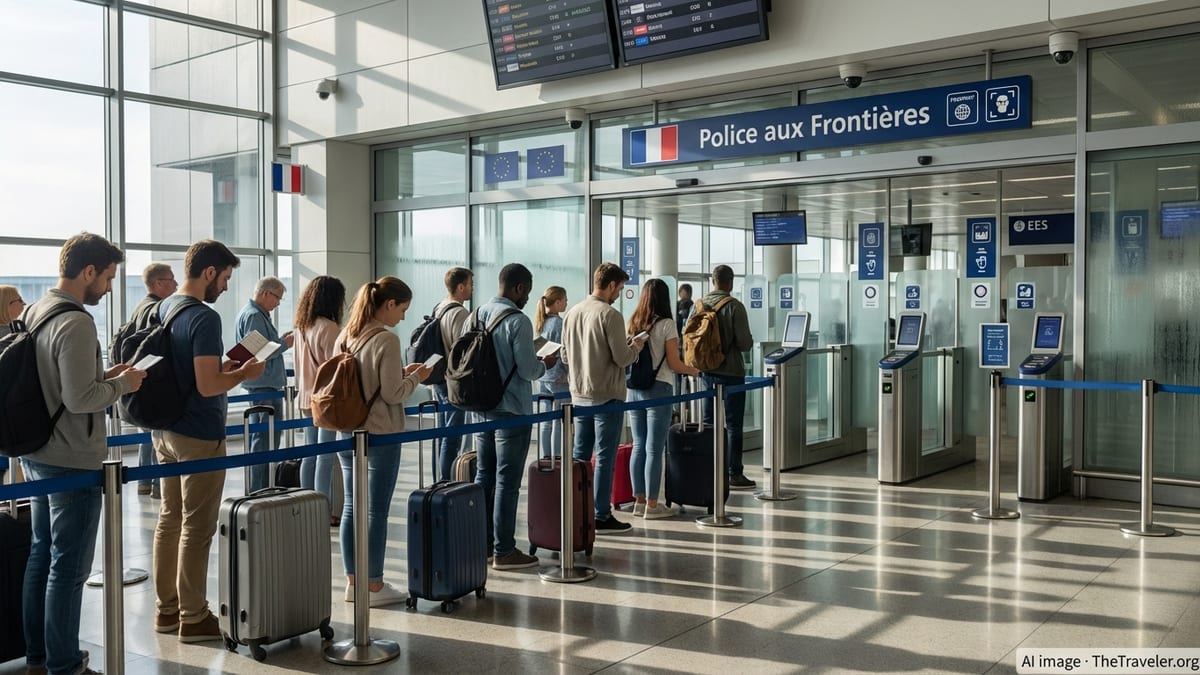
For tourists arriving in France once the system is fully deployed, this will mean a slightly different experience at the border. At major airports and some ferry or rail terminals, you may be directed to self service kiosks or e gates, where your passport will be scanned and your biometrics collected if it is your first trip under the new system. Subsequent visits should be quicker, as your data will already be stored and only your latest entry or exit will need to be recorded.
The core purpose of the Entry Exit System is to strengthen security and make it easier for authorities to identify overstays based on the 90/180 day rule. For most law abiding tourists, the main noticeable change will be a more automated process and the replacement of passport stamps with electronic records. However, during the early stages of rollout, some ports and airports may experience longer queues while equipment and procedures bed in. Travelers should factor in extra time for border formalities, especially at busy holiday periods.
Importantly, the Entry Exit System does not replace the need for a visa or future ETIAS authorization. Instead, it works alongside those tools. A visa exempt tourist who has obtained ETIAS approval will still need their details recorded in the Entry Exit System. Likewise, a traveler with a Schengen short stay visa will have their entry and exit logged, helping ensure compliance with permitted durations of stay.
Health, Insurance and Financial Means Requirements
France does not currently impose routine Covid 19 related entry rules on tourists, and vaccination or test certificates are not generally required for leisure travel. That said, health regulations can change if new variants emerge or public health circumstances shift. Tourists planning a visit in 2026 or later should always check official French government or consular sources close to departure for any temporary sanitary measures that might be in place, particularly during winter seasons.
Separate from public health rules, France and other Schengen states expect visitors to have adequate medical coverage for the duration of their stay. For travelers applying for a short stay visa, comprehensive travel medical insurance is usually a formal requirement, including a minimum level of coverage for emergency treatment and repatriation. Visa exempt tourists are strongly advised, although not always legally required, to carry similar insurance. Medical care in France is of high quality but can be expensive for non residents without coverage.
Another key condition of entry is proof of sufficient financial means. Border guards are entitled to ask tourists to demonstrate they can support themselves during their stay without resorting to work or public funds. Evidence might include recent bank statements, credit cards, cash, or proof that accommodation and major expenses have already been paid. The exact amount considered adequate can vary depending on your plans, length of stay and whether you are staying in hotels, rentals or with hosts.
Finally, visitors may be asked to show proof of onward or return travel, such as an airline ticket back to their home country or onwards to another destination outside Schengen within the allowed 90 day period. Being able to present clear, booked travel plans and accommodation details can significantly smooth the entry process and reduce questions at the border, especially for travelers arriving from countries with higher migration risk profiles.
On Arrival in France: What Border Officers Can Check
Holding a valid passport, visa or ETIAS authorization is only part of the story. Entry to France is always decided at the border by a French border police officer, who must be satisfied that you meet all conditions for admission. They may ask a series of straightforward questions about your trip, such as the purpose of your visit, how long you intend to stay, where you will be staying and how you will fund your time in the country.
To support your answers, you may be asked to show supporting documents. These can include hotel reservations, rental confirmations, an invitation letter from a host, return or onward tickets, travel insurance certificates and proof of funds. While many travelers are waved through with minimal questions, being able to produce this information quickly if requested is highly advisable. Having digital copies easily accessible on your phone or printed versions in your hand luggage can make the process faster and less stressful.
Border officers also have the authority to deny entry if they believe you intend to work without authorization, overstay or otherwise breach immigration rules. For example, arriving with a one way ticket, minimal funds and no clear accommodation plans may raise concerns, particularly if you have a history of overstays or prior refusals. Similarly, presenting inconsistent or untruthful information during questioning can lead to refusal of entry even if your documents appear in order.
If you are refused entry, the decision is normally recorded and may affect future attempts to visit France or other Schengen states. In serious cases, travelers can receive a formal entry ban for a defined period. Tourists should therefore take border checks seriously, answer questions calmly and honestly, and ensure their travel plans align with the permissions granted by their visa, ETIAS authorization or visa exempt status.
The Takeaway
Traveling to France for tourism in 2026 remains relatively straightforward, but the environment is evolving as Europe modernizes its borders. Passports must meet Schengen validity rules, and travelers from visa required countries still need to obtain a short stay visa in advance for holidays and family visits. Those who are visa exempt today will soon also need to secure ETIAS travel authorization once it comes into force, likely from late 2026, before boarding flights or ferries bound for France.
At the same time, the new Entry Exit System is changing the way arrivals and departures are recorded, with biometric checks and electronic logs replacing the familiar ink stamps. This will make it easier for authorities to monitor stays and enforce the 90 days in 180 rule across the Schengen Area. Tourists who understand that rule, plan their itineraries carefully and keep track of their days in Europe should have no difficulty complying.
Health and insurance expectations, proof of funds and basic documentation such as accommodation bookings remain important practical elements of every trip. While many visitors pass through border controls with only a quick passport scan and a few questions, being well prepared is the best insurance against delays or difficulties. Checking official French and European sources in the months before you travel will help you confirm whether ETIAS has become mandatory and whether any new public health or security measures apply.
Ultimately, the aim of these systems is to strengthen security without preventing legitimate tourism. With a little advance planning and an awareness of how passports, visas, ETIAS and the Entry Exit System interact, most travelers can continue to enjoy smooth entry to France and focus on the real purpose of their journey: discovering the country’s food, culture, landscapes and cities.
FAQ
Q1. Do I need a visa to visit France as a tourist in 2026?
Most nationals of visa exempt countries, such as the United States, Canada, the United Kingdom, Australia and Japan, do not need a traditional visa for short tourist stays of up to 90 days in any 180 day period. However, travelers from countries that are not visa exempt must still apply in advance for a Schengen short stay visa through French consular services.
Q2. When will ETIAS become mandatory for travel to France?
As of early 2026, ETIAS has not yet taken effect. Current EU plans indicate that it should start operations in the last quarter of 2026, with a transition period before it becomes strictly mandatory. Tourists planning trips from late 2026 onward should check the latest official updates, as the exact enforcement date may evolve.
Q3. How long can I stay in France without a visa?
If you are from a visa exempt country, you may usually stay in France and the wider Schengen Area for up to 90 days in any rolling 180 day period for tourism, family visits or similar short stays. Time spent in other Schengen states counts toward the same limit, so multiple trips and multi country itineraries must be planned carefully.
Q4. What passport validity do I need to enter France?
In most cases, your passport should be valid for at least three months beyond the date you intend to leave the Schengen Area, and it should have been issued within the last 10 years. Airlines and border authorities may refuse boarding or entry if these conditions are not met, so renewing an almost expired passport before travel is strongly recommended.
Q5. What documents can French border officers ask for on arrival?
Border officers may request proof of accommodation, such as hotel bookings or a host invitation, evidence of return or onward travel, travel medical insurance details and proof of sufficient funds for your stay. They can also ask questions about the purpose and duration of your visit and may refuse entry if they are not satisfied with your answers or documentation.
Q6. Do I still need travel insurance if I am visa exempt?
Travel medical insurance is formally required for many short stay visa applicants, but for visa exempt tourists it is usually only strongly recommended. Given the potential cost of emergency medical care and repatriation, most travelers are advised to obtain comprehensive coverage that clearly includes France and the rest of the Schengen Area for the full length of their trip.
Q7. How does the 90/180 day rule work in practice?
On any given day you are in the Schengen Area, authorities look back at the previous 180 days and total the number of days you were present. If that running total exceeds 90 days, you are considered to have overstayed. The rule applies to the entire Schengen Area, so days spent in other member countries reduce the time you can spend in France.
Q8. Will ETIAS guarantee my entry to France once it is approved?
No. ETIAS is a pre travel security screening, not a visa or a guarantee of admission. Even with an approved ETIAS linked to your passport, French border officers will still check that you meet entry conditions on arrival and have the right to refuse entry if they have concerns about your intentions, documentation or security risks.
Q9. What is the Entry Exit System and how will it affect my trip?
The Entry Exit System is a digital database that records entries and exits of most non EU travelers at Schengen external borders, replacing manual passport stamps. It uses passport scans and, in many cases, biometric data to log your movements and helps authorities enforce the 90/180 day rule. For tourists, it mainly means using automated kiosks or e gates and allowing extra time at border control while the system is fully rolled out.
Q10. What should I do if I plan to stay in France longer than 90 days?
Tourists who wish to spend more than 90 consecutive days in France, or who intend to live, work or study there, usually need to apply in advance for a long stay national visa matched to their purpose of stay. Relying on repeated short stays to live in France long term can lead to problems, so anyone with more permanent plans should seek advice on the appropriate visa category and residence procedures.