

More news on this day
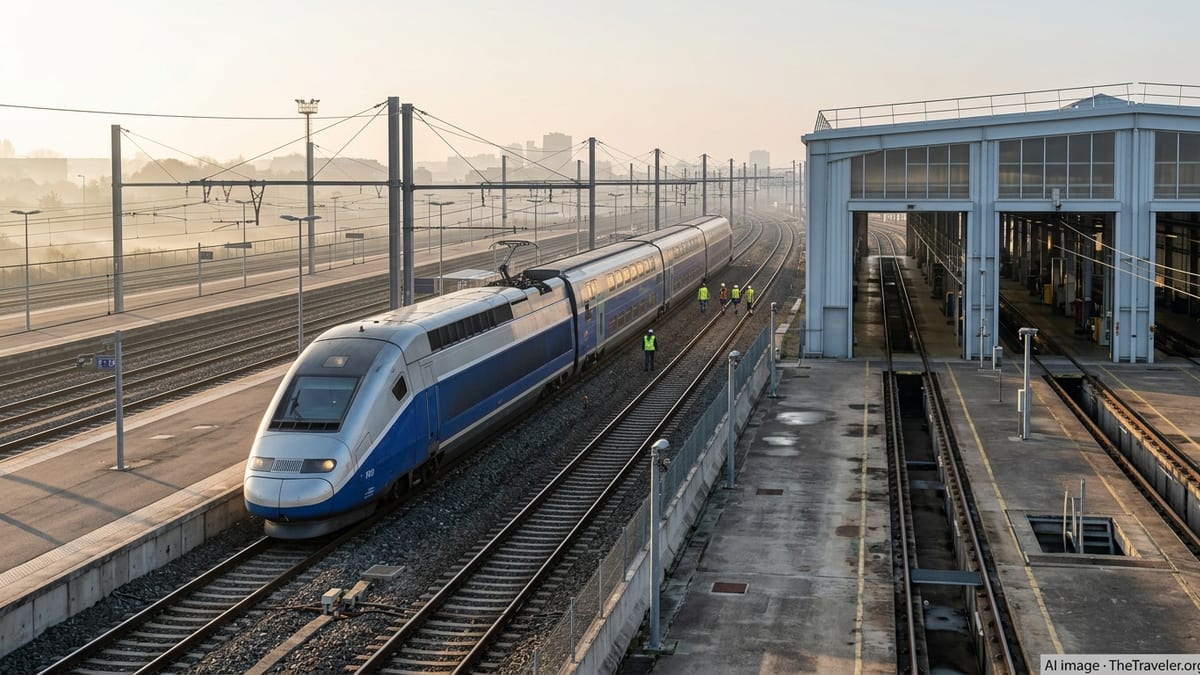
France is deepening its commitment to high-speed rail with plans for an €80 million maintenance hub designed to support the next generation of TGV and international services, strengthening both domestic connectivity and the country’s wider role in Europe’s low-carbon transport network.
Get the latest news straight to your inbox!
A Strategic Boost to France’s High-Speed Rail Backbone
Publicly available information indicates that the new €80 million facility is part of a broader push to modernize France’s high-speed rail ecosystem, which already spans thousands of kilometres of dedicated lines and serves tens of millions of passengers each year. The investment is intended to increase capacity for maintaining very high-speed trainsets, reduce bottlenecks in existing depots, and keep more rolling stock available for service at peak travel times.
Reports on France’s national rail strategy show that demand for high-speed services has been steadily rising as passengers opt for rail over short-haul flights on major corridors such as Paris to Lyon, Bordeaux, Marseille and destinations beyond France’s borders. By concentrating new resources in a state-of-the-art maintenance hub, planners aim to ensure that fleet availability keeps pace with new services, especially as additional high-speed links to southwestern France and cross-border routes advance.
The hub is expected to handle both routine servicing and more complex overhauls, which are critical for keeping trains running at speeds above 300 kilometres per hour. Centralizing these activities in a purpose-built site allows for better workflow, more advanced diagnostic tools, and optimized scheduling, all of which contribute to higher reliability for passengers.
Supporting Next-Generation TGV and International Services
According to published coverage of France’s rolling stock plans, the country is preparing for the large-scale introduction of new-generation very high-speed trains, including more energy-efficient, higher-capacity models tailored to dense domestic routes and international corridors. The €80 million maintenance hub is being framed as a necessary counterpart to those investments, ensuring that new trains can be serviced to the standards required for intensive daily operation.
Industry reporting highlights that modern high-speed trainsets are more technologically sophisticated than earlier generations, with advanced onboard systems, lightweight materials and modular interiors. These features promise lower energy use and more flexibility in seating layouts, but they also increase the importance of specialized maintenance capacity. The new facility is expected to incorporate upgraded inspection equipment, digital monitoring tools and workshops configured around the latest train architectures.
France’s high-speed network increasingly functions as a backbone for longer European journeys, linking to services toward Spain, Belgium, the Netherlands, Germany and Italy. As cross-border traffic returns and grows, the ability to maintain trains used on international services within France becomes more strategically important. The planned hub is expected to contribute to more resilient operations on these routes, limiting disruption caused by heavy maintenance cycles.
Modern Maintenance for a Low-Carbon Mobility Agenda
France has positioned high-speed rail as a central pillar of its climate and mobility policies, with successive strategies emphasizing the role of fast intercity trains in reducing emissions from aviation and road transport. Public documents on national transport planning show that expanding and upgrading rail infrastructure is seen as one of the most effective levers for cutting carbon on medium-distance journeys.
The €80 million maintenance hub fits into this framework by targeting operational reliability and lifecycle performance rather than simply adding new tracks. Well-maintained trains consume less energy, suffer fewer breakdowns and can remain in service for longer, improving the overall efficiency of the system. This, in turn, strengthens the case for travellers and regional authorities to favor high-speed rail over more carbon-intensive modes.
Technical material on recent upgrades across the French high-speed network also underscores a broader shift toward digitalized, condition-based maintenance. The new hub is expected to integrate this approach, using real-time data from trains to anticipate wear, schedule interventions more precisely and avoid unscheduled outages. Such practices can reduce maintenance costs and downtime while extending the life of key components.
Economic Impact and Regional Development Potential
Beyond its operational role, the €80 million hub is expected to generate economic benefits in its host region, through both direct employment and secondary activity in related industries. Large maintenance sites typically require skilled technicians, engineers, logistics staff and support services, creating a cluster of rail-related expertise that can attract additional investment.
Experience from other high-speed rail projects in France suggests that such facilities can anchor wider industrial ecosystems, particularly when located near existing lines, research centres and manufacturing plants. Suppliers of components, digital services and training may benefit from proximity to a major maintenance base where innovation can be tested and deployed on working fleets.
Regional authorities often view this type of investment as an opportunity to align transport infrastructure with broader development goals, including improved access to jobs and tourism flows. By reinforcing high-speed operations, the hub supports more frequent and reliable connections between major cities and secondary destinations, which can encourage business travel and city-to-city tourism throughout France and neighbouring countries.
Strengthening France’s Position in Europe’s Rail Future
Europe’s wider shift toward high-capacity, electrified rail corridors is creating new competitive dynamics among major rail markets. France, which was an early pioneer of high-speed services, is now focusing on renewing and extending that leadership through targeted investments in both infrastructure and fleet support.
Analyses of European rail development trends note that reliability, punctuality and cost-efficiency are increasingly important for operators facing competition from low-cost airlines and long-distance buses. A modern, well-equipped maintenance hub is a core component of that competitive equation, helping operators manage larger and more diverse high-speed fleets without sacrificing performance.
The €80 million hub therefore carries significance beyond its immediate technical function. It signals that France intends to pair ambitious line extensions and new rolling stock with the behind-the-scenes capability required to keep trains running smoothly. For travellers, the result is likely to be seen not in the depot itself but in more frequent departures, fewer disruptions and a stronger network of high-speed rail options across France and into the rest of Europe.