

More news on this day
Morocco’s tourism boom is accelerating into 2026, with more than 1.3 million visitors recorded in January and France pulling decisively ahead of North American and European rivals as the kingdom fast-tracks its 2030 mega-growth agenda.
Get the latest news straight to your inbox!
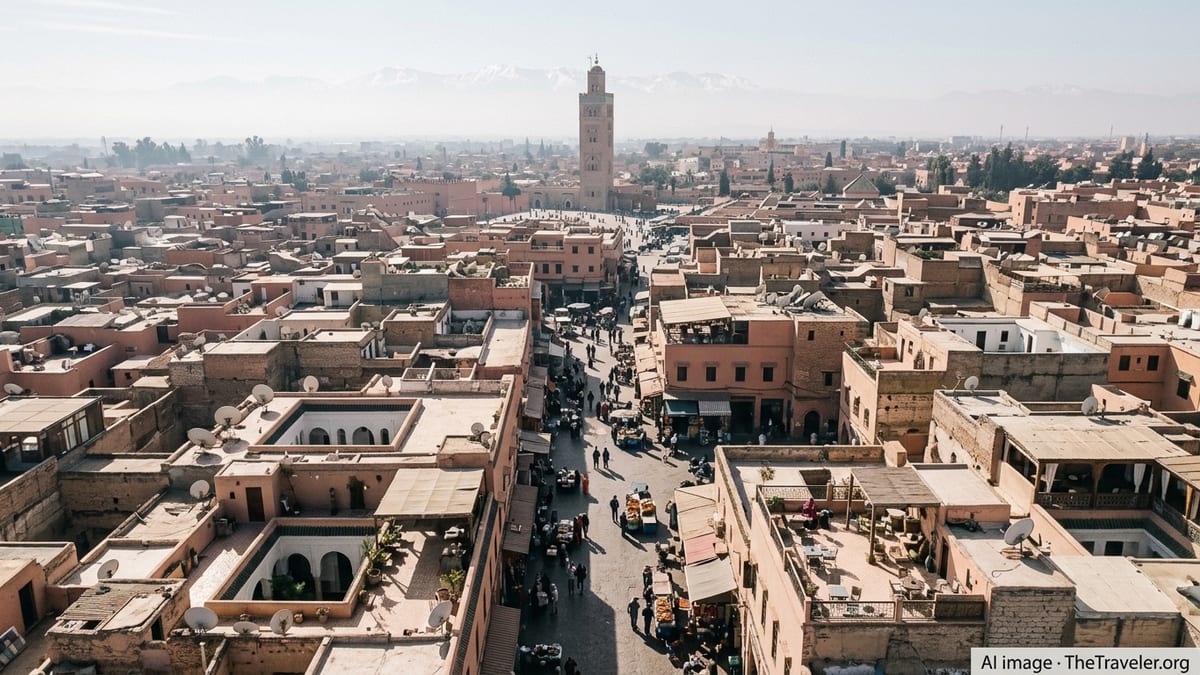
January Surge Confirms Morocco’s New Tourism Momentum
Latest border data for January 2026 indicate that Morocco welcomed in excess of 1.3 million international visitors, extending the strong double-digit growth trend recorded throughout 2024 and 2025. Publicly available briefings from Moroccan financial and sector analysts showed that January 2025 arrivals had already climbed to around 1.27 million, up roughly 27 percent year on year. The additional gains now being reported for early 2026 suggest that the sector has entered a new volume range, with January alone exceeding the 1.3 million mark.
This sharp seasonal performance follows a record 2025, when Morocco received close to 20 million visitors, compared with about 14 million in 2019. The country has also strengthened its position as Africa’s most visited destination, supported by a combination of expanded air links, heavy promotion of city and coastal breaks, and shifting demand away from more volatile markets in the wider region.
Market observers note that the January spike is particularly significant because it falls outside the peak summer season and major holiday periods. It is therefore seen as evidence that Morocco is successfully extending its tourism calendar beyond traditional winter sun and school holiday peaks, with city trips, cultural itineraries and events helping to smooth demand across the year.
Revenues have broadly tracked the increase in arrivals, with recent national statistics showing tourism income close to tripling since the early 2000s. That trend is expected to intensify if authorities succeed in pushing visitors toward higher-value cultural, coastal and nature experiences, rather than relying solely on volume growth.
France Consolidates Lead Over US, Canada, UK and Other Key Markets
Within this broader surge, France has clearly reasserted itself as Morocco’s dominant source market. Sector studies and regional tourism analyses for 2024 and 2025 consistently identify France as Morocco’s largest inbound market, ahead of Spain and significantly above long-haul contributors such as the United States and Canada. One recent global travel and tourism impact report, for instance, names France as Morocco’s biggest source of tourists, underscoring the depth of that relationship.
French visitors benefit from short-haul flight times, longstanding cultural and linguistic ties, and an extensive network of direct connections into cities including Marrakech, Casablanca, Agadir, Rabat and Fez. French booking data for summer 2025 even showed Morocco briefly overtaking traditional Mediterranean competitors such as Spain and Tunisia for international holidays, signaling the kingdom’s growing appeal to French travelers seeking alternatives to crowded European beach destinations.
While arrivals from the United States, Canada, the United Kingdom, Belgium, Italy and Poland are all rising, their absolute numbers still lag far behind those from France. Data compiled by a regional tourism observatory for the 2019 to 2025 period show steady increases from these markets, with particularly strong percentage growth from Poland and the United States. Yet even with this momentum, France continues to deliver the largest single flow of visitors, giving it an outsized role in Morocco’s tourism mix.
At the same time, sector analysts highlight the strategic importance of diversification. Growing air capacity from North America, new partnerships with European tour operators in Benelux and Italy, and targeted campaigns in Central and Eastern Europe are all designed to reduce over-reliance on any single country, even as France remains the clear leader.
Roadmap to 26 Million Visitors and a 2030 Mega-Growth Vision
The January surge is unfolding against the backdrop of an ambitious 2030 roadmap that aims to recast Morocco as one of the world’s leading tourism destinations. The Ministry of Tourism and the national tourism observatory have publicly laid out targets to welcome around 26 million visitors by 2030, up from roughly 19 to 20 million in 2025. The plan also seeks to lift Morocco into the top tier of global destinations, both by visitor numbers and by the sector’s contribution to gross domestic product and employment.
This long-term vision builds on an interim “Light in Action” program that runs through 2026 and aims to raise arrivals to about 17.5 million from a 2022 baseline of just under 11 million. Authorities and industry bodies describe a shift from purely quantitative growth toward a more diversified, higher-yield model, with greater emphasis on themed experiences, regional circuits and sustainable development.
Major international events are integral to the 2030 strategy. Morocco is preparing to co-host the 2030 FIFA World Cup and is positioning itself for other large-scale sports, cultural and business gatherings. Analysts expect these events to accelerate investment in hotels, transport and urban infrastructure, while also giving the country a global showcase moment that could further boost demand from distant markets such as North America and Asia-Pacific.
Strategic documents and independent commentary also point to the broader economic role of tourism, which already accounts for an estimated seven percent of national GDP. By 2030, the sector is intended to support hundreds of thousands of direct and indirect jobs, particularly in hospitality, transport, food services and cultural industries.
Destinations, Infrastructure and Air Links Underpin Expansion
Morocco’s city and coastal destinations remain central to the current boom. Marrakech continues to dominate hotel nights and international branding, while Agadir, Casablanca, Tangier and Essaouira benefit from rising interest in beach, surf and city-break combinations. Coastal resort development along the Atlantic, building on earlier initiatives such as Plan Azur, is again drawing attention as new properties reach the market and older sites are refurbished.
Infrastructure improvements are expected to reinforce this momentum. The country’s first high-speed rail line, between Tangier and Kenitra, is due to be extended south toward Rabat and Casablanca and eventually Marrakech by the end of the decade. Transport specialists say this will significantly cut journey times between key tourist gateways and interior destinations, making multi-city itineraries more attractive and reducing pressure on domestic air services.
On the aviation side, international coverage highlights an expanding network of direct flights into Moroccan gateways from Europe, North America and the Middle East. New and upgraded routes from France, the United Kingdom, Germany, Italy, Belgium, Poland and the United States have been singled out in trade publications as important drivers of inbound growth, supported by promotional partnerships between Morocco’s tourism board and major airlines and tour operators.
At the same time, authorities have encouraged private investment in accommodation ranging from large resorts and branded city hotels to guesthouses and riads in historic medinas. Observers note that this variety helps Morocco serve both mass-market and higher-end segments, from package holidaymakers to long-weekend cultural travelers and digital nomads.
Opportunities and Pressures as Morocco Climbs the Global Rankings
The combination of record January arrivals, France’s enduring dominance as a source market and the 2030 mega-growth plan places Morocco firmly in the spotlight of global tourism. Regional and international analysts increasingly compare the kingdom’s trajectory with that of established Mediterranean powerhouses such as France, Spain and Italy, especially as travelers look beyond the traditional European circuit.
However, the rapid expansion also brings challenges. Local commentators regularly raise concerns about pressure on housing and infrastructure in historic centers such as Marrakech and Fez, as well as on fragile coastal and mountain environments. As Morocco moves toward its 26 million visitor target, debates around regulation of short-term rentals, carrying capacity in popular sites and the balance between tourism and everyday urban life are intensifying.
Sustainability is therefore becoming a central theme of Morocco’s tourism narrative. The country’s broader climate and renewable energy commitments, widely cited in international climate indexes, are increasingly woven into destination branding, while new tourism projects are often framed around lower-impact design and community benefits. Industry observers argue that the credibility of Morocco’s 2030 vision will depend on how effectively these principles translate into on-the-ground practices.
For now, the data from January 2026 confirm that demand is moving in the direction policymakers hoped for when the roadmap was launched. With France in a commanding lead among source markets and arrivals from the United States, Canada, the United Kingdom, Belgium, Italy, Poland and others climbing, Morocco appears on course to turn its 2030 tourism vision into one of the defining growth stories of the decade.