

More news on this day
From the Red Sea to the Mediterranean, France’s new generation of stealth frigates and deck-launched drones is quietly transforming how the world thinks about safety along major cruise routes, ferry corridors and coastal tourist hubs.
Get the latest news straight to your inbox!
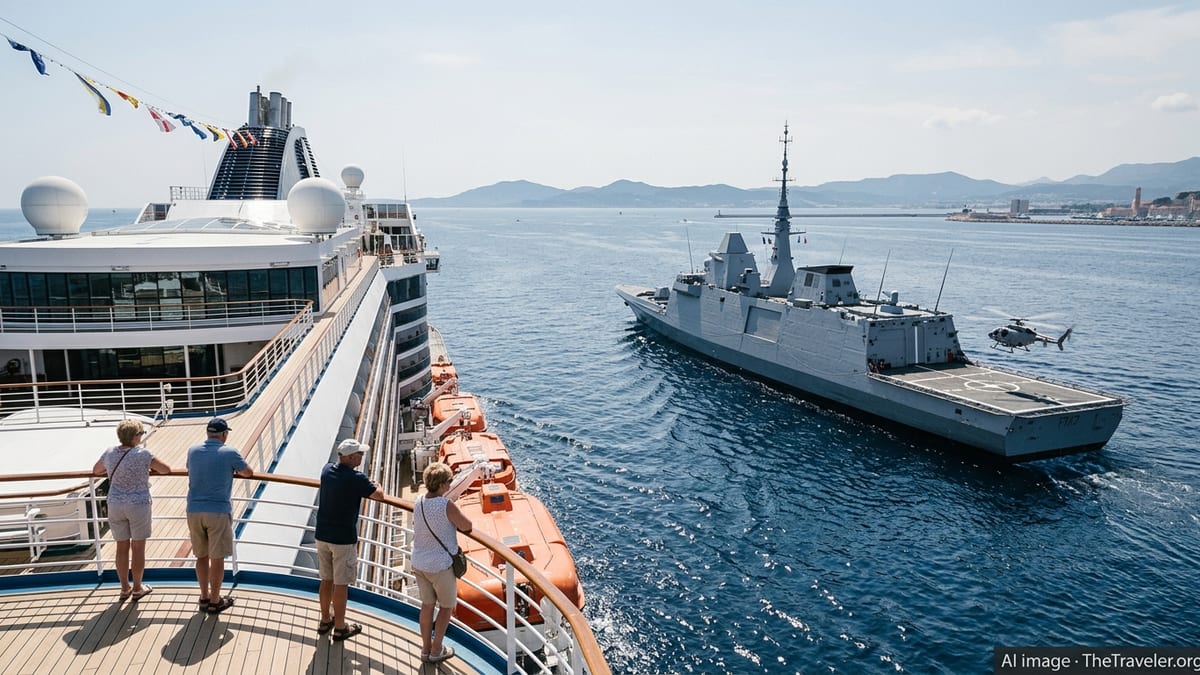
A Stealth Fleet Built for a New Era of Threats
France’s Defence and Intervention Frigate program, known as the FDI or Amiral Ronarc’h class, has moved from concept to operational reality at a moment when drones and missiles are reshaping security at sea. According to recent coverage in European security and defense publications, the compact, stealth-shaped frigates are optimized to counter drone swarms, cruise missiles and fast attack craft, using a fully digital architecture and advanced Sea Fire radar to maintain 360-degree surveillance in crowded waters.
The lead ship Amiral Ronarc’h has already conducted extensive sea trials and, based on publicly available information, is being positioned for deployment to high-risk regions such as the Gulf within months. Reports indicate that export versions are drawing interest from partners who share the same concerns as cruise lines and ferry operators transiting chokepoints like the Red Sea, the eastern Mediterranean and the approaches to the Suez Canal.
France’s naval modernization is not occurring in isolation. Coverage in specialist naval outlets points to a broader shift: surface fleets now assume that drones and loitering munitions are a daily operational reality rather than a future scenario. In this environment, the FDI’s low-observable profile, integrated sensors and ability to host both helicopters and unmanned air systems on its stern deck represent a baseline for managing threats that can appear without warning along popular maritime travel routes.
Drones Over the Deck: From Combat Tool to Protective Screen
French vessels have been experimenting aggressively with unmanned systems launched directly from their decks. In mid 2025, a demonstration from a Floréal-class surveillance frigate involved launching a fixed-wing unmanned aircraft configured as a loitering munition, illustrating how drones can extend a ship’s situational awareness far beyond the horizon and, if required, neutralize threats before they approach commercial sea lanes. Published analyses note that future FDI frigates and France’s next aircraft carrier are being designed with dedicated bays and interfaces for unmanned systems, anticipating routine drone operations at sea.
Alongside these combat-focused trials, France’s navy has been testing aerial drones and underwater gliders for maritime surveillance exercises off the Mediterranean coast. Reports describe scenarios where drones were used to scout beaches, detect small craft and counter hostile unmanned platforms, offering a preview of how the same technologies could track suspicious movements near cruise ships, large ferries or coastal resort areas that depend on reliable sea connections.
This expanding drone ecosystem sits literally above the traditional helicopter deck. The same aft flight area that once hosted only manned helicopters is increasingly seen as a launchpad for mixed air groups, combining crewed aircraft with rotary and fixed-wing drones. For the travel sector, that means a single warship escorting a convoy or patrolling a busy strait can now watch over a much larger swath of ocean, strengthening the virtual security bubble surrounding passenger vessels.
Ripples Across Cruise Routes and Ferry Corridors
Although France’s new stealth frigates are defense assets rather than commercial ships, their deployment patterns closely track key tourism arteries. Coverage of recent French naval operations in the Red Sea and eastern Mediterranean highlights a core mission of shielding international shipping from drone and missile attacks. While these missions are framed in military terms, any reduction in perceived risk along these routes can directly influence cruise itineraries, insurance calculations and passengers’ willingness to book sailings through contested waters.
Industry observers point out that major cruise lines and ferry operators routinely adjust schedules in response to maritime security advisories. When naval forces can demonstrate credible protection against drones and small, hard-to-detect threats, the result can be a reopening of routes that might otherwise be avoided or heavily restricted. France’s combination of stealthy frigates, long-range sensors and deck-launched drones offers a layered defense that reassures port authorities and travel planners looking to keep high-value passenger traffic flowing.
The psychological effect is almost as important as the technical one. Even when travelers are only vaguely aware of the specifics, news that advanced frigates equipped to counter drones are on station can help restore confidence in destinations reached by sea. Cruise marketers and tourism boards, particularly in the eastern Mediterranean and Gulf gateways, increasingly frame security as part of the overall value proposition, emphasizing that modern maritime protection enables access to coastal heritage sites, beach resorts and city-break stops that might otherwise seem too exposed.
French Ports Turn to Drones for Everyday Maritime Security
France’s embrace of drones is not limited to blue-water deployments. Port authorities along the Atlantic and Channel coasts have been piloting tethered and autonomous drone systems for several years, using them to monitor perimeter fencing, scan quaysides and inspect ship hulls for illicit activity. Trade and technology publications describe how self-operated security drones, flying pre-programmed patrol routes over facilities such as Dunkirk, have become part of the daily surveillance fabric.
More recently, European research projects involving French ports such as Le Havre have tested combined networks of fixed cameras, rotary drones and fixed-wing platforms to detect small, non-cooperative craft approaching sensitive areas. Executive summaries from these programs highlight the added value of drones in covering blind spots, operating in poor visibility and sharing real-time imagery with control rooms. For passenger terminals that handle cruise ships and cross-Channel ferries, this means a more continuous watch over gangways, embarkation zones and anchorages close to city centers.
The spillover into travel safety is tangible. Improved detection of suspicious movements near terminals can help prevent disruptions, reduce false alarms and support more targeted screening of vehicles and luggage. For tourists, the most visible change is subtle: smoother embarkation, shorter delays and port calls that proceed on schedule even when security concerns are elevated. Behind the scenes, however, drones circling above breakwaters and outer harbors represent a profound shift in how France guards the gateways that link its coastal cities to the global tourism network.
What This Means for Future Sea Travel
The convergence of stealth ship design, advanced radar and drone operations is likely to shape maritime travel well beyond France’s own waters. Other navies are closely watching the FDI program and the French navy’s experiments with unmanned systems, and analysts suggest that similar capabilities are set to appear across NATO fleets and partner nations. For travelers, that could translate into more consistent naval protection along popular cruise and ferry routes from the North Atlantic to the eastern Mediterranean and Indian Ocean.
At the same time, port-side drone infrastructure is expected to grow as operators look for cost-effective tools to monitor ever-larger passenger flows. Tethered surveillance drones, hull-inspection robots and autonomous surface craft may become standard features in major tourist ports, operating largely out of sight but feeding into risk assessments that determine whether ships depart on time and which destinations remain open.
France’s new stealth fleet and its expanding use of drones illustrate how quickly the frontier of maritime safety is moving. For the tourism sector, the implications are clear: the security of future sea journeys will depend not only on the size of a nation’s navy, but on the quiet presence of sensors, algorithms and unmanned craft watching over the waves where travelers rarely look.