

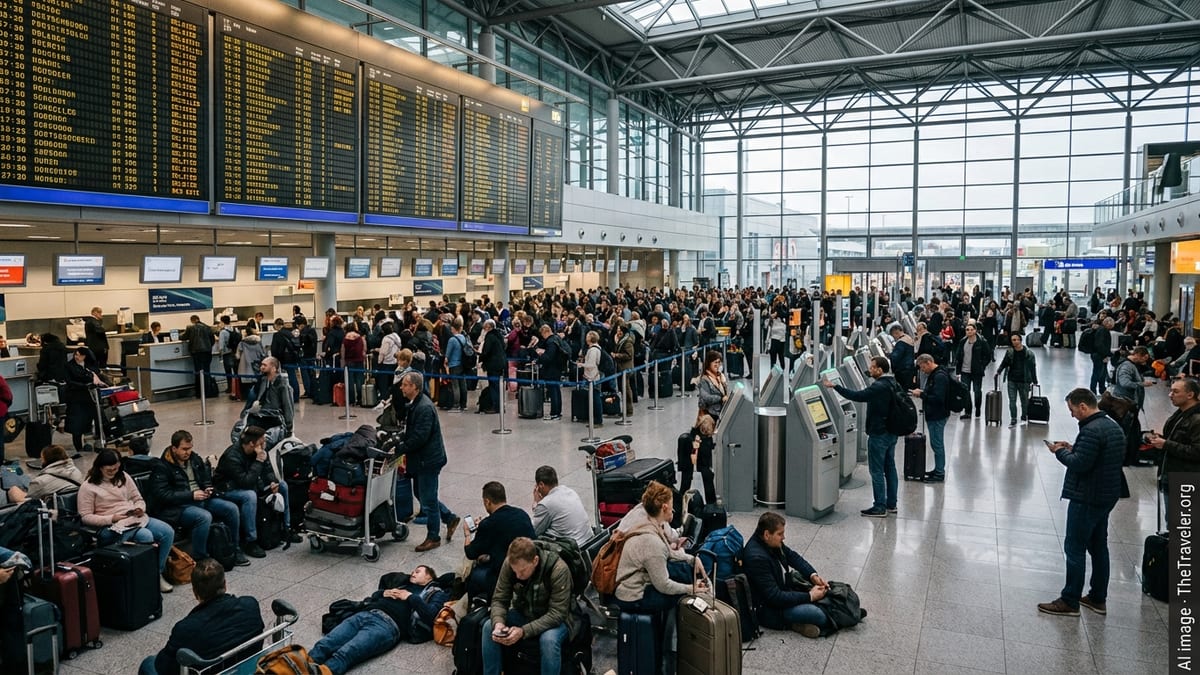
Hundreds of passengers were left stranded at Frankfurt International Airport on Tuesday after 123 flights were delayed and two canceled, creating ripple effects across Europe, the Middle East and Asia as major international carriers including Lufthansa, Qatar Airways and Singapore Airlines struggled to recover disrupted schedules.
Severe Operational Disruptions Hit Germany’s Busiest Hub
Frankfurt International Airport, one of Europe’s largest and busiest aviation hubs, faced a fresh wave of disruption as operational bottlenecks and knock-on delays combined to derail the morning and afternoon schedule. Airport display boards showed mounting delays through the day, with departure and arrival times repeatedly pushed back and passengers reporting a lack of clear, timely information at the gates.
The latest disruption comes amid a winter season in which Germany’s aviation network has already experienced repeated shocks, from weather-related slowdowns to staffing shortages and recent industrial action affecting major carriers. Frankfurt, which handles tens of millions of passengers a year and serves as the primary hub for Lufthansa, is particularly vulnerable to cascading delays, as even modest schedule changes can quickly reverberate through tightly timed connecting banks of flights.
While the total of two outright cancellations at Frankfurt on Tuesday was modest compared with some recent nationwide disruption days, the scale of the 123 delays meant that thousands of passengers were hit by missed connections, extended layovers and forced overnight stays. With long-haul departures to Asia and the Middle East among the services affected, the impact stretched well beyond Germany’s borders to cities such as Doha, Singapore and key transit points in Europe.
Airport staff deployed additional agents in the departure halls to assist with rebooking and to direct stranded travelers toward customer service counters. However, lines for airline desks grew quickly, with some passengers reporting waits of more than an hour to secure alternative routing or accommodation as evening approached.
Major Airlines Including Lufthansa, Qatar Airways and Singapore Airlines Affected
Lufthansa, Germany’s flag carrier and Frankfurt’s dominant airline, bore a significant share of the disruption as delays to morning European services knocked into its global long-haul operations. The carrier had already been contending with a challenging winter marked by weather disruptions across Europe and the aftermath of recent strike action that had forced the cancellation of hundreds of flights systemwide. As operations teams worked to reposition aircraft and crew, Frankfurt again became a pinch point for its intricate hub-and-spoke network.
Qatar Airways and Singapore Airlines, key Gulf and Asian carriers operating long-haul services in and out of Frankfurt, also saw schedules snarled. Late-arriving aircraft from earlier sectors, combined with congestion on the ground, contributed to prolonged turnaround times. Passengers bound for onward connections through Doha and Singapore reported concerns about missing late-night flights to destinations across Asia, Australasia and Africa, where alternative options are often limited to once-daily services.
For premium long-haul passengers, airline lounges remained busy well into the evening, with airlines distributing meal vouchers and, in some cases, arranging hotel stays for those facing overnight delays. Economy travelers, particularly those on the last legs of complex itineraries, were often left queueing at general service counters or waiting for digital rebooking options to appear in their airline apps.
The disruption at Frankfurt also added strain to partner airlines and codeshare services across Europe. Carriers feeding traffic into the German hub were forced to juggle seat availability as they attempted to accommodate stranded passengers from delayed long-haul flights, raising the risk of overbooked services and further operational knock-on effects at neighboring airports.
Scenes of Frustration in Terminals as Travelers Seek Answers
By midday, scenes inside Frankfurt’s terminals reflected mounting frustration among travelers who found themselves caught in long lines for rebooking, customer service and security rechecks. Families returning from winter holidays, business travelers en route to conferences and transit passengers on multi-stop itineraries converged at airline counters seeking clarity on when they might reach their destinations.
Several travelers described receiving multiple notifications on their phones as departure times were pushed back in increments of 30 to 60 minutes, creating uncertainty over whether they should remain at their gate or attempt to see agents about rerouting. For those with tight onward connections, the continuous adjustments made it difficult to know when their itinerary had effectively become unworkable.
Airport announcements urged passengers to monitor airline apps and departure boards, but some travelers complained of conflicting information between digital channels and what was being communicated at the gate. In the crowded concourses, portable charging stations and power outlets were in high demand as stranded passengers tried to keep phones and laptops powered while they waited for updates.
Food and beverage outlets in the departure halls and public areas reported brisk business as delays dragged into the afternoon and evening. While airlines provided meal vouchers in many cases, some passengers said they were unaware of their entitlements or were unable to secure assistance before their original boarding time had passed, highlighting ongoing communication challenges during irregular operations.
Knock-on Effects Across International Routes and Time Zones
The scale of the disruption at Frankfurt meant that its impact radiated across continents. For travelers departing from Asia and the Middle East, the delays translated into missed connections to secondary European cities, with some passengers forced to wait until the following day for the next available flight. Given that many long-haul services operate on daily or less frequent schedules, even a single missed connection can strand passengers for 24 hours or more.
Qatar Airways passengers routed via Doha to Frankfurt reported being advised to prepare for potential rebookings onward to Germany or neighboring countries such as Switzerland, Austria or the Netherlands, where alternative flights might be available sooner. Singapore Airlines travelers, meanwhile, faced uncertainty over onward European connections as delayed arrivals into Frankfurt collided with curfews and crew duty limits on subsequent sectors.
The timing of the disruption also created complications across time zones. Passengers leaving North America on overnight flights to Frankfurt were warned that their morning arrivals could feed into a congested and delayed bank of connections within Europe. Those with immediate meetings or events planned reported scrambling to adjust hotel bookings and ground transport, while some business travelers opted to hold virtual meetings from airport lounges rather than risk missing commitments altogether.
Airlines attempted to soften the impact by proactively rerouting some passengers through alternative hubs such as Munich, Zurich, Vienna and Amsterdam. While this helped reduce pressure on Frankfurt, it also added complexity for travelers unfamiliar with these airports or facing language barriers, especially when rebookings required navigating new security checks and immigration procedures at tight notice.
Passenger Rights and Compensation Under EU Rules
The latest wave of disruption has renewed attention on European air passenger rights, particularly Regulation EC 261/2004, which governs compensation and assistance for travelers facing cancellations and long delays. Under these rules, passengers departing from Frankfurt or arriving there on an EU airline may, in many circumstances, be entitled to financial compensation in addition to basic care such as meals and accommodation.
For long delays of three hours or more on arrival, travelers can qualify for compensation ranging from 250 to 600 euros depending on the length of their journey, provided the disruption was not caused by extraordinary circumstances such as severe weather or airspace closures. Airlines are also required to offer refreshments, access to communication and, if necessary, hotel stays and transport between the airport and accommodation when delays extend overnight.
Consumer advocates noted that passengers should keep all travel documents, including boarding passes, booking confirmations and receipts for meals or hotels purchased during the disruption. These records are crucial for submitting claims directly to airlines or through specialist claims services that assist travelers in pursuing compensation or refunds when eligible under EU law.
However, the application of compensation rules can be complex, particularly when multiple carriers are involved on a single itinerary or when delays stem from a mix of operational and external factors. Travelers were advised to document the reason given by the airline for the disruption and to follow up in writing, as verbal explanations at the gate may be incomplete or inconsistent with official records.
Airlines Respond With Rebooking Efforts and Operational Recovery Plans
In response to Tuesday’s disruption, airlines launched extensive rebooking operations, drawing on spare capacity across their networks and working closely with partner carriers in alliance frameworks. Digital tools played a larger role than in past crises, with many travelers receiving rebooking options directly in airline apps or via email, reducing the need for lengthy queues at service desks.
Lufthansa and other affected carriers focused on stabilizing their core hubs by prioritizing key long-haul departures and heavily booked European business routes. Aircraft and crew scheduling teams faced the challenge of aligning duty-time limits, maintenance windows and airport slot constraints while restoring punctuality for the following day’s operations. Airline spokespersons emphasized that the goal was to avoid a prolonged cascade of irregularities that could otherwise linger for several days.
Carriers also sought to reassure customers about safety standards amid the pressure to resume normal schedules. Operations managers reiterated that, despite delays, flights would not depart without full compliance with maintenance checks, crew rest requirements and weather restrictions, pointing out that occasional cancellations are sometimes necessary to maintain broader network reliability.
In the terminals, ground staff distributed information leaflets, directed passengers to online self-service tools and, in some cases, provided overnight kits containing essentials such as toiletries for those unexpectedly stranded. For travelers with tight personal circumstances, including medical needs or immovable events, airlines offered case-by-case support where possible, though some passengers still reported feeling left to navigate complex arrangements largely on their own.
Frankfurt’s Strategic Role Keeps It Under the Spotlight
The turbulence at Frankfurt highlights the strategic significance of the airport within global aviation. As a key European gateway, Frankfurt links medium-sized German cities and regional European destinations with major intercontinental routes. This central role means that even moderate operational issues can quickly translate into widespread disruption, particularly for passengers relying on single-day connections between continents.
Industry analysts note that Frankfurt’s tightly packed wave-based scheduling model, which clusters arrivals and departures into concentrated time windows to maximize connectivity, can be both a strength and a vulnerability. When everything runs smoothly, passengers benefit from short transfer times and extensive choice. When delays occur, however, the same structure can create bottlenecks in air traffic control, ground handling, security screening and immigration.
The latest incident adds to broader discussions about capacity, staffing levels and infrastructure at major European hubs. In recent months, airports across Germany and neighboring countries have grappled with the challenge of rebuilding operations to meet post-pandemic travel demand while dealing with ongoing labor negotiations, weather volatility and airspace constraints linked to geopolitical tensions.
For travelers, the lesson from Tuesday’s disruption is that even well-established hubs such as Frankfurt remain susceptible to sudden breakdowns in schedule reliability. Travel experts increasingly advise building longer connection times into itineraries, especially during peak seasons and winter months, and considering flexible tickets that allow for easier changes when plans are upended.
What Travelers Can Do When Stranded at Major Hubs
For passengers caught in the latest disruption at Frankfurt, travel advisors recommend a series of practical steps to minimize the impact of delays and cancellations. First, checking an airline’s official app or website often yields faster and more accurate information than airport departure boards alone. Many carriers now allow customers to accept alternative flights, request refunds or arrange accommodation digitally, without waiting in line at a counter.
Second, retaining all documentation and noting down the exact cause of the disruption is vital for pursuing any compensation or reimbursement later. Screenshots of delay notifications, copies of boarding passes and records of additional expenses can all support a claim under EU regulations if the delay meets the required thresholds and is deemed to be within the airline’s control.
Third, stranded travelers are encouraged to make early decisions about overnight stays if it becomes clear that onward travel will not be possible the same day. Although airlines may provide hotel vouchers in many situations, availability near major hubs can tighten quickly when large numbers of passengers are affected at once. Those who book their own accommodation should keep comprehensive receipts in case reimbursement is available.
Finally, experts stress the value of maintaining flexibility and patience during irregular operations. While the scenes at Frankfurt on Tuesday underscored how disruptive large-scale delays can be, they also highlighted the efforts of airport and airline workers attempting to manage a complex and dynamic situation. For many travelers, a combination of preparation, awareness of rights and proactive communication with airlines can make the difference between an exhausting ordeal and a manageable, if inconvenient, detour.