

More news on this day
Travelers across Egypt and the wider Middle East are facing fresh disruption after a new series of flight cancellations by Mesaair, Royal Jordanian, Saudia and other regional carriers cut into key links between Cairo, Luxor, Hurghada, Sharm El Sheikh and regional hubs including Amman, Bahrain and Dammam, according to newly compiled airport and industry data for late March 2026.
Get the latest news straight to your inbox!
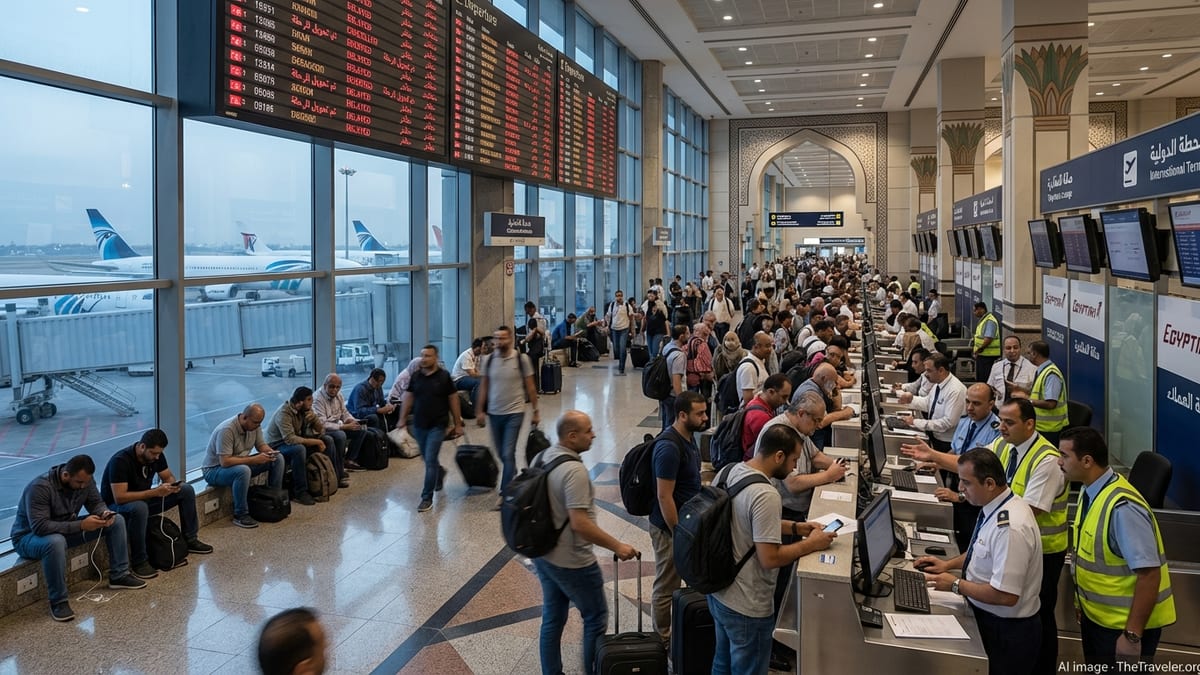
Latest Cancellations Across Egypt’s Main Tourist Gateways
Recent operational summaries compiled from live departure boards and industry tracking sites for the final days of March 2026 show at least a dozen additional flights scrubbed on routes serving Cairo, Luxor, Hurghada and Sharm El Sheikh. The affected services include both regional trunk routes and leisure-focused links that are critical for Egypt’s inbound tourism market.
Travel-focused industry coverage indicates that Mesaair, Royal Jordanian and Saudia are among the carriers most visible in this latest round of cuts, alongside smaller regional operators. One widely circulated update on March 29 highlighted cancellations from Cairo to Amman, Bahrain and Dammam, as well as disrupted services from Red Sea resorts toward Gulf hubs.
Sharm El Sheikh International and Hurghada International, both central to Egypt’s beach tourism economy, have reported intermittent gaps in overnight and early-morning departures. At Luxor International, cancellations and retimed flights on domestic and regional sectors are being flagged in timetable data as airlines shuffle aircraft and crews to cope with broader Middle East airspace and scheduling pressures.
Cairo International remains the focal point of the disruption. Aggregated data from airport information screens and independent trackers shows Cairo-origin or Cairo-bound flights repeatedly listed as canceled or heavily delayed, particularly services tied into regional connection banks in the Gulf and the Levant.
Impact on Routes Linking Egypt With Amman, Bahrain and Dammam
The latest cancellations are hitting some of the most heavily used regional corridors linking Egypt to neighboring states. Travel industry reports note that multiple frequencies between Cairo and Amman were withdrawn over the weekend and into early this week, including services operated by Royal Jordanian. One Cairo–Amman rotation that had already been disrupted earlier in the week was recorded as canceled again on Tuesday, extending the uncertainty for passengers relying on this key route.
Connections between Egyptian airports and Bahrain are also under pressure. Coverage from regional business outlets in recent days describes Bahrain’s airspace and hub operations as constrained, with Gulf carriers routing more traffic through Saudi Arabia’s Dammam. This has contributed to late schedule adjustments affecting flights from Egyptian gateways that typically feed into Bahrain’s network.
Dammam itself has emerged both as an alternative hub and a source of disruption. Travel operations updates show selected Saudia services involving Dammam and Egyptian cities among those canceled or retimed as the airline manages technical issues and reroutes traffic around constrained corridors elsewhere in the region. For passengers, that has translated into longer journey times, unexpected overnight stops and, in some cases, last-minute rebooking onto different routings entirely.
For Egypt’s outbound travelers, the shifting schedules have complicated access to connecting flights onward to Asia and Europe. Amman, Bahrain and Dammam traditionally serve as convenient stepping stones to long-haul destinations; with one or more links in the chain removed, itineraries that once involved a straightforward same-day connection now risk spilling over into multi-day journeys.
Wider Regional Strains Behind Egypt’s Disruptions
The latest turbulence for Egypt-bound and Egypt-origin flights is unfolding against a broader backdrop of regional aviation stress. In late March, Egyptian media and industry commentary described the Middle East and North Africa aviation sector as experiencing one of its most severe disruptions in years, citing airspace restrictions and reroutings linked to geopolitical tensions and security considerations.
Published assessments from Egypt’s aviation community point to thousands of flights per day being canceled or diverted across the wider region since the onset of the current crisis period. Carriers that serve Egypt have been forced to thread more complex routings between Europe, Asia and Africa, stretching crew and fleet resources and leaving less flexibility to absorb additional shocks such as weather or technical problems.
Recent days have also seen distinct operational challenges for individual airlines. Industry roundups on March 31 note that Saudia, Qatar Airways and Royal Jordanian collectively registered dozens of delays and nearly thirty cancellations within a short window, several of them involving Cairo. While not all of these flights touched Egypt directly, the knock-on effects on aircraft positioning and crew rotations have filtered into the Egyptian market.
These regional strains intersect with local factors. Egypt has recently experienced bouts of severe weather, including heavy rain and flooding in parts of Sinai and along the Red Sea, which prompted operational alerts and tighter check-in recommendations. Even when weather conditions improve, the residual backlog of delayed passengers and repositioning flights can linger for several days.
What Travelers Flying Via Cairo, Luxor and the Red Sea Need to Know Now
For travelers with imminent departures to or from Egypt, the latest cancellations underscore the importance of closely monitoring flight status. Publicly available information from airport screens and airline apps is being updated frequently, sometimes with changes occurring just hours before scheduled departure as carriers react to evolving constraints.
Travel industry advisories recommend that passengers with tickets involving Cairo, Luxor, Hurghada or Sharm El Sheikh build in extra buffer time for connections, particularly if their itineraries rely on same-day links through Amman, Bahrain or Dammam. Where possible, travelers are encouraged to consider earlier departures or alternative routings if a critical onward flight is at risk.
Flexible booking policies, introduced widely during earlier periods of disruption, remain in place at several regional airlines and may allow affected passengers to shift dates or reroute without standard change penalties. However, reports from the past 48 hours suggest that seats on remaining services are filling quickly, especially on weekend and holiday-period flights, limiting options for last-minute rebooking.
Travelers already in Egypt’s resort areas may also wish to keep a close eye on their return flights. With some overnight departures from Red Sea airports being consolidated or withdrawn, same-day surface travel from coastal cities to Cairo for more robust flight options is reappearing as a contingency strategy for tour operators and independent travelers alike.
Prospects for Stabilization as Spring Travel Builds
The timing of the latest cancellations is particularly sensitive for Egypt, coming just as spring travel demand gathers pace from Europe and the Gulf. Tour operators report healthy booking levels to the Nile Valley and Red Sea, and aviation planners had anticipated a busy season for Cairo, Luxor, Hurghada and Sharm El Sheikh.
Industry commentary suggests that airlines are working to stabilize schedules over the coming weeks, with some carriers already publishing revised timetables that reflect more conservative routing assumptions and longer block times to account for detours. The hope within the sector is that these adjustments will reduce the need for same-day cancellations that have characterized the current disruption wave.
Nonetheless, experts tracking Middle Eastern airspace developments caution that conditions remain fluid. Additional geopolitical flare-ups or further technical and weather-related challenges could force new rounds of cancellations or diversions, particularly on routes that cross contested or heavily managed skies.
For now, the practical outlook for travelers using Egypt’s main gateways is one of cautious planning rather than alarm. Flights are continuing to operate in and out of Cairo, Luxor, Hurghada and Sharm El Sheikh, but the pattern of intermittent cancellations by Mesaair, Royal Jordanian, Saudia and other carriers highlights the need for up-to-the-minute information, flexible itineraries and a willingness to adjust plans as this volatile spring travel period unfolds.