

More news on this day
Air travel across Europe has been hit by a new wave of disruption, with publicly available data indicating 1,149 delays and at least 31 cancellations affecting services operated by KLM, Wizz Air, Finnair and several other carriers across airports in France, Germany, Austria and beyond.
Get the latest news straight to your inbox!
Delays Mount Across Core European Markets
Fresh disruption has rippled through Europe’s aviation network, with delays concentrated at major hubs in France, Germany and Austria. Operational statistics and recent disruption trackers point to more than a thousand delayed flights in a single operating day, alongside several dozen outright cancellations. The knock-on effect has been felt most acutely on short and medium haul routes linking key cities such as Paris, Vienna, Frankfurt, Amsterdam and Helsinki.
Published coverage of recent disruption days in March and early April 2026 shows a recurring pattern: bad weather in parts of northern and western Europe, capacity restrictions in busy airspace and strained ground operations at large hubs are combining to create substantial reactionary delays. When turnaround times stretch and aircraft miss departure slots, later rotations are pushed back, swelling the delay totals even when underlying schedules remain intact.
Industry data for recent comparable events suggests that when delays climb above the 1,000 mark in a single day across Europe, disruption tends to spread rapidly between countries. Flights originating in France or Germany and transiting through regional hubs in Austria, the Netherlands or the Nordic countries can quickly fall behind schedule, especially where aircraft are shared across multiple routes. Travelers booked on connecting itineraries have been particularly exposed to missed onward flights and forced rebookings.
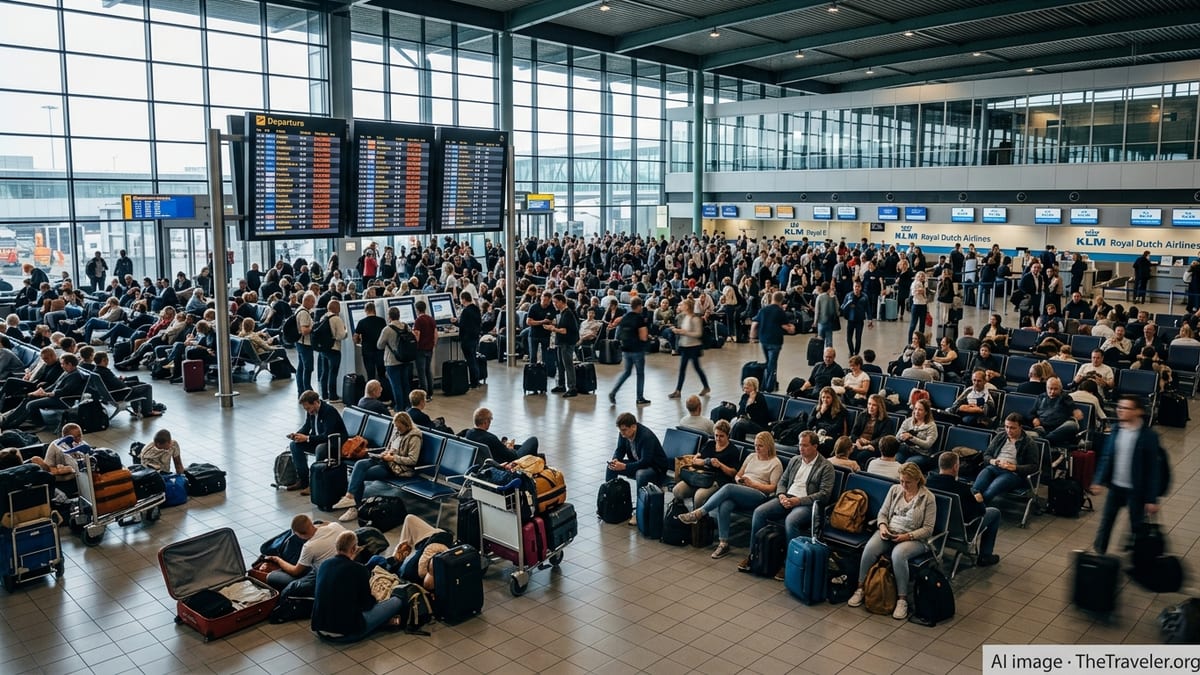
Although the latest episode has not resulted in a full-scale shutdown at any one airport, the high volume of delayed services has placed significant pressure on airline customer service channels and airport facilities. Crowded terminals, long queues at transfer desks and limited same-day alternative flights have been recurring themes reported by affected passengers.
KLM, Wizz Air, Finnair and Others Caught in the Disruption
The latest figures highlight that no single airline group has been spared. Carriers such as KLM, Wizz Air, Finnair, Austrian Airlines and other European operators feature prominently in disruption tallies compiled from tracking platforms and regional travel publications. For some, the impact has been concentrated in the form of extensive delays, while others have seen a higher share of outright cancellations.
Recent reporting on earlier disruption days in March 2026 showed KLM and its partners coping with more than one hundred delayed departures in Europe, a scale mirrored in the current wave of operational challenges. Finnair has also appeared in delay statistics, reflecting its role connecting northern Europe with major hubs further south. For Wizz Air, a period of restructuring in its Austrian operations, including changes to its Vienna base, has coincided with broader regional disruption, complicating the picture for low cost travelers using the carrier for point to point journeys.
Flag carriers and low cost operators alike have had to adjust schedules, consolidate lightly booked services and implement rolling delays to manage aircraft and crew availability. While many flights have ultimately departed, often with significant delay, cancellations have typically been concentrated on routes with multiple daily frequencies or on services where alternative ground or air options exist.
Publicly available performance reports from recent months illustrate that reactionary delays now account for a large share of disruption incidents for many European airlines. When one leg runs late because of weather or air traffic restrictions, the following sectors for that aircraft can accumulate additional delay, a dynamic that becomes especially problematic on complex multi sector schedules.
Paris, Vienna and Other Hubs Under Strain
Paris Charles de Gaulle has again emerged as one of the focal points of disruption. Traffic data from recent weeks shows that the airport has frequently ranked among the European hubs with the highest numbers of delayed departures, reflecting its role as a central interchange for both Air France KLM and a wide mix of partner and competing carriers. Even modest capacity constraints in the Paris region can therefore echo across the network.
Vienna has also been highlighted in performance briefings as an airport experiencing variability in punctuality, particularly when wider network issues in central Europe arise. With Austrian Airlines, Wizz Air and other carriers operating dense schedules to and from the Austrian capital, any ground handling or slot allocation challenges can cascade quickly into delays affecting onward connections to Germany, the Balkans and beyond.
Other key airports in Germany and neighboring states have reported similar patterns. Delay statistics for major hubs such as Frankfurt and Munich in recent disruption events point to a mix of air traffic flow management measures and ground handling bottlenecks, which can slow aircraft turnaround and stretch boarding and deicing times during adverse weather. Smaller but strategically important airports, including Amsterdam Schiphol and Copenhagen, often experience secondary effects as aircraft and crew arrive late from affected regions.
Airport performance reports published over the last year show that even marginal reductions in available runway capacity at busy European hubs can produce steep increases in arrival and departure delays. When those constraints coincide with peak travel periods or staffing shortages among ground handlers, the recovery period can extend well beyond the initial weather or technical trigger.
Passengers Face Missed Connections and Limited Alternatives
For passengers, the combined effect of 1,149 delayed flights and at least 31 cancellations translates into missed connections, extended airport waits and, in some cases, unplanned overnight stays. Travel forums and consumer platforms tracking the latest events show growing numbers of accounts from travelers who have had to rebook at short notice or accept rerouting via unfamiliar hubs to reach their final destinations.
On itineraries involving hubs such as Paris, Frankfurt or Vienna, a delay of even one or two hours on an initial leg can be enough to break minimum connection times, especially where additional security screening or terminal changes are required. With aircraft operating near full capacity on many routes, same day rebooking options can be scarce, leaving travelers with lengthy layovers or next day departures.
Legal frameworks such as European Union passenger rights legislation remain a crucial reference point for those affected. Public guidance from claims specialists and consumer organizations stresses that eligibility for compensation or reimbursement depends on a range of factors, including the length of delay, distance flown and the underlying cause, whether controllable operational issues or extraordinary circumstances such as severe weather or airspace restrictions.
Advisories issued in the wake of recent disruption days consistently recommend that passengers check flight status directly with airlines before setting out for the airport, monitor rebooking options through official digital channels and retain receipts for any additional expenses incurred. With disruption now recurring on multiple days across the current season, careful planning and contingency time in itineraries have become increasingly important for anyone flying through Europe’s busiest hubs.