

More news on this day
Hundreds of air travelers across Europe are facing unexpected overnight stays and missed connections as a fresh wave of disruptions triggers at least 37 flight cancellations and 276 new delays affecting major hubs in the United Kingdom, France, Germany and Turkey, with schedules for carriers including Air France, KLM, Virgin Atlantic and Norwegian heavily impacted.
Get the latest news straight to your inbox!
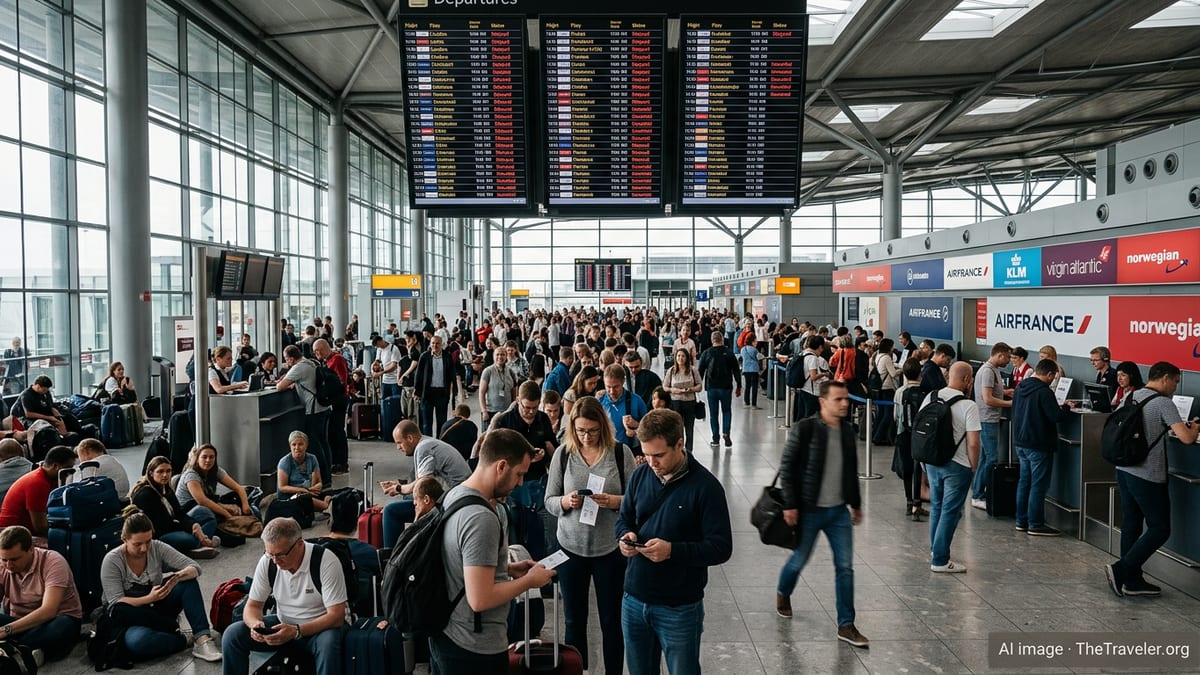
Major Hubs From London to Istanbul Buckle Under Disruption
Publicly available flight-tracking data and airport status boards on March 16 indicate that disruption is concentrated at some of Europe’s busiest gateways, including London, Paris, Frankfurt and Istanbul, where a combination of knock-on operational issues and regional airspace constraints has pushed already tight schedules to a breaking point.
Across these hubs, the tally of at least 37 cancellations and 276 newly reported delays appears to be spread through the day, hitting both early-morning departures and late-evening arrivals. That pattern has created particularly difficult conditions for connecting passengers, who are more likely to miss onward services as the delays cascade through airline networks.
European hubs tend to operate at near-maximum capacity under normal conditions, with little spare runway or gate space. When even a relatively small number of flights are disrupted, the resulting ripple effects can quickly strain ground handling, baggage systems and crew rotations, setting off a chain reaction that reaches well beyond the airports where the problems first emerge.
The current disruptions follow a winter marked by repeated weather incidents and region-wide air traffic control constraints. While the latest wave is smaller than previous large-scale episodes, the concentration of delays and cancellations at high-volume hubs has ensured that hundreds of passengers have been left effectively isolated, separated from their intended routes for many hours or overnight.
Flagship European Carriers Face Network Strain
Air France and KLM are among the hardest hit in the latest round of operational turbulence, according to live schedule information and recent traveler reports. Both airlines rely heavily on their Paris Charles de Gaulle and Amsterdam hubs for long-haul connections, so disruptions at one end of the network can rapidly impact flights across Europe, North America, the Middle East and Africa.
Virgin Atlantic services touching London, and Norwegian flights serving various European points, are also showing pockets of significant delay and a limited number of cancellations. As airlines adjust routes around sensitive airspace and cope with tight aircraft and crew availability, even minor technical or scheduling issues can translate into substantial timetable changes for passengers.
Published guidance on passenger experiences over recent weeks suggests that some travelers have struggled to obtain prompt rebooking and refunds when itineraries fall apart. The pressure on customer-service channels, particularly when several carriers are disrupted at once, can leave stranded passengers spending many hours in queues or on hold before securing alternative arrangements.
Airlines across Europe have been operating with limited slack in their fleets and staffing since the sharp rebound in post-pandemic travel demand. That leaves little room to absorb shocks such as sudden airport congestion, weather events or route suspensions, increasing the likelihood that localized problems will translate into multi-country disruption.
Knock-on Effects Stretch Beyond Europe’s Big Four Gateways
Although the most visible impacts are currently focused on London, Paris, Frankfurt and Istanbul, smaller European and intercontinental destinations are also feeling the consequences as aircraft and crews fail to arrive on time. Delayed inbound flights can force airlines to retime or cancel subsequent legs, leading to last-minute changes even at airports not initially affected.
Travelers connecting through Europe from long-haul departures in North America, Asia and Africa may find themselves stranded at intermediate points when their onward services are delayed or cancelled. In many cases, overnight accommodation and meal arrangements depend on whether the disruption is categorized as within the airline’s control or the result of external factors such as airspace restrictions or severe weather along parts of the route.
Public posts from passengers over the past few months highlight how fragile multi-stop itineraries have become when traversing Europe’s hub-and-spoke system. A missed connection in one city can lead to a complete re-routing via a different hub, with replacement flights sometimes departing a full day later, particularly when alternative capacity is limited.
As today’s disruptions unfold, travelers on affected routes may also see their baggage delayed or misrouted, especially where tight connections have been broken. Baggage systems and ground handlers often struggle to keep pace with aircraft that are swapped, retimed or diverted at short notice, adding another layer of inconvenience for those caught in the disruption.
Passenger Rights and What Stranded Travelers Can Expect
For flights departing from the European Union, the United Kingdom or European Economic Area, many affected passengers are covered by EU and UK air passenger rights regulations, which set minimum standards for assistance and, in some cases, financial compensation when flights are cancelled or heavily delayed. These frameworks apply to a wide range of carriers, including Air France, KLM and Virgin Atlantic, under specific conditions related to origin, destination and airline registration.
Under these rules, travelers experiencing long delays are generally entitled to basic care such as meals, refreshments and communications, and, when an overnight stay is required, hotel accommodation and transport between the airport and lodging, depending on the circumstances. Cash compensation may be payable when flights are cancelled or arrive three hours or more behind schedule, provided the disruption is not linked to extraordinary circumstances that the airline cannot reasonably control.
Consumer guidance circulated online in recent days urges passengers to keep all receipts for food, transport and incidental expenses incurred during disruptions, and to document the exact arrival time of delayed flights to support any later claims. While many airlines provide forms and apps to streamline the process, some travelers have reported lengthy timelines for refunds and compensation, particularly when mass disruptions strain back-office processing.
The complexity of today’s airspace situation, with several regions subject to rerouting and heightened caution, can make it difficult for passengers to determine whether their case falls under standard operational disruption or exceptional circumstances. In ambiguous situations, travelers are often encouraged by advocacy groups to submit claims and allow the airline or, if necessary, regulators and courts to assess eligibility.
Advice for Travelers Facing Today’s Delays and Cancellations
Travel information published in recent weeks shows that passengers caught in similar waves of disruption have generally fared better when they monitor flight status proactively and act quickly once problems emerge. Checking official flight-status tools and airport departure boards before heading to the terminal can help avoid unnecessary trips when a flight has already been cancelled or subjected to a long delay.
For those already at the airport, experience from recent disruption events suggests that using a combination of airline apps, self-service kiosks and customer-service desks can speed up rebooking compared with relying on a single channel. Some travelers have also reported success in contacting overseas call centers during off-peak local hours when domestic phone lines are congested.
Where possible, passengers with critical time-sensitive commitments are often advised by travel experts to explore backup options, such as alternative routings on other carriers or rail connections for shorter regional segments, especially when the pattern of disruption indicates that problems may continue throughout the day. However, any additional tickets purchased out of pocket should be weighed carefully against the likelihood of reimbursement, which varies by airline and the cause of disruption.
With the latest cancellations and delays once again underscoring how vulnerable Europe’s crowded skies remain to operational shocks, travelers planning journeys over the coming days may wish to allow extra connection times, avoid the last flight of the day where feasible and keep essential items in carry-on bags in case checked luggage is delayed. For the hundreds already stranded across London, Paris, Frankfurt, Istanbul and other airports, the focus will remain on reuniting with their itineraries as airlines work to stabilize their schedules.