

More news on this day
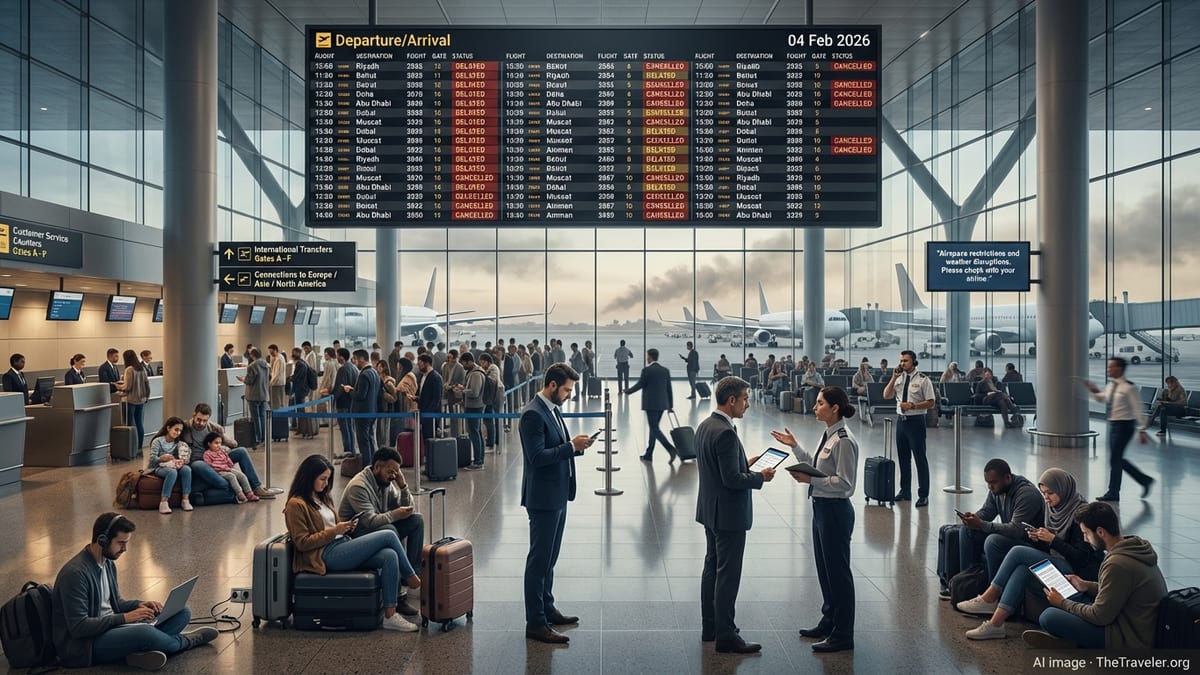
A fresh wave of flight disruptions is rippling across the Middle East on February 4, 2026, as 13 flights are canceled and 309 delayed across key hubs in Saudi Arabia, Lebanon, Qatar, the United Arab Emirates, Oman and neighboring states.
The turbulence is being felt most acutely at major international gateways such as Dubai, Doha, Abu Dhabi, Seeb and Jeddah, where carriers including Saudia, Flydubai, Etihad Airways and KLM are struggling to keep schedules on track amid a volatile mix of operational pressures, weather complications and ongoing regional tension.
More News
- TSA Rolls Out $45 ConfirmID Fee for Travelers Without REAL ID at Security
- Flying Blue Launches February 25% Promo Rewards on Transatlantic and Regional Routes
- United Fast-Tracks Starlink Wi‑Fi Across Fleet, Free for MileagePlus Members
Regionwide Disruptions Hit Key Gulf and Levant Hubs
The latest disruption, highlighted in regional aviation data and travel-industry reports on February 4, centers on a cluster of airports that together handle tens of millions of passengers every month. In Saudi Arabia, flight cancellations and delays are affecting services through Jeddah and other key airports that feed both domestic and long-haul routes. In Lebanon, Beirut–Rafic Hariri International Airport is contending with a series of delayed departures and arrivals, intensifying congestion at already stretched terminal facilities.
Across the Gulf, Qatar’s Hamad International Airport in Doha and the UAE’s principal hubs in Dubai and Abu Dhabi are reporting elevated delay levels, with knock-on effects for connecting traffic to Europe, Asia and North America. Muscat’s Seeb International Airport in Oman has also been caught in the dragnet of late-running services, as aircraft and crews arrive out of sequence and turnarounds take longer than planned.
Although the headline numbers, at 13 canceled flights and just over 300 delays, are modest compared to the worst days of regional disruption in recent weeks, the impact is magnified by the strategic role these hubs play in global connectivity. Even a relatively small spike in delays can cascade through tightly interwoven schedules, snarling connections and forcing airlines to re-time or reroute aircraft throughout the day.
Complicating matters further, the disruptions are unfolding against a backdrop of already heightened operational stress. In late January, more than 900 flights were canceled or delayed across major Middle Eastern airports over a single day as geopolitical tensions triggered widespread rerouting and precautionary groundings. That earlier shock left airlines and airports with little slack in their systems, making them more vulnerable to fresh disturbances this week.
Saudia, Flydubai, Etihad and KLM Among Carriers Under Pressure
Among the carriers now under renewed pressure, Saudi flag carrier Saudia is dealing with a combination of delayed and canceled services on routes linking Jeddah and other Saudi gateways with destinations across the Gulf, Europe and South Asia. The airline has already spent much of the past month juggling altered routings and shifting demand patterns as regional airspace guidance has evolved, and the latest disruption is adding strain to crews and aircraft already operating close to capacity.
Dubai-based Flydubai, a key player in short and medium-haul connectivity across the Middle East, Caucasus and parts of Europe, is also experiencing significant schedule stress. The carrier has been central in linking Dubai with cities in Lebanon, Oman and Saudi Arabia, and delays at its home base ripple quickly into outbound and return sectors, particularly on high-frequency routes. Earlier phases of disruption tied to airspace avoidance and weather have already forced Flydubai to adapt timing and occasionally insert technical stops, leaving little room for error when further delays arise.
Abu Dhabi’s Etihad Airways, which continues to operate a largely normal network despite regional headwinds, is likewise contending with a fresh wave of late departures and arrivals. The airline has recently completed key software updates and fleet adjustments designed to limit technical disruption, but regional constraints and congested corridors around the Gulf have extended flight times and complicated slot management at its Zayed International Airport hub.
European carriers are not immune. KLM, which only recently resumed and adjusted services into the region after a brief pause on some Middle East routes, is once again contending with schedule volatility. The Dutch airline has been operating with altered routings on certain services to avoid specific conflict-adjacent airspace, lengthening flight times and reducing the buffer available to absorb ground delays in Dubai, Doha and other Gulf destinations.
Complex Mix of Causes: Airspace Constraints, Weather and Capacity
No single factor fully explains the latest pattern of 13 cancellations and 309 delays. Instead, analysts and industry sources point to a complex interplay of airspace restrictions, lingering geopolitical risk, severe-weather episodes and the simple reality that the region’s aviation infrastructure is running extraordinarily hot during a period of sustained demand.
The most immediate structural pressure remains the patchwork of airspace advisories and restrictions that has developed since mid-January. European and other regulators have issued conflict-zone bulletins advising carriers to avoid Iranian airspace and, in some cases, segments of Iraqi and Israeli airspace. Many airlines now operate longer routings into and across the Gulf, stretching block times and compressing turnaround windows at hubs such as Dubai, Doha and Riyadh. When an inbound flight lands late, crews can breach duty limits and aircraft may miss onward departure slots, triggering the kind of rolling delays seen again this week.
Compounding those constraints, winter weather systems have periodically swept across the wider region, from Turkey and the Levant down into the Arabian Peninsula. Recent storms brought high winds and reduced visibility to airports including Jeddah, Bahrain and Amman, with resulting ground stops and diversions that reverberated into subsequent days. Even when conditions improve, airlines must reposition aircraft and clear passenger backlogs, and that recovery process can easily intersect with new sources of disruption.
Finally, capacity and staffing are persistent underlying challenges. The rapid rebound and subsequent growth in Middle East travel has filled terminals and saturates runway capacity at peak hours. Ground-handling teams, security screening lines and immigration checkpoints are all operating near their practical limits. When several delayed flights converge at the same time, queues lengthen sharply, boarding processes slow and taxi times increase. The numbers reported today are a snapshot of that structural fragility as much as a reaction to any single shock.
Passenger Experience: Long Queues, Missed Connections and Housing Scramble
For passengers, the statistics translate directly into longer hours in transit and a significant degree of uncertainty. At Dubai International, travelers report check-in queues spilling far beyond dedicated lanes at peak periods, as agents juggle a mix of on-time, delayed and rebooked customers. In Doha and Abu Dhabi, security and immigration bottlenecks have been compounded by clusters of late-arriving transit passengers trying to make connections that are now at risk, or already missed.
Those holding tight, multi-leg itineraries are among the hardest hit. A late inbound flight into a hub such as Jeddah or Seeb can easily cause passengers to miss onward departures, particularly if minimum connection times were already short. When connecting sectors are full or subject to their own delays, re-accommodation options narrow quickly. Families and business travelers alike can find themselves facing unplanned overnight stays or re-routed journeys that add many hours to total travel time.
Airlines are deploying standard disruption measures: issuing meal vouchers, arranging hotel accommodations for eligible travelers, and waiving change fees on many affected bookings. However, with hundreds of flights across the region running late within a compressed time frame, available hotel inventory near airports is tightening, especially in Dubai and Doha. Several carriers have advised passengers not to proceed to the airport until they have confirmed updated departure times, to avoid overcrowded terminals and unnecessary waiting.
In Beirut and other smaller, yet strategically important, airports, lounges and public seating areas have filled quickly as outbound passengers wait for delayed aircraft arriving from Gulf hubs. The knock-on effect is visible in everything from taxi queues to airport Wi-Fi bandwidth, underscoring how tightly synchronized, and vulnerable, regional travel has become.
Operational Responses and Early Signs of Stabilization
Airlines and airport operators insist that, while the current disruption is significant, it remains manageable and that systems are gradually adapting to the new constraints. Several carriers have adjusted schedules to introduce slightly longer planned block times and extended ground windows for affected routes, in an effort to build more resilience into daily operations. Where possible, additional standby crews have been rostered to step in when duty-time limits force original crews off delayed flights.
At hub airports, authorities have introduced temporary measures to ease passenger flow during peaks. These include opening supplementary security lanes, redeploying staff from quieter terminals to busy ones, and dynamically reallocating arrival and departure gates to reduce towing and taxi delays. Such tactics are particularly evident in Dubai and Abu Dhabi, where airport management has experience handling large-scale irregular operations from previous waves of disruption.
Some carriers, including KLM and Gulf-based airlines, have also emphasized more proactive communication, pushing real-time updates to passengers via mobile apps and messaging services when schedules shift. While this does not prevent delays, it can reduce the chaos at check-in desks and transfer counters by directing customers toward self-service tools or clarifying eligibility for refunds and free changes before they reach the airport.
Industry observers note that recent extreme events, including the late-January day that saw over 900 cancellations and delays in the region, have forced airlines to refine contingency planning. The smaller but still serious disruption now affecting 13 flights canceled and 309 delayed is being used as another test case for these enhanced playbooks, from prioritizing which routes to protect to determining when to consolidate lightly booked services.
What Travelers Should Do Now
For travelers with upcoming itineraries touching Dubai, Doha, Abu Dhabi, Seeb, Jeddah, Beirut or other affected airports, the most important step is to monitor flight status closely in the 24 to 48 hours before departure. Many airlines are advising passengers to rely on their official apps or direct email and SMS updates rather than third-party tracking sites alone, particularly given the fluid nature of airspace and routing decisions in the region.
Experts recommend building extra buffer time into travel plans. Those connecting through regional hubs should consider longer layovers where possible, especially if flying with different airlines on separate tickets. In the current environment, even a modest knock-on delay can be enough to scupper a tight self-connection, leaving passengers with limited recourse for free rebooking or accommodations.
Passengers should also familiarize themselves with airline disruption policies, including eligibility for meals, hotel stays and compensation, which vary depending on jurisdiction and cause of delay. While weather and airspace restrictions often fall under force majeure categories that limit financial compensation, many carriers still extend flexible rebooking windows and fee waivers during large-scale disruption events as a goodwill measure.
Finally, travel planners and corporate travel managers are revisiting routing choices for high-priority or time-sensitive journeys. In some cases, they are choosing daytime flights with more generous connection times or opting for routings through alternative hubs that are currently less exposed to the most volatile airspace corridors, even when this adds some distance to the trip.
FAQ
Q1. Which countries are most affected by the latest flight disruptions?
Saudi Arabia, Lebanon, Qatar, the United Arab Emirates and Oman are at the center of the current disruption pattern, with additional ripple effects in neighboring states linked through major hubs such as Dubai, Doha, Abu Dhabi, Seeb and Jeddah.
Q2. How many flights have been canceled or delayed?
Current regional data for February 4, 2026 indicates 13 flights canceled and 309 delayed across leading Middle East hubs, a smaller but still significant disruption compared with the larger wave of more than 900 cancellations and delays seen in late January.
Q3. Which airlines are most impacted?
Saudia, Flydubai, Etihad Airways and KLM are among the airlines directly affected, alongside other regional and international carriers that rely on Dubai, Doha, Abu Dhabi, Seeb and Jeddah for long-haul and connecting traffic.
Q4. What is causing these disruptions?
The disruption stems from a combination of factors, including airspace restrictions related to regional tensions, recent severe-weather systems, congested airport operations at peak times and lingering knock-on effects from earlier large-scale delays and cancellations.
Q5. Are safety concerns involved in the delays and cancellations?
Yes, safety is a core driver of many operational decisions. Airlines have adjusted routings and occasionally delayed or canceled flights to comply with conflict-zone advisories and to avoid airspace deemed higher risk by regulators and company security teams.
Q6. How are airports managing the passenger crowds?
Major airports are opening additional security and check-in lanes where possible, reallocating staff to busy terminals, and working closely with airlines to stagger departures and arrivals so terminals and gate areas do not become overwhelmed.
Q7. What support can affected passengers expect from airlines?
Depending on the carrier and circumstances, passengers may receive rebooking assistance, meal vouchers, hotel accommodation for eligible delays, and in some cases fee-free changes or refunds. Policies differ, so travelers should check the specific conditions of their ticket.
Q8. Should travelers change their plans if they are flying soon?
Most aviation authorities and airlines are not advising passengers to avoid travel entirely, but they strongly recommend monitoring flight status, allowing extra time at the airport, considering longer connections and being prepared for potential same-day schedule changes.
Q9. Are European and other international airlines also affected?
Yes. Carriers such as KLM and other European and Asian airlines have altered routings and schedules for flights serving the Gulf and wider Middle East, which can result in longer flight times, revised departure slots and, at times, cancellations or aircraft substitutions.
Q10. How long are these disruptions expected to last?
While today’s specific tally of cancellations and delays reflects short-term conditions, industry guidance suggests that some level of schedule volatility in the Middle East could persist at least through mid-February and potentially into the spring, depending on how regional tensions and airspace advisories evolve.