

More news on this day
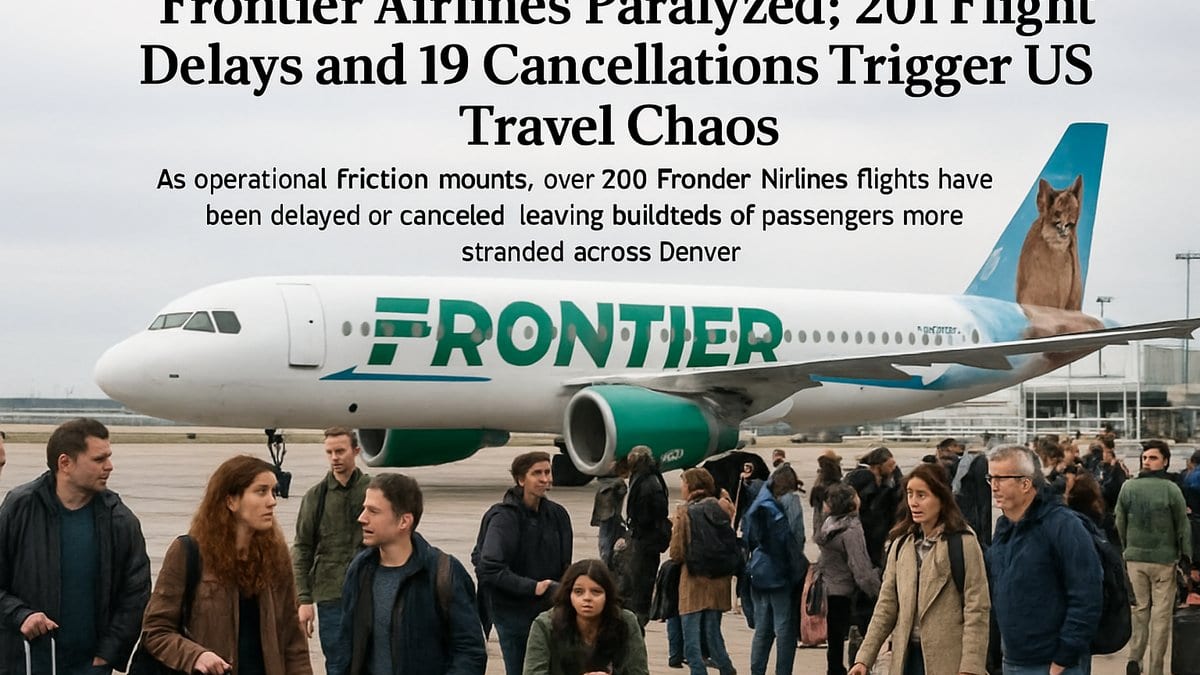
Frontier Airlines passengers across the United States faced fresh disruption as 201 delayed flights and 19 cancellations rippled through an already strained aviation network, compounding wider operational pressures and leaving travelers scrambling for alternatives.
Get the latest news straight to your inbox!
Network Strain Turns Routine Disruptions Into Systemwide Gridlock
The latest wave of Frontier Airlines delays and cancellations landed at a moment when the broader U.S. aviation system was already under stress from rolling storms, congestion, and tight crew scheduling. Recent data from flight-tracking and industry reports shows thousands of daily delays nationwide at major hubs such as Chicago, Dallas, New York, and Atlanta, creating a fragile operating environment in which even modest schedule shocks can trigger wider chaos.
Within that context, Frontier’s 201 delayed flights and 19 cancellations translated into far-reaching knock-on effects. The carrier’s point to point, high aircraft utilization model means individual aircraft often operate several segments in quick succession. When an early rotation is delayed, subsequent legs frequently depart late or risk cancellation, propagating disruption across multiple cities in a single operating day.
Publicly available performance data for Frontier in early 2026 has already highlighted the vulnerability of this lean scheduling approach. Industry trackers note that the airline’s cancellations and near-miss delays tend to cluster during periods of weather volatility or air traffic control constraints, a pattern reinforced by the latest disruption as the U.S. network adjusted from recent severe weather and ground delay programs.
As the 201 delays accumulated over the course of the day, airport departure boards at secondary hubs and leisure-focused destinations began to fill with late departures and rolling estimated times, reflecting how concentrated carrier-level disruption can spill into a national grid that is operating close to capacity.
Passenger Impact: Missed Connections, Overnight Stays, and Scrambled Plans
For passengers, the aggregate figures translated into thousands of disrupted journeys. Each delayed or canceled frontier flight typically carries a cabin largely filled with leisure travelers and cost conscious flyers, many with limited schedule flexibility. When those flights are pushed back or removed outright from the schedule, rebooking options are often constrained by the carrier’s relatively low frequency on many routes.
Reports from recent disruption days across U.S. airports illustrate how a cluster of cancellations can quickly overwhelm available alternatives. Travelers whose flights were among the 19 cancellations frequently encountered options that involved long overnight layovers, departures a full day later, or convoluted routings through distant hubs. For those facing 201 delayed flights, rolling schedule changes of 60 to 180 minutes created a cascade of missed hotel check ins, lost prepaid reservations, and missed events.
The situation has been particularly challenging for travelers departing from or arriving at airports where Frontier is one of only a few ultra low cost carriers with non stop service. When a flight is removed from the timetable, there is often no comparable low fare alternative on the same day, forcing passengers either to pay significantly higher walk up fares on other airlines or to scrap their trips altogether.
Travel insurance, credit card trip protection, and flexible hotel policies have softened the blow for some customers. However, anecdotal accounts from recent weeks suggest that many affected fliers were not fully aware of their coverage or of the documentation required to claim reimbursement for hotels, meals, or alternative transport, adding financial uncertainty to an already stressful experience.
Frontier’s Recent Headwinds and Operational Questions
The fresh wave of delays and cancellations arrives amid broader scrutiny of Frontier’s strategy and reliability. In recent months, publicly available coverage has highlighted the carrier’s decision to pause sales for travel beyond mid April 2026, a move that triggered speculation among customers and analysts about its forward schedule and financial outlook. At the same time, on time performance data has pointed to a pattern of elevated delays compared with some larger legacy rivals.
Analyst commentary following a recent slide in the stock price of Frontier’s parent company has linked investor anxiety to a combination of competitive pressure, high operating leverage, and a business model that leaves limited buffer when things go wrong. Unlike airlines with larger fleets and more robust spare aircraft pools, a carrier such as Frontier has less room to absorb mechanical issues, weather diversions, or crew timing constraints without visible impact on the day’s operation.
Travel industry observers note that ultra low cost carriers rely heavily on aggressive aircraft utilization to keep fares low. That can be attractive for price sensitive travelers in normal conditions, but it also leaves little slack for irregular operations. When multiple delay drivers converge, as they have across the United States in recent weeks, the resulting interference with tightly sequenced turns can be severe, rapidly converting local problems into a multi state disruption.
In this environment, each new day of heavy delays and cancellations at Frontier raises questions about whether schedule buffers, staffing levels, and contingency plans are calibrated to a period of increasingly volatile weather and air traffic conditions. Industry analysts are watching closely to see whether the carrier adjusts its summer schedules or operating assumptions in response.
Wider U.S. Aviation Turbulence Amplifies the Shock
The impact of Frontier’s 201 delays and 19 cancellations has been magnified by a broader landscape of aviation turbulence across the United States. In the days surrounding the disruption, national tallies from aviation analytics firms recorded thousands of delays and hundreds of cancellations as storms, residual winter weather, and regional air traffic control initiatives rippled through the network.
Recent coverage of major hubs such as Chicago O Hare, Dallas Fort Worth, and New York area airports has described multi day periods where delays reached into the high hundreds at single airports, with ground delay programs and diversions affecting carriers across the spectrum. When these large airports are struggling to maintain throughput, downstream airports served by Frontier and other low cost carriers inevitably absorb rolling schedule slippages.
Travel publications reviewing March and early April traffic have pointed to a pattern in which severe weather events, followed by lingering congestion and crew repositioning challenges, have repeatedly pushed airlines into reactive mode. Frontier’s latest disruption fits into this national narrative, with its own operations strained by the same weather systems and capacity constraints that have challenged larger competitors.
As a result, passengers caught in the Frontier disruption often found that broader capacity at neighboring airports was already stretched thin. Seats on competing carriers during peak hours were limited or priced at a premium, while hotel availability near some key hubs tightened as travelers whose flights were canceled across multiple airlines sought last minute accommodation.
What Stranded Travelers Can Do Next Time
The scale of the Frontier delays and cancellations has renewed focus on how travelers can prepare for, and respond to, similar events in the future. Consumer travel advocates emphasize that passengers should monitor their flight status closely through official airline channels and independent flight trackers, particularly during periods of unsettled weather or when news reports highlight elevated nationwide delays.
Experts also suggest building extra time into itineraries that involve connections, cruises, or time sensitive events. On routes frequently operated by ultra low cost carriers, travelers may benefit from considering earlier departures, even if it means a longer layover, to provide a buffer against knock on disruptions like those that recently affected Frontier.
Another recommendation gaining attention is the strategic use of payment methods and insurance products. Some premium credit cards and standalone travel insurance policies reimburse expenses such as hotels, meals, and rebooked flights after a qualifying delay or cancellation, but only if travelers keep receipts and meet specified timing thresholds. Understanding those terms in advance can make a significant difference when large scale disruption strikes.
Finally, aviation analysts advise that passengers review airline specific delay and cancellation policies published on carrier websites. While federal rules in the United States establish certain baseline protections, the level of customer care offered during irregular operations can vary by airline and by disruption type. In the wake of Frontier’s 201 delays and 19 cancellations, travelers are increasingly weighing not only ticket price, but also operational resilience and support during the unexpected.