

More news on this day
Frontier Airlines’ quiet retreat from New York’s John F. Kennedy International Airport has arrived at a pivotal moment in the airport’s $19 billion overhaul, leaving budget conscious travelers and industry watchers asking what the carrier’s departure means for the long planned Terminal 6 and for New York’s already complex air travel market.
Frontier’s JFK Exit and the Shifting Low Cost Landscape
Frontier’s withdrawal from JFK comes after a short lived push to grow in New York, including plans announced in early 2025 for new flights from JFK to Miami, Los Angeles and Dallas, with teaser fares as low as nineteen dollars one way. Those ultra cheap tickets were meant to position the Denver based ultra low cost carrier as a budget foil to legacy airlines and to tap into heavy demand on trunk routes linking New York with major Sun Belt and West Coast hubs. Instead, within months, the airline has reversed course, pulling back from JFK at a time when it is also exiting several smaller U.S. airports as part of a broader network reset.
Frontier has not publicly framed its JFK exit as a rejection of New York’s largest international gateway, but the move is consistent with its focus on maximizing aircraft utilization and targeting airports where it can command scale and lower unit costs. Slot constraints, congested airspace and stiff competition at JFK make it one of the most challenging and expensive places in the country for a low cost carrier to carve out sustainable margins, even on seemingly high demand routes. The retreat underscores how difficult it can be for budget carriers to build lasting beachheads at the big New York airports without substantial slot portfolios or deep local partnerships.
For travelers, the immediate effect is a reduction in the very lowest headline fares out of JFK, especially on Florida and West Coast routes where Frontier’s marketing had emphasized rock bottom pricing. Most of the city pairs the airline served remain well covered by other carriers, but the disappearance of an ultra low cost player tends to remove a layer of fare discipline, particularly on off peak days and shoulder seasons, potentially nudging average prices upward.
Terminal 6: A Flagship Project Without Its Early Budget Player
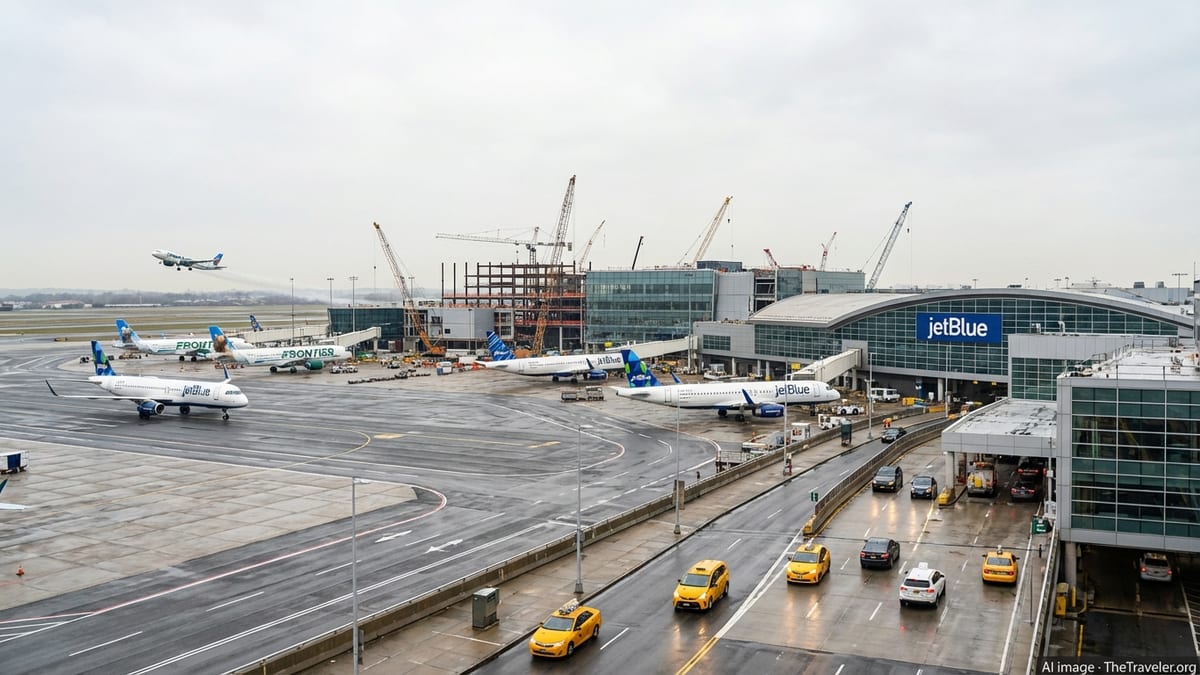
Frontier’s retreat lands just as construction advances on JFK’s new Terminal 6, a four point two billion dollar project being developed in two phases on the airport’s north side. The terminal is being built by the JFK Millennium Partners consortium, which includes Vantage Airport Group and JetBlue and is designed to connect seamlessly, both pre and post security, with JetBlue’s existing Terminal 5. The first phase, featuring roughly five to six gates, is scheduled to open in 2026, with full build out to ten gates expected by 2028. The design emphasizes widebody capability, long departure curbs and nearly one hundred thousand square feet of retail, dining and lounge space inspired by New York City.
When Terminal 6 was conceived, planners envisioned a mix of full service and low cost carriers, taking advantage of common use gate technology and flexible layouts. Public statements over the past two years have highlighted Lufthansa Group airlines and JetBlue as anchor tenants, with “advanced discussions” underway with additional carriers. In that context, Frontier’s full scale retreat from JFK removes one obvious ultra low cost candidate from the near term tenant list, at least until the carrier’s network strategy stabilizes.
Yet industry analysts note that the economics of Terminal 6 were never likely to revolve around an ultra low cost carrier. The building has been pitched as a modern international gateway with extensive lounge space, biometric technology and premium amenities that tend to resonate most with higher yielding customers. The widebody focus and the ability to handle long haul flights to Europe and beyond align more naturally with hybrid and full service airlines than with carriers built around ultra low fares and rapid aircraft turns. In that sense, Frontier’s absence may simplify tenant mix decisions rather than disrupt them.
For JFK Millennium Partners and the Port Authority of New York and New Jersey, the departure does, however, narrow the roster of potential low cost domestic partners that could have helped diversify the concourse and fed JetBlue’s network. While nothing prevents future discussions if Frontier’s strategy changes, attention is likely to shift to other value driven airlines and international groups that can better leverage widebody gates and premium concessions.
JetBlue’s Dual Role at Terminal 5 and Terminal 6
Frontier’s exit indirectly strengthens the central role JetBlue already plays at JFK. The New York based carrier is both an equity partner in the Terminal 6 project and the primary tenant of Terminal 5, which is undergoing its own extensive refresh. Plans unveiled in 2025 call for more than forty new concessions and a redesigned center concourse inspired by New York’s parks, with greenery, benches and flexible spaces for performances and pop up experiences. The refresh is expected to be largely complete by the end of 2026, roughly paralleling the opening of the first gates at Terminal 6.
As JetBlue renovates Terminal 5 and prepares to extend its footprint into the new facility next door, it is cementing its position as JFK’s leading mid market and leisure oriented carrier. With Frontier gone, JetBlue faces marginally less pressure from ultra low cost competition on key leisure routes, even as it juggles financial pressures and reworks its network following abandoned merger plans and shifting partnerships. For New Yorkers, that likely means JetBlue remains the primary source of relatively affordable, product rich service on many domestic and near international routes out of JFK.
Terminal 6’s physical connection to Terminal 5 is intended to create a coordinated “anchor terminal” complex on the north side of the airport, with shared road access, for hire vehicle zones and a continuous post security environment. In practice, that arrangement could allow JetBlue and its partners to balance domestic and international operations flexibly across both terminals. Without Frontier in the mix, there may be more room for JetBlue to scale its own presence, or to work with other carriers that fit better into its partnership and alliance strategy.
Travelers are likely to notice the effects of that integration more than the absence of any single carrier. A smoother connection experience, upgraded dining and retail and modernized security lanes across Terminals 5 and 6 could deliver a step change in the way New Yorkers use JFK, even if the airport’s most aggressive ultra low cost option is no longer part of the picture.
Capacity, Competition and Fares for New York Travelers
For New York area travelers, the critical question is whether Frontier’s exit from JFK will meaningfully constrain capacity or raise prices. On heavily served routes such as New York to Miami, Los Angeles and Dallas, most analysts expect other carriers to absorb the lost seats quickly, limiting long term fare increases. American, Delta, JetBlue and United already operate substantial schedules on those corridors from JFK or nearby hubs, and the broader New York region still benefits from overlapping service out of LaGuardia and Newark.
However, the role of an ultra low cost carrier is not merely to add seats but to set a lower baseline for publicized fares. Frontier’s very low base fares, even when supplemented by ancillary fees, exerted competitive pressure that often forced rivals to match or at least respond with sale fares on off peak days. Without that stimulus, fare sales may become less frequent or less aggressive, particularly during slower travel months when price sensitive travelers previously had the most to gain from Frontier’s presence.
In the near term, some New Yorkers may simply shift to other low cost carriers at alternate airports. Spirit maintains a presence in the region, and carriers such as Southwest, Allegiant and Breeze focus on different airports within reasonable reach of the city. Yet for travelers wedded to JFK, particularly those connecting to international flights, the loss of a true ultra low cost partner at the airport narrows the menu of options. That effect could be magnified if Terminal 6 evolves into a predominantly premium and international facility.
Over the medium term, the sheer scale of the Terminal 6 project may itself introduce fresh capacity and competition, especially as widebody capable gates attract new long haul entrants and encourage existing foreign carriers to consolidate operations into the new building. Increased international capacity often spurs lower connecting fares and gives consumers more choice, partially offsetting any lost domestic discount options.
Port Authority Strategy and the Broader JFK Redevelopment
The Port Authority’s multibillion dollar transformation of JFK is designed to modernize every major passenger touchpoint, from terminals to roadways, rather than to optimize conditions for any particular carrier. Terminal 6, the expansion of Terminal 4 and upgrades at Terminals 1 and 8 are all framed as long term investments in New York’s global competitiveness as an air travel hub. Within that framework, a single airline’s tactical exit, even from a high profile field like JFK, is unlikely to alter the underlying strategy.
That does not mean officials will ignore the implications of Frontier’s retreat. Regulators and planners closely track how different airline business models perform in the region, especially as they consider slot policy, gate allocation and future infrastructure projects. The challenge is to balance the high capital costs of new terminals with a tenant mix that ensures steady rent and concession revenue while preserving room for low cost competition that benefits consumers.
In public comments surrounding Terminal 6, the Port Authority and its partners have emphasized flexibility. Common use gates, adaptable security layouts and modular retail zones are intended to allow the terminal to evolve as airline strategies change. If ultra low cost carriers prove eager and able to re enter JFK in the future, the infrastructure will exist to accommodate them, even if the first wave of tenants skews more toward network and hybrid airlines.
For now, the priority remains keeping Terminal 6 on schedule for its 2026 opening and integrating it cleanly into the broader JFK campus. On that front, construction updates indicate the project remains on track, with the initial set of gates due to open in the first half of that year and full completion targeted for 2028.
Frontier’s Network Reset and What It Signals
Frontier’s step back from JFK is part of a wider series of adjustments to its network that highlight the pressures facing ultra low cost carriers across the United States. In recent months the airline has scaled down or exited multiple airports, including some secondary and leisure focused fields, citing insufficient demand or a mismatch between local markets and its high utilization model. At the same time, Frontier has announced a wave of new routes concentrated on larger metro areas, beach destinations and cross border leisure markets, often paired with branding around “The New Frontier” and refreshed in flight products.
This pattern suggests the carrier is prioritizing markets where it can deploy higher capacity Airbus aircraft with strong load factors, rather than spreading itself thin across a patchwork of competitive hubs and niche airports. In that context, JFK, with its intense competition, slot rigidities and complex operations, likely appeared less attractive than airports where Frontier can command more gates and operational control. Shifting capacity to markets like Newark, Philadelphia or Baltimore, where constraints are different and cost structures may be lower, can fit more neatly into an ultra low cost playbook.
For travelers, the message is that ultra low cost options will continue to be available in the broader New York region, but not necessarily at every airport. Frontier’s strategy, like that of its peers, will evolve with fuel prices, consumer demand and competitive dynamics. The airline’s retreat from JFK today does not preclude a return if conditions change, especially once Terminal 6 is fully operational and if new partnership opportunities arise.
Industry observers will be watching how Frontier’s moves influence the strategies of other discount carriers. If JFK proves inhospitable for one ultra low cost airline, others may be wary of committing scarce aircraft and marketing resources there, at least until the new terminal environment stabilizes and fresh capacity becomes available.
What New York Travelers Should Expect Next
In the immediate future, the most tangible change for New York travelers is the disappearance of Frontier branded jets and fare sales from JFK departure boards. Customers who previously relied on the airline from that airport will need to rebook on other carriers or shift their travel plans to different New York area airports where Frontier or other low cost carriers continue to operate. Refund policies and reaccommodation options vary, so affected passengers are encouraged to check communications from the airline and review their itineraries.
As Terminal 6 moves toward its first phase opening in 2026, travelers can expect construction related impacts around the north side of the airport, followed by a gradual rollout of new facilities, lounges and concession spaces. JetBlue’s refreshed Terminal 5 and the new Terminal 6 together are set to redefine the experience for many domestic and international passengers, even without Frontier among the initial tenants. The focus will be on smoother connections, upgraded amenities and a more coherent layout for the growing mix of global carriers that call JFK home.
Longer term, the competitive dynamics that shape fares and route choices for New Yorkers will depend more on the combined strategies of JetBlue, the three largest legacy airlines and international partners than on the presence or absence of any single ultra low cost player. Frontier’s retreat is a notable data point in that evolving story but not its final chapter. As infrastructure comes online and partnerships shift, the balance between price, convenience and service at JFK will continue to change, keeping New York at the center of America’s aviation debate.